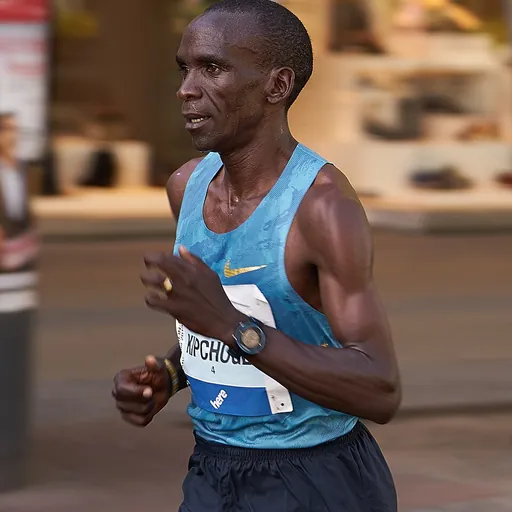
Eliud Kipchoge
Kenyan long-distance runner
About Eliud Kipchoge
Born 1984. Eliud Kipchoge is a Kenyan marathon runner, long-distance runner, athletics competitor and athlete.
Eliud Kipchoge (born 5 November 1984) is a Kenyan long-distance runner who competes in the marathon and formerly specialized in the 5000 metres. Kipchoge is the 2016 and 2020 Olympic marathon champion, and was the world record holder in the marathon from 2018 to 2023, until that record was broken by Kelvin Kiptum at the 2023 Chicago Marathon. He is widely considered to be one of the greatest marathon runners of all time. He has since 2024, been defeated in his last three marathons. Kipchoge's last world record run broke by 30 seconds his own 2018 world record, which was in turn a 78-second improvement over the existing best, the greatest improvement in a marathon world record time since 1967.
On 12 October 2019, Kipchoge ran the marathon distance for the Ineos 1:59 Challenge in Vienna, achieving a time of 1:59:40.2, becoming the first person in recorded history to do a sub-two-hour marathon. The run did not count as a new marathon record, as he ran with specialized shoes, standard competition rules for pacing and fluids were not followed, and it was not an open event.
Kipchoge was appointed Elder of the Order of the Golden Heart by former Kenyan President Uhuru Kenyatta on 20 October 2019 in recognition of his sub-two-hour marathon. He was also named the 2019 BBC World Sport Star of the Year. In 2023 he was awarded the Princess of Asturias Award in the category "Sports".
Personal life Kipchoge was born on 5 November 1984 in Kapsisiywa, Nandi County, in Kenya. He graduated from the Kaptel Secondary School in Nandi County in 1999 but did not run seriously or as a profession then. He ran to school on a daily basis. Kipchoge was raised by a single mother (a teacher), and only knew his father from pictures. He is the youngest of four children. He met his trainer Patrick Sang (a former Olympic medalist in the steeplechase) in 2001 at the age of 16.
Kipchoge's wife and three children live in Eldoret, Kenya. He lives and trains in Kaptagat, 30 km (19 miles) from Eldoret. He is a devout Catholic.
Following the death of Kelvin Kiptum in 2024, Kipchoge and his family faced online threats falsely accusing him of being involved in Kiptum's death. These threats impacted his training and well-being.
Career 2002–2004 In 2002, he won at the Kenyan trials for the 2002 IAAF World Cross Country Championships junior race. At the World Cross Country Championships, held in Dublin, Kipchoge finished fifth in the individual race and was part of the Kenyan junior team that won gold. Kipchoge also won the 5000-meter race at the Kenyan trial for the 2002 World Junior Championships in Athletics but fell ill and missed the championships. He won the junior race at the 2003 IAAF World Cross Country Championships.
He set a world junior record in the 5000 m at the 2003 Bislett Games, running a time of 12:52.61 minutes. This stood as the world and African junior record until 2012, when it was improved to 12:47.53 minutes by Hagos Gebrhiwet of Ethiopia.
Kipchoge won a gold medal at the 5000 m final at the 2003 World Championships in Paris, outsprinting runner-up Hicham El Guerrouj, the world record holder in the 1500 metres and mile, by four-hundredths of a second in 12:52.79.
In July, he participated in the Golden League 2004 Roma Meeting. In the 5000 m event, he dipped first among the starters with 12:46.53, which made him the sixth-fastest ever in the event.
In 2004, Kipchoge won a bronze medal in the 5000 m final at the 2004 Athens Olympics, behind El Guerrouj and Kenenisa Bekele. He also won the Trofeo Alasport cross country race earlier that season.
2006–2009 Kipchoge won the bronze in the 3000 metres indoor at the 2006 World Championships in Moscow.
At the end of the year, Kipchoge won the San Silvestre Vallecana New Year's Eve 10 km road race in a time of 26:54 minutes, which beat his own course record by 40 seconds. This time was also better than the 10K road world record at the time but was run on a downhill course.
Kipchoge (third from the right) during the 5000 m heat at the 2007 World Championships in Osaka. He won a silver medal in the final.Kipchoge won a silver medal at the 5000 m final of the 2007 World Championships at Osaka in 13:46.00, behind Bernard Lagat (13:45.87).
During the 2008 Olympics held in Beijing, China, Kipchoge won a silver medal in the 5000 m event with a time of 13:02.80; although better than the previous Olympic record of 13:05.59, it was not enough to match Kenenisa Bekele's pace, who won the gold medal for this race. On the circuit, he won the Great Yorkshire Run 10K and Campaccio Cross Country that year.
He failed to reach the podium at the 2009 World Championships in Athletics, finishing in fifth place. He also finished ninth in the 3000 m at the 2009 IAAF World Athletics Final.
2010–2011 He made his debut on the 2010 IAAF Diamond League by winning the 5000 m Qatar Athletic Super Grand Prix in a meet record time.
Kipchoge then entered the Carlsbad 5000 in California, United States. The Carlsbad 5 km road race is the venue for the world's best times for a 5k road race for men and women, respectively. The fastest to cover the track was Sammy Kipketer in 2000, with 12:59.52 min. Kipchoge made a world best attempt, and although he won the race, weather affected his chances, and he finished in 13:11, the fourth-fastest ever for the course up to that point in time.
In the first athletics final of the 2010 Commonwealth Games, he attempted to win the 5000 m Commonwealth title. Ugandan runner Moses Kipsiro held a slender lead over him in the race's final stages, and Kipchoge ended up in second place, taking the silver medal some seven-hundredths of a second behind. He flew back to Europe immediately after to take part in the Belgrade Race through History the following day. His shoe fell off in the first kilometre, and, after putting it back on, he made up much ground on the field to eventually take second place two seconds behind Josphat Menjo.
At the start of 2011, he won the short race at the Great Edinburgh Cross Country, ahead of Asbel Kiprop. He attempted to retain his title at the Carlsbad 5000 in April but came a close second behind Dejen Gebremeskel. In May he raced the 3000 metres (finished third) in Doha, with a time of 7:27.66 and ranked him as the 12th-fastest at the distance up to this point. Kipchoge was chosen to represent Kenya at the 2011 World Championships in Athletics and reached the 5000 m final for the fifth consecutive time, although he only managed seventh place on this occasion.
2012 Kipchoge returned to the Edinburgh Cross Country in 2012, but this time he finished third behind Asbel Kiprop and Britain's Jonathan Hay. He was also third at the Carlsbad 5000 in March. He attempted to gain a place on the 10,000 m Olympic team at the Prefontaine Classic, but fell back in the late stages of the Kenyan trial race, finishing seventh. A seventh-place finish in the Kenyan 5000 m trial race meant he would not make a third consecutive Olympic team.
He made his half marathon debut in the Lille Half Marathon. The run was won by a new course record time of 59:05 (previously 59:36 by ilahun Regassa set in 2008) by Ezekiel Chebii (former personal_best 59:22), trailed by Bernard Koech 59:10, and Kipchoge earned a third place with 59:25. His time of 59:25 became the second fastest Half Marathon debut, only second to Moses Mosop's 59:20 in Milan in 2010.
On 6 October 2012, Kipchoge ran at the 2012 IAAF World Half Marathon Championships in Kavarna, Bulgaria. Zersenay Tadese of Eritrea won in 1:00:19, and Kipchoge placed sixth in 1:01:52.
Wilson Kipsang (front) and Kipchoge (behind) running in the 2013 Berlin Marathon in which Kipsang set the world record with 2:03:23 and Kipchoge, racing in his second marathon, finished second, 42 seconds later.
2013 Kipchoge opened his 2013 season with a win at the Barcelona Half Marathon in a time of one hour and four seconds. Making his marathon debut in April, he demonstrated a smooth transition to the longer distance by taking the Hamburg Marathon title with a run of 2:05:30 hours (with a half marathon split time of 1:03:13 hours), beating the field by over two minutes and setting a new course record. In August 2013, he won the Half Marathon of Klagenfurt in 1:01:02 minutes.
Then, he raced in the 2013 Berlin Marathon and finished second in 2:04:05 (with a half marathon split time of 1:01:32 hours), the fifth-fastest time in history, in his second-ever marathon, behind Wilson Kipsang, who set a new marathon world record with 2:03:23. Third place went to Geoffrey Kamworor of Kenya with 2:06:26.
2015
On 2 February, Kipchoge participated in the Ras al-Khaimah Half Marathon. He placed sixth with a time of 1:00:50. The run was won by Mosinet Geremew (Ethiopia) in 1:00:05. Kipchoge ran 2:04:42 to win the 2015 London Marathon in April. He also won the 2015 Berlin Marathon later in the year. His win and then-personal best time (2:04:00) occurred even though his shoes malfunctioned, causing his insoles to flap out of both shoes from 10 km onward; rather than risk time lost from an adjustment, he finished the race with bloodied, blistered feet.
2016 In April, Kipchoge won the 2016 London Marathon for the second consecutive year in a time of 2:03:05. His performance broke the course record in London and became the second-fastest marathon time in history, missing Dennis Kimetto's world record by 8 seconds.
Rio Olympic Games
As the prerace favourite, during the 2016 Rio Summer Olympics, Kipchoge gained a gold medal in the marathon event. On the last day of the Olympic Games on 21 August 2016, he won in a time of 2:08:44. The runner up was Feyisa Lilesa (Ethiopia) in 2:09:54 and the bronze medal went to Galen Rupp (USA), doing his second marathon, crossing the finish line in 2:10:05. When the halfway point after 21.0975 km was reached, 37 men were within 10 seconds of the lead runner. The participants' field diminished to 3 lead runners shortly before 34 km. Kipchoge made his final move on silver medal winner Lilesa around 36 km into the race. He covered the first half of the race in 1:05:55 while doing the second half in 1:02:49, which amounts to a difference of more than 3 minutes, a negative split. The winning gap between Kipchoge and Lilesa by 70 seconds was the largest victory margin since the 1972 Olympic marathon. Kipchoge's winning time of 2:08:44 was, as of August 2021, his slowest marathon time. One hundred fifty-five runners started the race, the largest field in Olympic history; 140 of them finished the race. With this win, Kipchoge became the second Kenyan male after Sammy Wanjiru in Beijing 2008 to win an Olympic marathon gold medal. At the same Olympics, the women's marathon was won by Jemima Sumgong, who became the first female Kenyan winner.
2017
On 6 May, Kipchoge, along with Zersenay Tadese (then world record holder in the half marathon) and Lelisa Desisa (2-time Boston Marathon winner), attempted the first sub-two-hour assisted marathon in the Nike Breaking2 project on the Monza Formula 1 racetrack near Milan, Italy. All three runners ran a test 2 months before the attempt. The target time was 1 hour for a half Marathon. Kipchoge finished first in 59:17. The course was measured at 2400 m per lap. During the 2-hour attempt, the runners were paced by a lead car and 30 supporting pacers joining in stages (both considered illegal under IAAF rules). The race started at 5:45h local time on the 2.4 km track. Kipchoge finished in 2:00:25, while the other two had to slow and finished far behind. The runners planned even 14:13 5k splits to break 2 hours. His 5k splits were: 14:14, 14:07, 14:13, 14:15, 14:14, 14:17, 14:17, 14:27, and 6:20 to finish. The 5k split times from 25k and further would be world records: 25k in 1:11:03, 30k in 1:25:20, 35k in 1:39:37, 40k in 1:54:04.
On 24 September, he won the 2017 Berlin Marathon in a time of 2:03:32. In rainy conditions, he finished 14 seconds ahead of Guye Adola who ran his first marathon, and set the fastest marathon debut ever. Former marathon world record holder Wilson Kipsang and 2016 winner Kenenisa Bekele failed to finish.
2018 Kipchoge won the London Marathon in a time of 2:04:17 with a half marathon split time of 1:01:00. In a time of 2:04:49 Shura Kitata (Ethiopia) came in second and Mo Farah (Great Britain) finished in 2:06:21, a British record. Kenenisa Bekele finished sixth 2:08:53 and defending champion Daniel Wanjiru. eighth 2:10:35. Kipchoge confirmed question on attempting to break the Marathon world record. The women's race saw a win by Vivian Cheriuyot (Kenya) with a time of 2:18:31 the 4th best time ever and Brigid Kosgei (Kenya) place second in 2:20:13.
2018 Berlin and first world marathon record Eliud Kipchoge (L) and his three pacers (R) about 30 minutes into the run en route to the marathon world record in 2018. He is shown a few seconds before crossing the river Spree.
On 16 September, Kipchoge won the 2018 Berlin Marathon in a time of 2:01:39, breaking the previous world record by 1 minute and 18 seconds (2:02:57 set by fellow countryman Dennis Kimetto at the Berlin Marathon in 2014). It was the greatest improvement in a marathon world record time since 1967. He finished 4:43 min ahead of second-placed fellow Kenyan Amos Kipruto. The world record holder from 2013, Wilson Kipsang of Kenya, came in third at 2:06:48. It was the 11th world record set at the Berlin Marathon. On 11 January 2019, Kipchoge was named the 2018 Sportsman of the Year at the Kenyan Sports Personality of the Year Awards in Mombasa, Kenya.
2019 Kipchoge won the 2019 London Marathon in a time of 2:02:37, the second fastest marathon ever at that time, behind his 2018 Berlin Marathon win. He became the first man to win the event four times and set a new course record, beating his own 2016 London Marathon best by 28 seconds. The lead runner passed the half marathon mark in 1:01:37. Mosinet Geremew (Ethiopia) finished as the runner up in 2:02:55 and Mule Wasihun (Ethiopia) came in third place in 2:03:16.
Ineos 1:59 Challenge
In May 2019, a few days after his London Marathon win, Kipchoge announced another take on the sub-two-hour marathon, named the Ineos 1:59 Challenge. On 12 October 2019 in Vienna's Prater park, he ran 4.4 laps of the Hauptallee in 1:59:40, becoming the first person in recorded history to break the two-hour barrier over a marathon distance.
The effort did not count as a new world record under IAAF rules due to the setup of the challenge. Specifically, it was not an open event; Kipchoge was handed fluids by his support team throughout; the run featured a pace car and included rotating teams of other runners pacing Kipchoge in a formation designed to reduce wind resistance and maximise efficiency. The achievement was recognised by Guinness World Records with the titles 'Fastest marathon distance (male)' and 'First marathon distance run under two hours'.
2020 Kipchoge placed 8th in the 2020 London Marathon in October with a time of 2:06:49, the lowest finish of his marathoning career so far.
Kipchoge successfully defended his title from the Rio Olympics by winning the gold medal in the men's marathon at the Tokyo Games in a time of 2:08:38, becoming only the third person to successfully defend their gold medal in the men's marathon, after Abebe Bikila in 1960 and 1964, and Waldemar Cierpinski in 1976 and 1980. He was the favourite to win and attacked around the 30 km mark, looking back only once afterwards. He won by 80 seconds, the largest margin in 49 years. The silver medal went to Abdi Nageeye (Netherlands), while Bashir Abdi (Belgium) came in third for a bronze medal with 2:10:00. Kipchoge was the oldest Olympic marathon winner since Carlos Lopes won in 1984 at the age of 37. The run was staged 500 miles north of Tokyo in Sapporo, with 106 runners participating. A documentary on the Ineos 1:59 Challenge, titled Kipchoge: The Last Milestone, was released digitally on-demand on 24 August 2021.
2022 On 20 January, Kipchoge announced his desire to win all six World Marathon Majors (he had already won three, the London, Berlin, and Chicago marathons, by that time). This was followed up by an announcement on 18 February that he would be participating in the 2021 Tokyo Marathon (which took place on 6 March 2022 due to COVID-19 restrictions in 2021) and that the majority of his recent training has been dedicated towards this goal. He won the Tokyo Marathon with a time of 2:02:40 – a course and all-comers' record. Amos Kipruto of Kenya finished second with a personal best of 2:03:13, and Tamirat Tola from Ethiopia came in third in a time of 2:04:14.
2022 Berlin and second world marathon record
On 25 September, Kipchoge won the Berlin Marathon decisively in a time of 2:01:09, beating by 30 seconds his own previous world record, which he set on the same course in 2018. With his fourth victory in Berlin, he equaled the record achievement of Haile Gebrselassie. He finished 4:49 min ahead of second-placed compatriot Mark Korir while Ethiopia's Tadu Abate took third place with a time of 2:06:28. Kipchoge achieved halfway in 59:51, which, being at the time, the fastest split in marathon history, would have been a world record in the standalone half-marathon in 1993, and was only 26 seconds off his best in that distance. He slowed down later with the second half in 61:18. It was the eighth time in a row that the men's record was set in Berlin and the 12th record there overall. the 38-year-old was unable to stay with the lead group on a hilly section after the 30 km mark. He suffered the third defeat of his marathon career, finishing sixth with a time of 2:09:23. Evans Chebet was the winner in 2:05:54, successfully defending his title.
At the 2023 Berlin Marathon, his first race since the Boston defeat, Kipchoge won the race for a record fifth time, finishing at 2:02:42. He ran alone from onward after Ethiopia's Derseh Kindie dropped away, but fell short of breaking his own world record that he had set the previous year. With the victory, Kipchoge became the first man in history to win the Berlin Marathon five times, having already won in 2015, 2017, 2018, and 2022. Fellow Kenyan Vincent Kipkemoi came in third place in a time of 2:03:13. The half marathon split time was 1:00:22.
Kipchoge failed to finish the marathon for the first time in his career when defending his gold medal at the 2024 Paris Olympics, dropping out of the race after around , citing discomfort around his waist. He later told reporters that he would not compete at another Olympic Games. When asked about the prospects of competing in Los Angeles in 2028: he explained:
The Marathons winner was Tamirat Tola (Ethiopia) in a time of 2:06:26, an Olympic record; silver went to Bashir Abdi (Belgium) 2:06:47; and bronze to Benson Kipruto (Kenya) in 2:07:00. Kipchoge's longtime rival Kenenisa Bekele finished2:12:24 placed 39 among 71 finishers with 10 runners dit not finish. Despite the performance, Kenyan President William Ruto still recognized Kipchoge's achievements:
Kipchoge competed in the 2025 New York City Marathon, finishing 17th, thus completing all six World Marathon Major courses. After finishing, Kipchoge announced a new project known as Eliud's Running World, where he will run seven marathons across seven continents over a period of two years to raise awareness about sustainability and education. This would also be in an effort to raise money to build libraries in Kenya.
International
Marathons
2:14:36 Sydney Marathon Not part of WMM 9th2:08:31 (*) Officially billed as the 2021 Tokyo Marathon, the race took place on 6 March 2022 after the 2021 edition was postponed because of the COVID-19 pandemic. As a consequence of this postponement, the 2022 Tokyo Marathon was cancelled.
(x) Cancelled due to the COVID-19 pandemic.
(p) Postponed due to the COVID-19 pandemic.
National titles Kenyan Cross Country Championships Senior race: 2004, 2005 Junior race: 2002, 2003 Kenyan Junior Championships 5000 m: 2002 Kenyan Olympic Trials 5000 m: 2004
Circuit wins
1500 m FBK Games: 2004
3000 m Qatar Athletic Super Grand Prix: 2004, 2005, 2007, 2009 Memorial Van Damme: 2004 British Grand Prix: 2006 BW-Bank-Meeting: 2006 Sparkassen Cup: 2006, 2010
Two miles Prefontaine Classic: 2005 Birmingham Indoor Grand Prix: 2012
5000 m Notturna di Milano: 2003, 2009 DN Galan: 2003 Golden Gala: 2004 Memorial Van Damme: 2005, 2008 Ostrava Golden Spike: 2008 Qatar Athletic Super Grand Prix: 2010
5K run Carlsbad 5000: 2010
4 miles 4 Mile of Groningen: 2005, 2006, 2007
10K run San Silvestre Vallecana: 2005, 2006 Great Yorkshire Run: 2009
Half marathon Barcelona Half Marathon: 2013, 2014 Kärnten Läuft: 2013 Delhi Half Marathon: 2016
Cross country Trofeo Alasport: 2004 Great Edinburgh International Cross Country: 2005, 2011 Campaccio: 2009
Personal bests All information taken from World Athletics profile.
+ Outdoor Distance Time Date Location Venue Notes1500 m 3:33.20 31 May 2004 Hengelo, Netherlands FBK Games Mile run 3:50.40 30 July 2004 London, United Kingdom London Grand Prix 3000 m 7:27.66 6 May 2011 Doha, Qatar Qatar Athletic Super Grand Prix Two miles 8:07.68 4 June 2005 Eugene, United States Prefontaine Classic 5000 m 12:46.53 2 July 2004 Rome, Italy Golden Gala 10,000 m 26:49.02 26 May 2007 Hengelo, Netherlands FBK Games 10 km (road race) 28:11 27 September 2009 Utrecht, Netherlands Singelloop Utrecht 26:54 31 December 2006 Madrid, Spain San Silvestre Vallecana (not legal)Half marathon 59:25 1 September 2012 Lille, France Lille Half Marathon 30 km 1:27:13 24 April 2016 London, United Kingdom London Marathon World bestMarathon 2:01:09 25 September 2022 Berlin, Germany Berlin Marathon 1:59:40 12 October 2019 Vienna, Austria Ineos 1:59 Challenge (not legal)
Awards AIMS Best Marathon Runner Award – Men: 2015, 2016, 2017 2018 United Nations Kenya Person of the Year. 2018, 2019 IAAF Male athlete of the year award. 2019 BBC World Sport Star of the Year. Kipchoge was cited as one of the Top 100 most influential Africans by New African magazine in 2019. 2021 Association of National Olympic Committees Best Male Athlete Tokyo 2020 Olympics. 2021 Abebe Bikila Award. 2023 Princess of Asturias Award.
Don’t just read it —
keep it.
Full-length biographies made to live with: read them, listen on the way to work, watch them tonight.
- E-book
- Audio
- Video
Instant download · yours to keep · every purchase keeps this site free
Important facts
People in Eliud Kipchoge's life
Named in this biography and alive at the same time





Related people
Same field, nearest in time



Contemporaries
People whose lives overlapped Eliud Kipchoge's



Frequently asked questions
Who is Eliud Kipchoge?
Kenyan long-distance runner
When was Eliud Kipchoge born?
Eliud Kipchoge was born on 5 November 1984 in Kapsisiywa.
What is Eliud Kipchoge's occupation?
Eliud Kipchoge is a marathon runner, long-distance runner, athletics competitor and athlete.
What nationality is Eliud Kipchoge?
Eliud Kipchoge is Kenyan.
Sources & further reading
Cite this page
APA: Biography.guide. (2026). Eliud Kipchoge. https://biography.guide/eliud-kipchoge/
MLA: "Eliud Kipchoge." Biography.guide, https://biography.guide/eliud-kipchoge/.
Chicago: "Eliud Kipchoge." Biography.guide. https://biography.guide/eliud-kipchoge/.
Data last updated: 2026-09-22 · Spot an error? Report a correction.
Portrait: Wikimedia Commons · author & licence
Page generated 2026-09-27 05:03 UTC