
Elisabet Eurén
Lecturer, peace activist, suffragette
About Elisabet Eurén
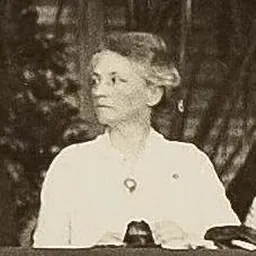
Lived 1864 – 1939 (aged 75). Elisabet Eurén was a Swedish peace activist, female supporter of women's right to vote, lecturer and peace movement.
Elisabet Eurén (born Elisabeth Matilda Vilhelmina Eurén; 9 July 1864 – 20 August 1939) was a Swedish educator, women's rights and peace activist.
Born in Stora Kopparberg parish, Eurén graduated from a teaching seminary in Stockholm in 1884. After several years of teaching at different schools for girls and travelling abroad multiple times, she was appointed by Umeå public school training seminary in 1893. There, she instigated several reforms, including the opening of a school library and the establishment of a municipal workhouse.
In 1903, she became chair of the local suffragist branch of the National Association for Women's Suffrage until she left Umeå for the Swedish capital about a year later. In Stockholm, she began working at the public school training seminary as a teacher and librarian. In 1918, she was one of the first women in Sweden to be appointed as lecturer at a higher learning institute, a position she occupied until her retirement in 1924.
During her Stockholm years, Eurén was also active in the peace movement and the inclusion of pacifist thinking in school teaching, as well as ecumenical religious movements. She died in 1939 and is buried in Solna. Eurén never married or had any children, similar to many other working women at the time. She died on 20 August 1939 at the age of 75 as a result of hepatic cirrhosis and cystopyelitis, an inflammation of the urinary tracts and kidneys, at the Red Cross hospital in Norra Djurgården, Stockholm, To continue her education and her knowledge of foreign languages she undertook frequent travels abroad that brought her to Hanover and Switzerland in 1889 and to England in 1891. In later years she would also travel to Norway (1898), Germany, Italy and Tyrol (1907), Denmark (1907 and 1917) and France (1921).
Back in Sweden, Eurén began working as a teacher in Stockholm, first at the Royal Normal School for Girls (Statens normalskola för flickor) 1885–1887 and at Brummerska skolan 1885–1886, and later also at the Girls‘ High School (Lyceum för flickor) 1887–1892. In 1893 she pursued further pedagogical education and graduated a second time from the Royal Advanced Female Teaching Seminary. She then moved to Umeå, her mother's birthplace, where she was appointed as a teacher at Umeå public school training seminary (folkskoleseminarium).
Reform pedagogy At the Umeå seminary Elisabet Eurén was the only female teacher at the time, her main subjects being Swedish, pedagogical methodology and later also Christian theology. She also became known and appreciated for her advocacy of new teaching methods that focused on practical matters and self-improvement. To this aim, the well-read Eurén initiated the establishment of a school library and introduced a more practical training outfit for gymnastics classes.
Apart from contacts to the Swedish Dress Reform Association and other proponents of women's rights, Elisabet Eurén was also socially engaged. It was her initiative that led to the establishment of a workhouse for the poor in 1897, which was not only the first in the city of Umeå but the Västerbotten county as well. The workhouse was financed by the Lars Hierta Memorial Foundation (Lars Hierta minnesfond) and since 1901 managed by a foundation, of which Eurén became the first secretary until she moved to Stockholm three years later. For a short time she also held the position of chair for the local suffragist association that was founded in Umeå in 1903.
Involvement in peace activism, ecumenism and social reform Following the death of her mother in 1904, who had spent the last years of her life in her daughter's apartment in Umeå, Elisabet Eurén moved back to Stockholm and continued working as a teacher for Swedish, nature studies, pedagogy and methodology at the public school training seminary in Maria Prästgårdsgata in the district of Södermalm. Together with her colleague Marie Louise Gagner, among others, she also advocated for well-written and affordable literature for young people while being very critical of the so-called colportage literature: books and story papers that were peddled in the rural districts of Sweden and had a reputation for being superficial, lurid and sensationalist.
Eurén continued her reformatory work in the pedagogical field and together with like-minded female colleagues became a strong proponent for structural changes in public education. She joined the board of the Swedish Association of Seminary Teachers (Svenska seminarielärareföreningen) in 1906 and became its deputy chair from 1913 to 1918.
During this later period Eurén increasingly began to turn to the Christian faith and related community and social reform programs. She joined the Association for Christian Community Life (Förbundet för kristet samhällsliv) after its establishment in 1917, through which she came into contact with the association's president, the theologian, school headmaster and social reformist Natanael Beskow, as well as the activist writer Ebba Pauli. Back in 1912 they had founded Birkagården, the first of Sweden's so-called ‘settlement’ houses that served as contact points between the urban poor and middle-class volunteers and provided services such as education, daycare for children or medical assistance, even this with a strong Christian orientation.
Eurén strongly supported the ecumenical and social educational work at Birkagården, something that was also highlighted in the obituary published in Svenska Dagbladet upon her death in 1939. Described as deeply devotional, she also established close contacts with the Swedish Quakers, the Society of Friends (Vännernas samfund) during the 1930s and was the only woman to be appointed to the Swedish Ecumenical Agency (Svenska ekumeniska nämnden) in 1933. Through Matilda Widegren, even she a teacher and graduate from Stockholm Royal Advanced Female Teaching Seminary, as well as a leading figure of the Swedish peace movement, Eurén was introduced to other female teachers concerned with teaching school pupils about issues related to peace and democratic values, with the aim of "promoting the creation of the ethical and social spirit, which must form the necessary basis for the relationship between peoples" ("").
The movement gained most traction during and after the First World War with the Swedish Schools’ Peace Association (Svenska skolornas fredsförening) that was active from 1919 to 1956. Elisabet Eurén alternately became the association's chair and deputy chair and also played a leading role in the sister organization Nordic Teachers' Peace Federation (Nordiska lärarens fredsförbund) up until 1936. With no surviving immediate family, Eurén's inheritance went to the Public Inheritance Fund (Allmänna arvsfonden).
Written works (selection) Några bilder från kväkarnas internationella arbete under och efter världskriget [Some Images from the Quakers’ International Work during and after the World War]. EOS: Uppsatser och meddelanden utgivna av Svenska skolornas fredsförening, Stockholm: Oskar Eklunds bokförlag 1927a, pp. 64–73. Översikt av det internationella fredsarbetet under året 1926 [Overview of the International Peace Work during the Year 1926]. EOS: Uppsatser och meddelanden utgivna av Svenska skolornas fredsförening, Stockholm: Oskar Eklunds bokförlag 1927b. Från de nordiska skolornas fredsföreningars möte i Roskilde [From the Meeting of the Nordic Schools’ Peace Associations in Roskilde]. Skola och samhälle, 1925 (6:2), pp. 51–59. Den internationella Folkhögskolan vid Helsingör. Nya vägar [The International Folk High School in Elsinore. New Roads]. Illustrerad tidskrift, 1923(1):20, pp. 153–155. Vägen until den första kvinnliga fullmaktstjänsten [The Road to the First Female Civil Servant Position]. Hertha, 1917(4):12, pp. 226–232.
Don’t just read it —
keep it.
Full-length biographies made to live with: read them, listen on the way to work, watch them tonight.
- E-book
- Audio
- Video
Instant download · yours to keep · every purchase keeps this site free
Important facts
People in Elisabet Eurén's life
Named in this biography and alive at the same time


Related people
Same field, nearest in time



Contemporaries
People whose lives overlapped Elisabet Eurén's




Frequently asked questions
Who was Elisabet Eurén?
lecturer, peace activist, suffragette (1864-1939)
When was Elisabet Eurén born?
Elisabet Eurén was born on 9 July 1864 in Stora Kopparberg parish.
When did Elisabet Eurén die?
Elisabet Eurén died on 20 August 1939 in Bromma parish.
What was Elisabet Eurén's occupation?
Elisabet Eurén was a peace activist, female supporter of women's right to vote, lecturer and peace movement.
What nationality was Elisabet Eurén?
Elisabet Eurén was Swedish.
Sources & further reading
Cite this page
APA: Biography.guide. (2026). Elisabet Eurén. https://biography.guide/elisabet-euren/
MLA: "Elisabet Eurén." Biography.guide, https://biography.guide/elisabet-euren/.
Chicago: "Elisabet Eurén." Biography.guide. https://biography.guide/elisabet-euren/.
Data last updated: 2026-09-26 · Spot an error? Report a correction.
Page generated 2026-09-27 05:15 UTC