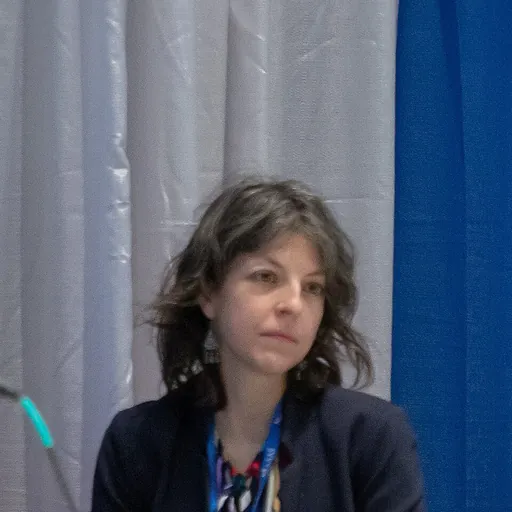
About Elika Bergelson
Elika Bergelson was a researcher.
Elika Bergelson is a language scientist known for her work on language acquisition and cognitive development. She was the principal investigator of the SEEDLingS project, a longitudinal study of word learning in infants from 6 to 18 months. Bergelson was selected for Forbes' 30 under 30 in 2015 for her work on language acquisition.
Bergelson is an associate professor of developmental psychology at Harvard University.
Awards 2019 Steve Reznick Early Career Award from the Cognitive Development Society
2019 Developmental Science Early Research Career Prize for Best Article for the paper "Day by day, hour by hour: Naturalistic language input to infants"
2022 Infancy Studies (ICIS) Distinguished Early Career Contribution Award
2023 Federation of Associations in Behavioral & Brain Science (FABBS) Early Career Impact Award
Biography Elika Bergelson was born to Russian immigrant parents and grew up in Columbus, Ohio. She was raised in household speaking three languages: English, Russian and Hebrew. After graduating, she became a research fellow at the University of Maryland. She then completed a master's degree and Ph.D. in psychology at the University of Pennsylvania In her dissertation "Word learning in 6-16 month old infants," she documented 6-month old infants' ability to comprehend about a dozen words and a marked increase in vocabulary comprehension at ages 13–14 months. This increase in the number of words infants comprehend is called the "comprehension boost". Her work has been supported by grants from the National Science Foundation, the Food and Drug Administration, and the National Institutes of Health.
Research Bergelson studies the impact of the environment on language acquisition during infancy. Her work has led to new ways of thinking about infants' ability to learn words and the impact of factors relating to the linguistic environment infants are exposed to during their formative years. Her approach includes using daylong recordings to validate what adult speakers in infant-caregiver dyads claim to be the words produced by their infants.
In research conducted with Daniel Swingley, Bergelson challenged the idea that children begin to "link words to their referents" at 12 months and claimed that it actually begins at 6 months of age. she found that 6-month-old infants looked equally at two objects upon hearing their label if they had related meanings (e.g., juice and milk). On the other hand, the infants looked longer at the target object when the two objects were unrelated. They concluded that this provided evidence of word recognition in infants as young as 6 months.
In other work, Bergelson examined variables related to the home environment and language acquisition. She and her colleagues found that the more language young children heard, the more speech they produced. They coded utterances for the gender of the speaker, whether the speech was adult-directed or child-directed, and maternal education. This study compared daylong audio-recordings to hourlong video-recordings, and found that they provided different information and led to different conclusions about the language input young children receive. Video-recordings provided a sample that was dense with nouns and questions, some of which did not occur in daily interactions, while the audio-recordings captured nouns that were consistently used across families.
In 2023, Bergelson received the FABBS "Early Career Impact" award, recognizing her efforts to further understanding of infant language acquisition and development and her work with public outreach Her research has influenced child-rearing practices, both by parents and public entities.
Representative publications
Bergelson, E. (2020). Why do older infants understand words better? Leveraging lab studies and home recordings to build and test theories of early word comprehension. Child Development Perspectives. 14(3), 142–149. Bergelson E., Amatuni, A., Dailey, S., Koorathota, S., Tor, S. (2019). Day by day, hour by hour: Naturalistic language input to infants. Developmental Science, 22(1), e12715. Bergelson, E., & Aslin, R. N. (2017). Nature and origins of the lexicon in 6-mo-olds. Proceedings of the National Academy of Sciences, 114(49), 12916–12921. Bergelson, E., & Aslin, R. (2017). Semantic specificity in one-year-olds' word comprehension. Language Learning and Development, 13(4), 481–501. Bergelson, E., & Swingley, D. (2012). At 6–9 months, human infants know the meanings of many common nouns. Proceedings of the National Academy of Sciences, 109(9), 3253–3258. Bergelson, E., & Swingley, D. (2018). Young infants' word comprehension given an unfamiliar talker or altered pronunciations. Child Development. 89(5), 1567–1576.
Don’t just read it —
keep it.
Full-length biographies made to live with: read them, listen on the way to work, watch them tonight.
- E-book
- Audio
- Video
Instant download · yours to keep · every purchase keeps this site free
Important facts
Related people
Same field, nearest in time





Frequently asked questions
Who was Elika Bergelson?
American developmental psychologist
What was Elika Bergelson's occupation?
Elika Bergelson was a researcher.
Sources & further reading
Cite this page
APA: Biography.guide. (2026). Elika Bergelson. https://biography.guide/elika-bergelson/
MLA: "Elika Bergelson." Biography.guide, https://biography.guide/elika-bergelson/.
Chicago: "Elika Bergelson." Biography.guide. https://biography.guide/elika-bergelson/.
Data last updated: 2026-09-23 · Spot an error? Report a correction.
Portrait: Wikimedia Commons · author & licence
Page generated 2026-09-27 05:08 UTC