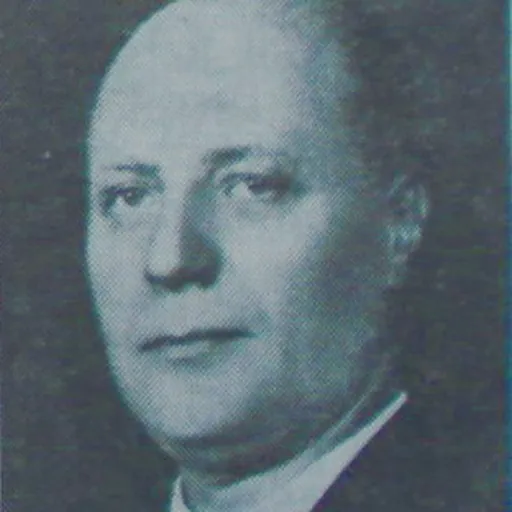
About Elie Carafoli
Lived 1901 – 1983 (aged 82). Elie Carafoli was a Romanian and Turkish military flight engineer and engineer.
Elie Carafoli (September 15, 1901, Veria, Salonica Vilayet, Ottoman Empire–October 24, 1983, Bucharest, Romania) was an accomplished Romanian engineer and aircraft designer. He is considered a pioneering contributor to the field of aerodynamics.
Biography First years, education Carafoli was of Aromanian descent. In 1915, he left Greece for Bitola, and then Bucharest, where he studied at Gheorghe Lazăr High School. In 1919 he entered University Politehnica of Bucharest, graduating with a degree in electrical engineering. He pursued his studies at the University of Paris, while also working at the Institut aérotechnique in Saint-Cyr-l'École, France. He obtained a Ph.D. in 1928, with a thesis entitled Contribution to the theory of aerodynamic lift.
Activity in Romania In 1928, Carafoli returned to Bucharest, where he joined the faculty at the Polytechnic University, and founded the Aerodynamics chair; later in 1936 he was promoted to full professor. It was here that he built the first wind tunnel in South-Eastern Europe, and elaborated some of the theory on which calculations of wing profiles of supersonic aircraft are based.
From 1930 to 1937 Carafoli worked at Industria Aeronautică Română in Braşov. Together with Lucién Virmoux from Blériot Aéronautique, he designed the IAR CV-11, a single-seat, low-wing monoplane fighter aircraft. A prototype was flown in 1931 by Captain Romeo Popescu, in an attempt at breaking the flight airspeed record, but the plane crashed, and the pilot lost his life. Carafoli also designed the IAR 14 and IAR 15 aircraft, and later in 1937 initiated the development of the legendary IAR 80 fighter aircraft, at the urging of Prime Minister Armand Călinescu.
Recognition In 1948, he was elected to the Romanian Academy. In 1949 he became director of the Institute of Applied Mechanics of the academy.
Carafoli was President of the International Astronautical Federation from 1968 to 1970. In 1971, he reorganized, along with Henri Coandă, the Department of Aeronautical Engineering of the Polytechnic University of Bucharest, spinning it off from the Department of Mechanical Engineering.
Carafoli was awarded the Louis Breguet Prize (Paris, 1927), the Gauss Medal, and the Apollo 11 Medal (1971).
Selected publications
Don’t just read it —
keep it.
Full-length biographies made to live with: read them, listen on the way to work, watch them tonight.
- E-book
- Audio
- Video
Instant download · yours to keep · every purchase keeps this site free
Important facts
People in Elie Carafoli's life
Named in this biography and alive at the same time
Related people
Same field, nearest in time


Contemporaries
People whose lives overlapped Elie Carafoli's


Frequently asked questions
Who was Elie Carafoli?
Romanian aircraft designer (1901–1983)
When was Elie Carafoli born?
Elie Carafoli was born on 15 September 1901 in Veria.
When did Elie Carafoli die?
Elie Carafoli died on 24 October 1983 in Bucharest.
What was Elie Carafoli's occupation?
Elie Carafoli was a military flight engineer and engineer.
What nationality was Elie Carafoli?
Elie Carafoli was Romanian and Turkish.
Sources & further reading
Cite this page
APA: Biography.guide. (2026). Elie Carafoli. https://biography.guide/elie-carafoli/
MLA: "Elie Carafoli." Biography.guide, https://biography.guide/elie-carafoli/.
Chicago: "Elie Carafoli." Biography.guide. https://biography.guide/elie-carafoli/.
Data last updated: 2026-09-22 · Spot an error? Report a correction.
Portrait: Wikimedia Commons · author & licence
Page generated 2026-09-27 05:01 UTC