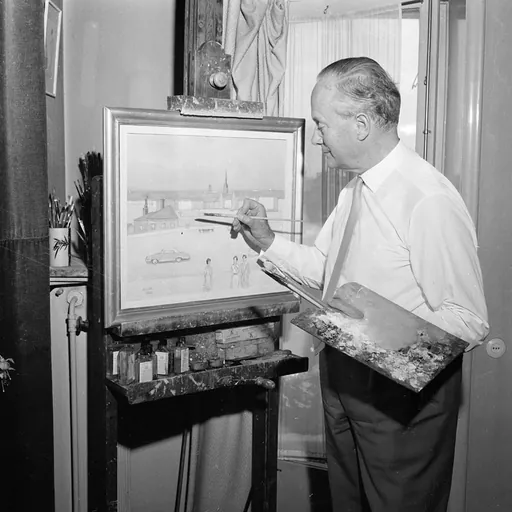
About Einar Jolin
Lived 1890 – 1976 (aged 86). Einar Jolin was a Swedish painter.
Einar Jolin (7 August 189029 August 1976) was a Swedish painter best known for his decorative and slightly naïve Expressionist style. After studying at Konstfack, Stockholm in 1906 and at the Konstnärsförbundets målarskola (the Artists Association Art School), Jolin and his friends Isaac Grünewald and Einar Nerman went to Paris for further studies at Henri Matisse's Académie Matisse from 1908 to 1914.
He painted portraits, still lifes and cityscapes, always accentuating what he called "the beautiful" in his motifs. He mainly worked in oils and watercolors, using delicate brush strokes and light colors. His most noted works are his paintings of Stockholm during the 1910s and 1920s in his trademark naïve style.
Jolin made numerous travels, collecting impressions and inspiration for his paintings. He journeyed to Africa, India and the West Indies, but favored the countries around the Mediterranean Sea, especially the island of Capri where he also exhibited his works.
He had several exhibitions at Liljevalchs konsthall in Stockholm and in 1954, he toured the United States with an exhibition, during which Dag Hammarskjöld purchased a painting for his office in the United Nations building.
Biography Early life and education Einar Jolin was born 7August 1890 in Stockholm. He was the son of professor Severin Jolin and grandson of actor Johan Christopher Jolin. He grew up on Kammakargatan 45 in the Jolinska Huset (Jolin Residence), a three-story townhouse with a garden, built by his grandfather. Jolin grew up in the middle of Stockholm close to Tegnérlunden, Adolf Fredrik Church and Vasaparken, which may have influenced his depiction of houses, roof tops, and views of Stockholm in his paintings. Other residents in the house were his parents, brother Eric, sisters Ingrid and Signe, grandmother Mathilde Wigert-Jolin and his aunt, artist Ellen Jolin (1854–1939) who was the first to teach Jolin the basic techniques of painting.
Jolin's artistic education started at the Technical School (later known as Konstfack) in Stockholm in 1906. The school mainly taught painting techniques and Jolin was more interested in learning about style. Within the year, he started looking for another place to continue his studies. At the beginning of the 20th century, the Konstnärsförbundet (The Artist's Association) had a school on Glasbruksgatan in Stockholm. Jolin applied there in the autumn of 1907. His future teacher Karl Nordström reviewed his drawings and Jolin was admitted to the school the same year. Jolin joined the inner circle at the school, a group of Scandinavian artists who would later become known as (The Young Ones) or 1909 års män (The Men of 1909). Among these were Isaac Grünewald, Leander Engström, Birger Simonsson and Gösta Sandels. Jolin described the pupils at the school as: "... a bunch of individuals with long hair, great muffler scarves and slouch hats worn askew in a way that really impressed me since I was only seventeen and the youngest of the bunch. The most amazing of them all was of course Isaac who had longer and more raven hair than anybody else and a fluttering violet scarf. I had not yet beheld such a creature. We became good friends." Jolin's education at the Artist's Association was curtailed by the school's closure in the spring of 1908.
Paris In 1908, Jolin and Isaac Grünewald left Sweden for the vibrant life in Paris and its art community. The Swedish painter, graphic artist and forester Carl Palme knew Henri Matisse and helped the artist to find a suitable location for the new Académie Matisse. An abandoned nunnery in central Paris became the first home for the academy. Together with Grünewald and Leander Engström, Jolin joined the Matisse Academy, where their friends from Stockholm had already been accepted as pupils. At the Academy, Jolin would develop his sense for a stylish line in combination with bright and clean colours in his paintings.
Jolin's time at the Academy proved more educational for him than the schools he had previously attended and the experience he got from having an established artist as mentor, was important for his development as an artist. Even so, the influence of Matisse on his young pupils should not be exaggerated. Jolin learned croquis at the academy and also developed a natural, spontaneous speed in his brushwork. He mostly painted models and still life, and during a visit to the south of France in 1911, he made his earliest landscapes.
During his time in Paris, Jolin became good friends with Nils Dardel. Jolin also spent some time in Senlis where he depicted its street life 1913,
Return to Stockholm Portrait of artist Einar Jolin next to one of his paintings, sometime between 1925 and 1941. In the spring of 1914, when Jolin and his friends from the Académie Matisse returned to Stockholm, the group became known as De Unga (The Young Ones). Their participation and paintings created uproar in the Baltic Exhibition in Malmö.
Jolin had planned to return to Paris the following summer, but the outbreak of World War I on 28July 1914, forced him to reconsider his decision. With the road to France closed, he decided to stay in Stockholm, in the so-called "Scandalous House" near Katarina Church in the southern part of town.
In 1917, Jolin rented a studio at Kungsbroplan in Stockholm and painted diligently. At the end of that year he was visited by Herman Gotthardt, a wholesaler from Malmö, who had recently taken up art collecting as a hobby. He studied Jolin's numerous works and, as at this time the artists sold very few paintings, it came as a surprise to him when Gotthardt bought 16 canvases. Jolin received seven thousand crowns (sek) for the paintings, and at home the same evening he was able to show his parents the money from his first major sales, saying: "Look here, this is what I earned today".
Jolin spent most of 1918 in Copenhagen, They sold well enough for him to stay in Denmark almost a year. Jolin enjoyed life in the Danish capital, the social life was more spontaneous than in Stockholm and people from different professions, or social standings, mixed with each other in a way that appealed to him.
Travelling After World War I, traveling was once again possible for the many young artists who had been forced to stay home during the six years of war. In 1920, Jolin went on a journey, first to Italy, North Africa and Spain for new international impressions, and then on to India, Africa and the West Indies. In the spring of 1924, Jolin went to Spain with his first wife, Britt von Zweigbergk. Like many other artists he painted the bullfights, but contrary to the strong, and sometimes bloody, bullfight painted by his colleague and close friend Gösta Adrian-Nilsson (GAN), Jolin's works were created in the calm and orderly manner that had earned him his second nickname: Eleganten Einar (Einar, the Elegant).
Throughout his life he continued to paint romanticized exteriors of Stockholm, whether in spring sunshine or winter haze, the city was always depicted as beautiful and unspoiled. He expressed the idea that only through the emotions of an individual could nature be depicted the right way. In the magazine Konst (Art) 1913–14, he writes on False perspective and exaggerations in modern art etc. that: "Nature is wonderful, but a photo is nothing, because nature becomes wonderful only when it is seen and understood by a great human, and a great human always sees and feels something special in nature, something she wants to reproduce."
Award In 1957, Jolin received the Prince Eugen Medal from His Majesty King Carl XVI Gustaf of Sweden.
Exhibitions
Stockholm seen from the Katarina Church tower behind Fiskargatan 9, around 1860. Some of the exhibitions of his work during his lifetime were: 1912 Salong Joël, Stockholm 1914 Baltic Exhibition, Malmö 1915 Stockholm 1916 Liljevalchs konsthall, Stockholm 1918 Liljevalchs konsthall, Stockholm 1918 Valand, Gothenburg 1918 Copenhagen, Denmark 1919 Liljevalchs konsthall, Stockholm 1922 Svensk-Franska Konstgalleriet, Stockholm 1931 Galerie Moderne, Stockholm 1933 Konstakademin, Stockholm 1945 Galerie Blanche, Stockholm 1953 Sunset Club, Seattle, USA 1954 Galerie St Etienne, New York, USA 1954 Swedish Institute, Minneapolis, USA 1954 Upsala College, New Jersey, USA 1955 Swedish-American Historical Museum, Philadelphia, USA 1957 Liljevalchs konsthall, Stockholm 1970 Royal Swedish Academy of Arts, Stockholm 1975 Handelsbanken, Stockholm 1990 Museum of Modern Art Stockholm
In 2010–2011, The Liljevalchs art venue held a commemorative exhibition showcasing some of Jolins best works.
Don’t just read it —
keep it.
Full-length biographies made to live with: read them, listen on the way to work, watch them tonight.
- E-book
- Audio
- Video
Instant download · yours to keep · every purchase keeps this site free
Important facts
People in Einar Jolin's life
Named in this biography and alive at the same time
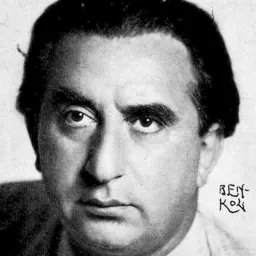
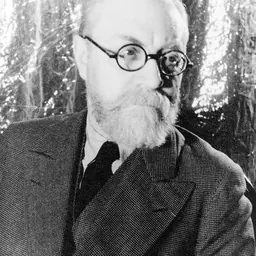





Related people
Same field, nearest in time



Contemporaries
People whose lives overlapped Einar Jolin's





Frequently asked questions
Who was Einar Jolin?
Swedish artist (1890-1976)
When was Einar Jolin born?
Einar Jolin was born on 7 August 1890 in Stockholm, Adolf Fredriks parish.
When did Einar Jolin die?
Einar Jolin died on 29 August 1976 in Stockholm, S:t Görans church parish.
What was Einar Jolin's occupation?
Einar Jolin was a painter.
What nationality was Einar Jolin?
Einar Jolin was Swedish.
Sources & further reading
Cite this page
APA: Biography.guide. (2026). Einar Jolin. https://biography.guide/einar-jolin/
MLA: "Einar Jolin." Biography.guide, https://biography.guide/einar-jolin/.
Chicago: "Einar Jolin." Biography.guide. https://biography.guide/einar-jolin/.
Data last updated: 2026-09-22 · Spot an error? Report a correction.
Portrait: Wikimedia Commons · author & licence
Page generated 2026-09-27 05:03 UTC