Egtved Girl
Bronze age girl found in a Danish burial mound
About Egtved Girl
Lived 1390 BC – 1370 BC (aged 19–20).
The Egtved Girl was a Nordic Bronze Age girl whose well-preserved remains were discovered outside Egtved, Denmark, in 1921. Aged 16 to 18 at death, she was slim, tall, had short, blond hair and well-trimmed nails. Her burial has been dated by dendrochronology to 1370 BC. She was discovered together with cremated remains of a child in a barrow approximately wide and high. Only the girl's hair, brain, teeth, nails, and a little of her skin remain preserved.
Discovery
The individual who became known as the Egtved Girl was discovered on 24 February 1921 during the excavation of a Bronze Age burial mound near Egtved in Jutland, Denmark.
The burial mound measured approximately in diameter and high. Beneath it, archaeologists uncovered a well-preserved oak-log coffin made from a split oak trunk and aligned east to west.
Rather than opening the coffin at the excavation site, archaeologists transported it intact to the National Museum of Denmark in Copenhagen, where it was carefully examined.
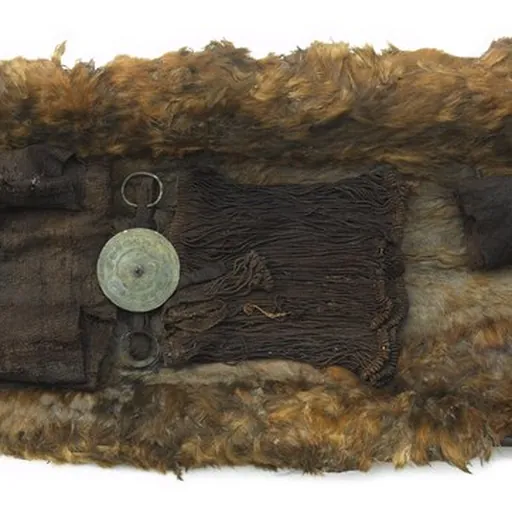
The sealed oak coffin created conditions that preserved parts of her body and many of the organic materials buried with her. The acidic, oxygen-poor environment slowed decomposition, allowing her hair, brain, teeth, fingernails and small traces of skin to survive, together with her clothing and a variety of grave goods.
The reconstruction is displayed at the National Museum alongside the original clothing and other objects from her burial.
A small museum at the place where the Egtved Girl was discovered also displays copies of her clothing, jewellery and bronze belt plate. The museum stands beside a reconstructed version of her burial mound and includes information about her discovery in 1921.
Scientific analysis
Dating
The individual who became known as the Egtved Girl was a young woman who lived during the later Nordic Bronze Age, around 1390–1370 BCE. She died in her late teens, at approximately 16 to 18 years of age, and stood about tall. She had a slim build, short blond hair and well-trimmed fingernails. , but married and moved to Denmark, subsequently traveling back and forth between the two areas.
When Thomsen and Andreasen analyzed samples locally from places uncontaminated by modern farming, they found that the range of strontium isotopic values in the surrounding natural environment matched those in the girl. Thus, it is most plausible that she originated from and spent her entire life in the Egtved area, and did not come from far away as proposed by Frei et al. Thomsen and Andreasen's results show that the girl did live about half the year in one area – likely the river valley in Egtved – and the other half of the year in another place – likely the local plateau, perhaps in the practice of transhumance farming and seasonal pastoral movement within a small area.
In a 2019 article based on strontium isotope analysis, Sophie Bergerbrant suggests an origin of Sweden or Norway for the Egtved Girl.
Don’t just read it —
keep it.
Full-length biographies made to live with: read them, listen on the way to work, watch them tonight.
- E-book
- Audio
- Video
Instant download · yours to keep · every purchase keeps this site free
Important facts
Contemporaries
People whose lives overlapped Egtved Girl's



Frequently asked questions
Who was Egtved Girl?
Bronze age girl found in a Danish burial mound
When was Egtved Girl born?
Egtved Girl was born in 1390 BC.
When did Egtved Girl die?
Egtved Girl died in 1370 BC.
Sources & further reading
Cite this page
APA: Biography.guide. (2026). Egtved Girl. https://biography.guide/egtved-girl/
MLA: "Egtved Girl." Biography.guide, https://biography.guide/egtved-girl/.
Chicago: "Egtved Girl." Biography.guide. https://biography.guide/egtved-girl/.
Data last updated: 2026-09-23 · Spot an error? Report a correction.
Portrait: Wikimedia Commons · author & licence
Page generated 2026-09-27 05:07 UTC