
About Edward Sharpham
Lived 1576 – 1608 (aged 31–32). Edward Sharpham was a playwright and writer.
Edward Sharpham (baptised 1576 – 1608) was an English playwright and pamphleteer.
Life He was baptised on 22 July 1576, the third son of Richard Sharpham of Colehanger, a manor in the parish of East Allington. His father having died when Sharpham was five his mother married Alexander Hext, with whom she had three children. Having been widowed a second time in 1588, she subsequently married Charles Barnaby of Clement's Inn.
Sharpham probably attended grammar school in Devon, possibly William Kemp's school in Plymouth. He was admitted to the Middle Temple on 9 October 1594.
In 1592 Sharpham's mother began a lawsuit against a Thomas Fortescue, alleging he had murdered her first husband by poison and also used witchcraft to make her fall in love with him. Four years later Sharpham himself also sued Fortescue and another man, William Bastard, on a charge of having tampered with evidence relating to his mother's suit. He remained associated with the Middle Temple.
On 22 April 1608, aged 31, Sharpham made his will. He died the next day, and was buried in St. Margaret's, Westminster.
Works Sharpham is believed to have been the 'E.S.' who in 1597 wrote The Discoverie of the Knights of the Poste, a pamphlet of the "conycatching" genre detailing the tricks of conmen active on the road between London and Exeter. He may also be the 'E.S.' who contributed a commendatory poem to the publication of Ben Jonson's Volpone (1607), although Jonson later described Sharpham as a "rogue".
His first known play, The Fleire, was written for one of the popular boys' theatre companies, the Children of the Blackfriars. Composition date is some time between late 1605 and the play's appearance in the Stationers Register on 13 May 1606. Cynical in tone, The Fleire is a court-oriented satire similar to Marston's The Malcontent and The Fawne. The play's popularity, at least as text, is shown by its being reprinted three times.
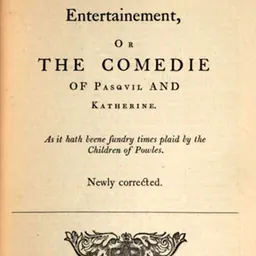
Cupid's Whirligig was Sharpham's second and last play, produced early in 1607 and printed later the same year with a dedication to fellow Devonian and author Robert Hayman. Again, it satirises court life in a general way, though it has been speculated that the character Nucome, carefully described as 'Welsh', may actually be a veiled attack on the king's Scottish favourite Robert Carr. This play too was eventually reprinted three times.
Don’t just read it —
keep it.
Full-length biographies made to live with: read them, listen on the way to work, watch them tonight.
- E-book
- Audio
- Video
Instant download · yours to keep · every purchase keeps this site free
Important facts
People in Edward Sharpham's life
Named in this biography and alive at the same time


Related people
Same field, nearest in time


Contemporaries
People whose lives overlapped Edward Sharpham's



Frequently asked questions
Who was Edward Sharpham?
English playwright
When was Edward Sharpham born?
Edward Sharpham was born in 1576.
When did Edward Sharpham die?
Edward Sharpham died in 1608.
What was Edward Sharpham's occupation?
Edward Sharpham was a playwright and writer.
Sources & further reading
Cite this page
APA: Biography.guide. (2026). Edward Sharpham. https://biography.guide/edward-sharpham/
MLA: "Edward Sharpham." Biography.guide, https://biography.guide/edward-sharpham/.
Chicago: "Edward Sharpham." Biography.guide. https://biography.guide/edward-sharpham/.
Data last updated: 2026-09-20 · Spot an error? Report a correction.
Page generated 2026-09-27 05:02 UTC