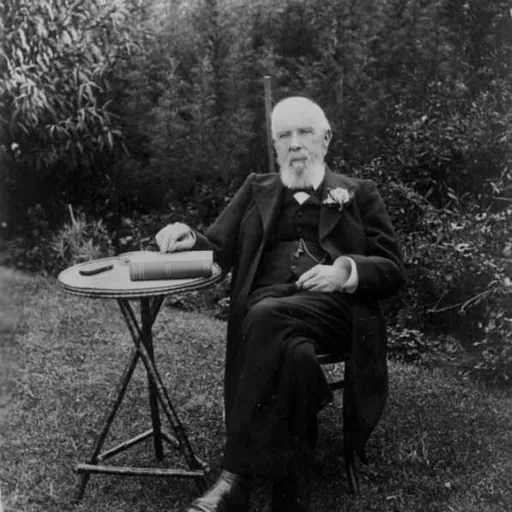
Edward Marsh Williams
Missionary, interpreter, and judge
About Edward Marsh Williams
Lived 1818 – 1909 (aged 90). Edward Marsh Williams was a New Zealand.
Edward Marsh Williams (2 November 1818 – 11 October 1909) was a missionary, interpreter, and judge who played a significant role in the British colonisation of New Zealand. He was born in Hampstead, Middlesex, the eldest son of Archdeacon Henry Williams and Marianne Williams.
At the age of 21 in 1840, when Captain William Hobson arrived in New Zealand, Edward — who had grown up among the Māori at Paihia, and as a result was fluent in Te Reo and understood Māori culture — helped his father translate the Treaty of Waitangi into Te Reo. Edward was appointed by Lieutenant Governor Hobson as government interpreter, Clerk to the Court, and the first postmaster at Auckland. Edward was appointed to judicial positions: as Resident Magistrate for the Bay of Islands and in 1881 Edward was appointed a judge of the Native Land Court (which became the Māori Land Court) of New Zealand.
Williams translated into Māori over 210 hymns and also The Pilgrim's Progress. He drew in Sylvan Cove, Stewart Island / Rakiura in 1840.
Early life Williams arrived with his parents at the Paihia, Bay of Islands, in July 1823 aboard the ship Brampton.
In 1835, Williams returned to England on . He was apprenticed to a London doctor, but after twelve months he ended his studies as the consequence of brain fever (an uncertain diagnosis) and he returned to New Zealand.
Translation of the Treaty of Waitangi In 1840, when Captain William Hobson arrived in New Zealand he appointed Williams' father to take charge of the translation of the Treaty of Waitangi. As Williams was an experienced Māori linguist as well as being well-acquainted with Māori customs, he assisted his father to translate the treaty into the Māori language.
Williams was appointed as the Māori interpreter to Major Thomas Bunbury of the 80th Regiment, who had been appointed by Lieutenant Governor Hobson as Commissioner. On 29 April 1840 they travelled on under Captain Joseph Nias to take a copy of the Treaty of Waitangi (known as the "Herald-Bunbury" copy) to the South Island. On 16 June 1840 they arrived in Port Underwood in Cloudy Bay and obtained nine signatures. They then visited various Māori chiefs along the east coast of the South Island, stopping at Akaroa (two signatures), Otago Harbour (two signatures) and to Ruapuke Island in Foveaux Strait where they obtained a further three signatures.
The actual proclamation of sovereignty was made by Lieutenant Governor Hobson on 21 May 1840 (the North Island by treaty and the South by discovery), notwithstanding that his agents were collecting signatures for the Treaty in the South Island at this stage.
Later life On 20 April 1840, Williams defused a culture misunderstanding that could have resulted in conflict between the Ngāpuhi and the colonial troops. An early court case related to the murder of Patrick Rooney, a shepherd working at Pakaraka, by a Ngāpuhi known as Kihi, who was discovered and delivered up by other Ngāpuhi to the authorities at Kororāreka. Willoughby Shortland was in the act of a magisterial examination of the charge against Kihi when Te Haratua, a chief from Pakaraka, arrived with about three hundred armed warriors and began a haka. Shortland, believing the warriors had hostile intentions, sent for the troops. Williams, who was present as a witness, identified that Te Haratua and the warriors did not have any hostile intentions, having come over to make a public display of their abhorrence of the murder. He persuaded Te Haratua and the warriors to leave and explained in a quiet way that it was ignorance of Māori culture on Shorthand's part that made him call for the troops.
Williams became a director of the New Zealand Banking Company, which was the first company formed in New Zealand and which was established on 1 September 1840 at Kororareka in the Bay of Islands with about £7,000 of capital. Williams was appointed by Hobson as government interpreter, clerk to the court and the first postmaster at Auckland He was with the first party of officials at the founding of Auckland on 18 September 1840, which had been designated as the capital of New Zealand. when he retired to manage the family property at Pakaraka. He retained office until 1891 when he finally retired into private life. The Revd Arthur Frederick Williams, born 1860 in Waimate North
Williams died at Te Aute on 11 October 1909.
Don’t just read it —
keep it.
Full-length biographies made to live with: read them, listen on the way to work, watch them tonight.
- E-book
- Audio
- Video
Instant download · yours to keep · every purchase keeps this site free
Important facts
Family & relationships
People in Edward Marsh Williams's life
Named in this biography and alive at the same time





Contemporaries
People whose lives overlapped Edward Marsh Williams's




Frequently asked questions
Who was Edward Marsh Williams?
missionary, interpreter, and judge (1818-1909)
When was Edward Marsh Williams born?
Edward Marsh Williams was born on 2 November 1818 in Hampstead.
When did Edward Marsh Williams die?
Edward Marsh Williams died on 11 October 1909 in Te Aute College.
What nationality was Edward Marsh Williams?
Edward Marsh Williams was New Zealand.
Sources & further reading
· Wikipedia: Edward Marsh Williams
· DBpedia: Edward Marsh Williams
Cite this page
APA: Biography.guide. (2026). Edward Marsh Williams. https://biography.guide/edward-marsh-williams/
MLA: "Edward Marsh Williams." Biography.guide, https://biography.guide/edward-marsh-williams/.
Chicago: "Edward Marsh Williams." Biography.guide. https://biography.guide/edward-marsh-williams/.
Data last updated: 2026-09-21 · Spot an error? Report a correction.
Portrait: Wikimedia Commons · author & licence
Page generated 2026-09-27 04:58 UTC