
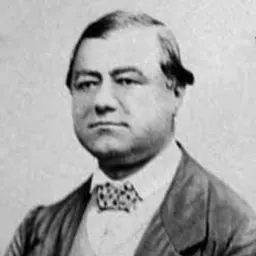
Edward George Horder
English medical missionary to China
About Edward George Horder
Lived 1852 – 1908 (aged 55–56).
Edward George Horder (1852-Nov 22, 1908) was an English medical missionary to China notable for his work with leprosy patients. As a member of the Church Missionary Society (C.M.S.), Horder spent 25 years in the city of Pakhoi–now Beihai–building and operating the first mission hospital in the Guangdong province. In addition to becoming the second-largest C.M.S. mission hospital in China, Horder's Pakhoi mission station was the first institution in the region to treat leprosy patients. Even after Horder's departure, the hospital remained a health center in Beihai and was the site of service for a generation of new missionaries. Although the leper wing closed in 1936, the hospital itself still survives as the Beihai People Hospital.
Personal life Early life and education Born in 1852 in Surrey, England, Horder spent his childhood in Wandsworth. He then moved to Edinburgh to train as a physician and surgeon, boarding in the household of John Lowe for the duration of his education.
Marriage and family In 1889, Horder married Caroline Stubbs, and ran the hospital during Horder's departure to Japan in 1894. However, with the outbreak of the Sino-French War, the C.M.S. instead sent Horder to the Haihow mission on the island of Hainan. After serving at Haihow for a year, Horder relocated to the Hong Kong mission, assisting Reverent J.B. Ost in instructing medical students and operating a dispensary.
In April 1886, Horder returned to Beihai to direct the mission station. Construction was completed in July 1887, and the hospital opened shortly thereafter to receive patients–some of the first of which were opium smokers.
Despite weathering a smallpox epidemic and subsequent bubonic plague outbreak in 1894, the Pakhoi hospital became the largest C.M.S. mission hospital (in terms of patients received) in South China. and leper asylum. He departed for Beihai in 1897, where he remained until his final return to England in 1906. By 1894, three additional buildings were constructed to enlarge the asylum. Even after Horder's departure, the Pakhoi hospital would treat patients with the awareness that "the kind of life [the patient] lives" was a key determinant of a patient's prognosis.
Legacy The Leper Asylum was commended by the C.M.S. for the "remarkable" work it performed with leper patients, When Horder's wife visited the hospital in 1926 for the 40th anniversary of its founding,
The occupational therapy practiced in the Leper Asylum was adopted as a treatment regimen by C.M.S. missionaries; at the leprosy settlement in Purulia, missionaries encouraged leper patients to learn agriculture, carpentry, bricklaying, and even dressmaking to promote their recovery. A generation of new missionaries, including Leopold G. Hill
In 1936, the Leper Asylum closed after 50 years of operation due to a lack of sufficient space to treat an influx of new patients. In 1952, this name was changed to "Beihai People Hospital". leaving the hospital under the direction of missionary doctor Neville Bradley. Though they meant to depart for the Pakhoi mission station upon their recovery, they decided to remain in England after being advised that Beihai's tropical climate would damage their health.
After Horder's death, Stubbs remained active in the CMS, organizing exhibitions and training missionary assistants.
Don’t just read it —
keep it.
Full-length biographies made to live with: read them, listen on the way to work, watch them tonight.
- E-book
- Audio
- Video
Instant download · yours to keep · every purchase keeps this site free
Important facts
People in Edward George Horder's life
Named in this biography and alive at the same time


Contemporaries
People whose lives overlapped Edward George Horder's




Frequently asked questions
Who was Edward George Horder?
English medical missionary to China
When was Edward George Horder born?
Edward George Horder was born in 1852.
When did Edward George Horder die?
Edward George Horder died in 1908.
Sources & further reading
· Wikipedia: Edward George Horder
· DBpedia: Edward George Horder
Cite this page
APA: Biography.guide. (2026). Edward George Horder. https://biography.guide/edward-george-horder/
MLA: "Edward George Horder." Biography.guide, https://biography.guide/edward-george-horder/.
Chicago: "Edward George Horder." Biography.guide. https://biography.guide/edward-george-horder/.
Data last updated: 2026-09-20 · Spot an error? Report a correction.
Page generated 2026-09-27 05:07 UTC