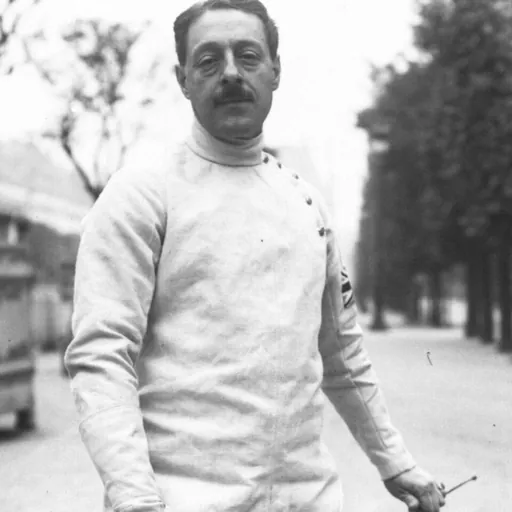
About Edgar Seligman
Lived 1867 – 1958 (aged 91). Edgar Seligman was a British fencer and painter.
Marriage Edgar's wife Georgette A. Mosenthal at 28, by P. A. de Lazlo, 1907 Having established a national reputation in amateur fencing in the 1906 Athens Olympics, on October 12, 1909, Seligman was married to George Joseph Mosenthal's daughter, Georgette Alice Henriette Mosenthal. They were married with a traditional ceremony at the Synagogue at 34 Upper Berkely Street, one of the oldest in Great Britain, now known as the West London Synagogue. Edgar was forty-two, and Georgette was twelve years younger, and both had lived and possibly met on Queen's Gate, a street in South Kensington, London. The reception was at the home of Mrs. George (Margeurite Biedermann b. 1859 in Paris) Mosenthal, the Bride's mother, at 190 Queen's Gate, London. Seligman's brother, then Captain H.S. Seligman of the Royal Horse Artillery was best man. Georgette's mother, Mrs. George (Margeurite Biedermann) Mosenthal (b. 1859, Paris), had been the subject of a portrait in oil by American Painter John Singer Sargent, now on display at the National Portrait Gallery in Washington, D.C. Around 1890, she had been painted in white in a full-length portrait by Jewish London painter and Royal Academician Solomon Joseph Solomon.
As Fencer Seligman attended Salle Bertrand in London, a well established fencing school founded in the late nineteenth century by fencing master Baptise Bertrand originally on London's Warwick Street. Seligman would attend fencing school and compete or judge occasional competitions at Salle Bertrand's as late as 1928, and London's F. McPherson's School of Arms in Westminster as early as 1906, and stay active as a competitor at least through the 1920s with his last competitive Olympics in 1924 at the age of 57. Military teams often competed at Bertrand's and McPherson's, and the competitions were often arranged by the British Fencing Association. One of his earliest exhibits was at London's Mendoza gallery in 1907. He had a studio in Kensington's Roland Gardens.
Fencing career
British Championships At the British Championships, Seligman won the epee event in 1904 and 1906. He later won the foil event from 1906 to 1907 while also winning the sabre event in 1923 and 1924.
He died on 27 September 1958, in Kensington, London, where he had lived nearly all of his life. He bequeathed his collection of over 5000 16th and 17th century portrait engravings to the Victoria and Albert Museum. Best known in his collection are the works of 17th century French engraver Robert Nanteuil.
Don’t just read it —
keep it.
Full-length biographies made to live with: read them, listen on the way to work, watch them tonight.
- E-book
- Audio
- Video
Instant download · yours to keep · every purchase keeps this site free
Important facts
People in Edgar Seligman's life
Named in this biography and alive at the same time




Related people
Same field, nearest in time


Contemporaries
People whose lives overlapped Edgar Seligman's

Frequently asked questions
Who was Edgar Seligman?
British artist and épée, foil, and sabre fencer (1867-1958)
When was Edgar Seligman born?
Edgar Seligman was born on 14 April 1867 in San Francisco.
When did Edgar Seligman die?
Edgar Seligman died on 27 September 1958 in London.
What was Edgar Seligman's occupation?
Edgar Seligman was a fencer and painter.
What nationality was Edgar Seligman?
Edgar Seligman was British.
Sources & further reading
Cite this page
APA: Biography.guide. (2026). Edgar Seligman. https://biography.guide/edgar-seligman/
MLA: "Edgar Seligman." Biography.guide, https://biography.guide/edgar-seligman/.
Chicago: "Edgar Seligman." Biography.guide. https://biography.guide/edgar-seligman/.
Data last updated: 2026-09-22 · Spot an error? Report a correction.
Portrait: Wikimedia Commons · author & licence
Page generated 2026-09-27 05:03 UTC