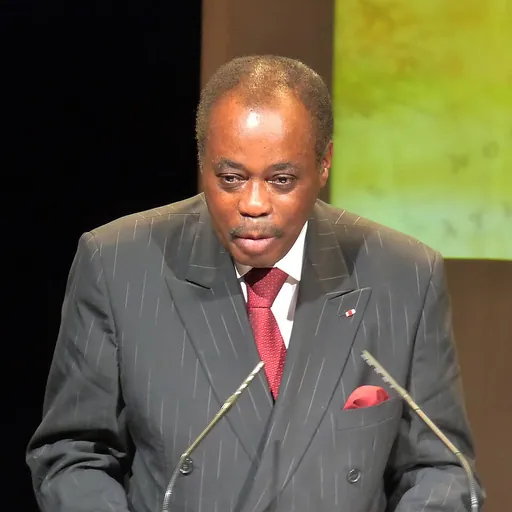
About Edem Kodjo
Lived 1938 – 2020 (aged 81). Edem Kodjo was a politician, teacher, author and minister.
Édouard Kodjovi "Edem" Kodjo (23 May 1938 – 11 April 2020), was a Togolese politician and diplomat. He was Secretary-General of the Organisation of African Unity from 1978 to 1983; later, in Togo, he was a prominent opposition leader after the introduction of multi-party politics. He served as Prime Minister from 1994 to 1996 and again from 2005 to 2006. Kodjo was President of the Patriotic Pan-African Convergence (CPP). Kodjo died on 11 April 2020, in Paris.
Early life Kodjo was born in Sokodé, Tchaoudjo Prefecture, French Togoland on May 23, 1938. He had his secondary school education at West Africa Secondary School in Ghana. Kodjo participated in the creation of the Rally of the Togolese People (RPT) ruling party in late 1969 and became the new party's Secretary-General. He was removed from his position as RPT Secretary-General in 1971. and as Minister of Foreign Affairs from 1976 to 1978. One of the key issues facing the OAU during Kodjo's five-year tenure was the status of the Sahrawi Arab Democratic Republic (SADR), which claimed independence for the former colony of Spanish Sahara, at that time partly occupied by Morocco. Kodjo controversially allowed the SADR to be seated as a member of the OAU on February 28, 1982, over the objections of Morocco and various other African countries that supported the Moroccan position. According to Kodjo, that decision was based simply on the fact that a majority of OAU member states had recognized the SADR, but it led to a serious crisis within the OAU, with a number of member states boycotting OAU meetings. Senegalese President Abdou Diouf accused Kodjo of "mischief-making".
After leaving his post as OAU Secretary-General in 1983, Kodjo lived in France, where he taught at the Sorbonne, wrote for Jeune Afrique, and founded a magazine, Afrique 2000. In 1985 he published Africa Tomorrow in France, which was later translated into English by E. B. Khan and published in the United States in 1987.
1990s In 1991, a few months before the National Conference, Kodjo returned to Togo and founded a new opposition political party, the Togolese Union for Democracy (UTD). he was designated by the Collective of Democratic Opposition (COD II) as its sole candidate for the presidential election of August 25, 1993, although Gilchrist Olympio of the Union of the Forces of Change (UFC) did not accept this decision.
Along with other opposition leaders, Kodjo pressured Eyadéma to hold a free and fair parliamentary election in 1994. In this election, the Action Committee for Renewal (CAR) and the UTD together won an initial majority in the National Assembly, the CAR with 36 seats and the UTD with seven; The CAR and UTD initially agreed to nominate CAR President Yawovi Agboyibo as Prime Minister. However, after the election in three constituencies was cancelled, the two parties lost their narrow majority, and Eyadéma invited Kodjo to form a government,
Kodjo served as Prime Minister of Togo until August 20, 1996. He resigned as Prime Minister after the RPT won the elections that were held over again in the constituencies where the results had been annulled, giving the RPT and its allies a parliamentary majority; a new government under Kwassi Klutse of the RPT was formed. Kodjo announced on May 4, 1998 that he would not be a candidate in the June 1998 presidential election, stressing the need for opposition unity. He backed the leading opposition candidate, UFC President Gilchrist Olympio.
2000–2020 Kodjo subsequently became the leader of a new party, the Patriotic Pan-African Convergence (CPP), which was created in August 1999 through the merger of four parties, including the UTD. Kodjo criticized Eyadéma for not honoring his pledge to step down in the 2003 election and again called for the opposition to put forward a single candidate. During the campaign, the CPP called for a debate on television between Kodjo and Eyadéma after the RPT engaged in what the CPP considered personal attacks on Kodjo. and took fifth place;
Following the disputed April 2005 presidential election, which occurred shortly after Eyadema's death, Eyadema's son and successor Faure Gnassingbé named Kodjo, a representative of the moderate opposition, as Prime Minister again on June 8, 2005, choosing him instead of a candidate from the radical opposition. He took office on June 9, succeeding Koffi Sama.
In an announcement on September 16, 2006, Gnassingbé accepted Kodjo's resignation and named Yawovi Agboyibo as Prime Minister. On September 25, Gnassingbé appointed Kodjo by decree as Minister of State to the Presidency.
In the October 2007 parliamentary election, Kodjo ran for a seat in the National Assembly as a candidate of the CPP in Avé Prefecture, where he was the first name on the party's candidate list.
At a CPP congress in late April 2009, Kodjo announced that he was retiring from day-to-day politics in order to make way for younger leadership. He also said that he would not be a candidate in the 2010 presidential election. Acting as the Special Envoy of La Francophonie, he arrived in Madagascar to help mediate in that country's political crisis on May 8, 2009. In an interview with Jeune Afrique, published in May 2009, he said that he had served his country in all possible capacities, except that of President: "I have made my contribution to the construction of my country". According to Kodjo, he had lost interest in "internal politics" and preferred to devote himself to Pan-Africanism by working to facilitate a cooperative approach to finding solutions to African problems.
In 2016 he acted as the African Union's mediator during the dispute between the government and the opposition in the Democratic Republic of the Congo regarding the timing of the next election.
Death Kodjo died of COVID-19 on April 11, 2020, in Paris, France. The Togolese Foreign Minister Robert Dussey paid tribute to him, calling him "a brilliant academic".
Don’t just read it —
keep it.
Full-length biographies made to live with: read them, listen on the way to work, watch them tonight.
- E-book
- Audio
- Video
Instant download · yours to keep · every purchase keeps this site free
Important facts
People in Edem Kodjo's life
Named in this biography and alive at the same time




Related people
Same field, nearest in time




Contemporaries
People whose lives overlapped Edem Kodjo's


Frequently asked questions
Who was Edem Kodjo?
Togolese politician (1938-2020)
When was Edem Kodjo born?
Edem Kodjo was born on 23 May 1938 in Sokodé.
When did Edem Kodjo die?
Edem Kodjo died on 11 April 2020 in Neuilly-sur-Seine.
What was Edem Kodjo's occupation?
Edem Kodjo was a politician, teacher, author and minister.
What nationality was Edem Kodjo?
Edem Kodjo's recorded nationality: Togo.
Sources & further reading
Cite this page
APA: Biography.guide. (2026). Edem Kodjo. https://biography.guide/edem-kodjo/
MLA: "Edem Kodjo." Biography.guide, https://biography.guide/edem-kodjo/.
Chicago: "Edem Kodjo." Biography.guide. https://biography.guide/edem-kodjo/.
Data last updated: 2026-09-22 · Spot an error? Report a correction.
Portrait: Wikimedia Commons · author & licence
Page generated 2026-09-27 05:01 UTC