
About Ecgbert
Lived 678 – 766 (aged 87–88). Ecgbert was an English archbishop, writer and catholic priest.
Ecgbert (Also spelled Egbert, Ecgbert has been claimed to have been a student of Bede, who much later visited Ecgbert in 733 at York, but this statement may simply mean that Ecgbert was a student of Bede's writings, and not that he was formally taught by him.) (other sources date the appointment to 734) by his cousin Ceolwulf, the king of Northumbria. Pope Gregory III gave him a pallium, the symbol of an archbishop's authority, in 735. (The pope who forbade the brothers was Pope Paul I.) An example of the brothers' co-operation is the fact that some of Eadberht's coins feature Ecbert's image on the opposite face.
Ecgbert's problems with the monasteries in his diocese came from the secular practice of families setting up monasteries that were totally under their control as a way of making the family lands book-land and free from secular service. Book-land was at first an exclusive right of ecclesiastical property. By transferring land to a family-controlled monastery, the family would retain the use of the land without having to perform any services to the king for the land.
Educational activities
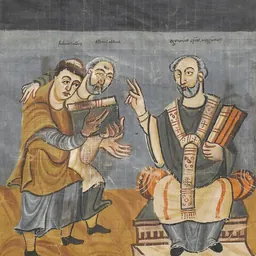
The school Ecgbert founded at York is held by the modern historian Peter Hunter Blair to have equalled or surpassed the famous monasteries at Wearmouth and Jarrow. The school educated not just the cathedral clergy but also the offspring of nobles. Blair also calls the library that was established at York "a library whose contents were unequalled in the western Europe of its day". Among the students at the school was Alcuin, who was placed by his family with Ecgbert. Both Liudger, later the first Bishop of Münster, and Aluberht, another bishop in Germany, also studied at the school in York.
Correspondents
Bede wrote Ecgbert a letter dealing with monastic issues as well as the problems of large dioceses. Bede urged Ecgbert to study Gregory the Great's Pastoral Care, The main thrust of Bede's letter was to urge Ecgbert to reform his church to more closely resemble Gregory the Great's original plan for it. Bede's admonition to divide up dioceses fell on deaf ears, as Egbert did not break up his large diocese. The suffragans continued to be limited to the bishops of Hexham, Lindisfarne, and Whithorn.
Boniface wrote to Ecgbert, asking for support against Æthelbald of Mercia. Boniface also asked the archbishop for some of Bede's books, and in return sent wine to be drunk "in a merry day with the brethren." On another occasion, Boniface sent the archbishop a cloak and towel.
Writings
Ecgbert wrote the Dialogus ecclesiasticae institutionis, (Sometimes the title is given as Succinctus dialogus ecclesiasticae institutionis or an even longer title of Succinctus dialogus ecclesiasticae institutionis a Domino Egbherto, Archiepiscopo Eburacae civitatis conpositus.) The Dialogus details a code of conduct for the clergy and how the clergy was to behave in society. The exact date it was composed is unclear, but it was probably after 735, based on the mention of the archiepiscopal status of Ecgbert in one title as well as the internal evidence of the work.
Other works were attributed to Egbert in the Middle Ages, but they are not regarded by modern scholars as authentic. These include a collection of church canons, as well as a penitential and a pontifical. The penitential, known as the Paenitentiale Ecgberhti, was ascribed to Ecgbert by the 8th or 9th centuries, but its surviving versions have little or no content that can be reliably traced to Ecgbert. The pontifical, known as the Pontificale Egberti, is thought to owe its attribution to Ecgbert's authorship to the fact that the penitential ascribed to Ecgbert was included within its contents. Lastly, the collection of church laws known previously as the Excerptiones Ecgberhti but today as the Collectio canonum Wigorniensis, has been shown to be the work of a later archbishop of York, Wulfstan, and was not connected with Ecgbert until after the Anglo-Saxon period. Besides these Latin works, an Old English text, known variously as the Scriftboc, Confessionale Pseudo-Egberti or Confessionale Egberti, was once stated to be a translation from Latin by Ecgbert, but is now known to date from the late 9th or 10th century.
Death and legacy
Ecgbert died on 19 November 766, Alcuin also claimed that he was known as a teacher of singing. The historian Henry Mayr-Harting stated that Ecgbert "must be regarded as one of the great architects of the English church in the eighth century".
Don’t just read it —
keep it.
Full-length biographies made to live with: read them, listen on the way to work, watch them tonight.
- E-book
- Audio
- Video
Instant download · yours to keep · every purchase keeps this site free
Important facts
People in Ecgbert's life
Named in this biography and alive at the same time

Related people
Same field, nearest in time





Contemporaries
People whose lives overlapped Ecgbert's


Frequently asked questions
Who was Ecgbert?
Archbishop of York
When was Ecgbert born?
Ecgbert was born in 678.
When did Ecgbert die?
Ecgbert died on 19 November 766 in York.
What was Ecgbert's occupation?
Ecgbert was an archbishop, writer and catholic priest.
What nationality was Ecgbert?
Ecgbert was English.
Sources & further reading
Cite this page
APA: Biography.guide. (2026). Ecgbert. https://biography.guide/ecgbert/
MLA: "Ecgbert." Biography.guide, https://biography.guide/ecgbert/.
Chicago: "Ecgbert." Biography.guide. https://biography.guide/ecgbert/.
Data last updated: 2026-09-20 · Spot an error? Report a correction.
Page generated 2026-09-27 05:01 UTC