
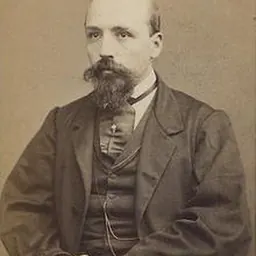
Dr John Lamplugh Kirk
British physician and amateur archaeologist
About Dr John Lamplugh Kirk
Lived 1869 – 1940 (aged 70–71). Dr John Lamplugh Kirk was a British anthropologist, archaeologist and physician.
Dr John Lamplugh Kirk MRCS (30 April 186926 February 1940) was a British medical doctor, amateur archaeologist and founder of York Castle Museum in York, North Yorkshire.
Personal life He was born in Hull in 1869 and practised as a doctor in London before moving to Pickering in 1898. Kirk resided in Houndgate Hall, Pickering from 1910 to 1938. Kirk spent some time painting natural and landscape scenes, such as his 1891 'Stags in the Snow'.
Kirk was intimately involved in Yorkshire Archaeological Society and was a member of the general committee, executive committee and acted as director and honorary treasurer.
Professional life Archaeologist In February 1911 Kirk collaborated with Oxley Grabham (Keeper of the Yorkshire Museum) in the excavation of a Bronze Age Tumulus near Pickering and of an Iron Age chariot burial at Pexton Moor. Kirk excavated the fort of Virosidum at Bainbridge, North Yorkshire in 1925-26 with R. G. Collingwood. He excavated part of the Roman camp at Malton in 1927 with Philip Corder. The results of this excavation formed the core of the Roman archaeology collection of the Malton Museum. Kirk undertook excavations on the late Iron Age settlement at Costa Beck near Pickering between 1925 and 1929 - these excavations were published by Mary Kitson Clark in 1931. Kirk and Corder also excavated at the side of Langton Roman Villa, near Malton, In addition to collecting and photographing social history, he would accept 'bygones' in lieu of payment from his medical patients.
Initial plans to house the collection at Pickering Memorial Hall in the 1920s ultimately failed. In 1931 Kirk advertised more widely for expressions of interest from sites who wished to house his collection, receiving responses from sites in Middlesbrough, Wakefield, Batley, Doncaster and York, with the latter eventually being successful. A major attraction of this new museum was the recreation of a late Victorian street, named 'Kirkgate'; this was the first of its kind in Britain.
Kirk and his deputy curator, Violet Rodgers were both recreated by re-enactors on Kirkgate, the reconstructed Victorian street, as part of the Castle Museum's 80th anniversary in 2018.
Awards and fellowships Kirk was a Member of the Royal College of Surgeons and a Fellow of the Society of Antiquaries of London. In 1938 he was elected an honorary member of the Yorkshire Philosophical Society.
Don’t just read it —
keep it.
Full-length biographies made to live with: read them, listen on the way to work, watch them tonight.
- E-book
- Audio
- Video
Instant download · yours to keep · every purchase keeps this site free
Important facts
People in Dr John Lamplugh Kirk's life
Named in this biography and alive at the same time



Related people
Same field, nearest in time




Contemporaries
People whose lives overlapped Dr John Lamplugh Kirk's



Frequently asked questions
Who was Dr John Lamplugh Kirk?
British physician and amateur archaeologist (1869–1940)
When was Dr John Lamplugh Kirk born?
Dr John Lamplugh Kirk was born in 1869 in Kingston upon Hull.
When did Dr John Lamplugh Kirk die?
Dr John Lamplugh Kirk died on 26 February 1940.
What was Dr John Lamplugh Kirk's occupation?
Dr John Lamplugh Kirk was an anthropologist, archaeologist and physician.
What nationality was Dr John Lamplugh Kirk?
Dr John Lamplugh Kirk was British.
Sources & further reading
· Wikipedia: Dr John Lamplugh Kirk
· DBpedia: John Kirk (archaeologist)
Cite this page
APA: Biography.guide. (2026). Dr John Lamplugh Kirk. https://biography.guide/dr-john-lamplugh-kirk/
MLA: "Dr John Lamplugh Kirk." Biography.guide, https://biography.guide/dr-john-lamplugh-kirk/.
Chicago: "Dr John Lamplugh Kirk." Biography.guide. https://biography.guide/dr-john-lamplugh-kirk/.
Data last updated: 2026-09-20 · Spot an error? Report a correction.
Page generated 2026-09-27 05:19 UTC