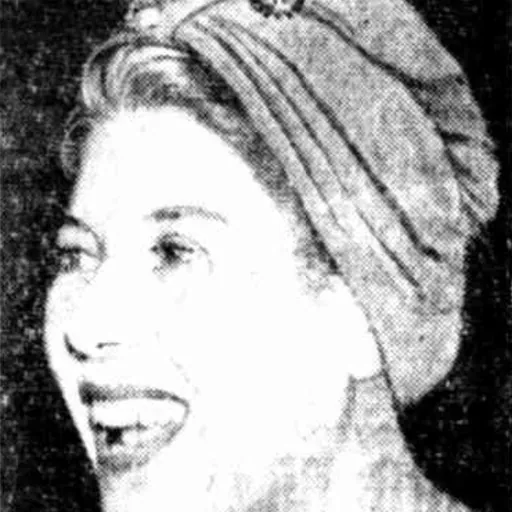
About Dorothy Gordon
Lived 1891 – 1985 (aged 94). Dorothy Gordon was an Australian actor and journalist.
Dorothy Hetty Fosbery Jenner , née Gordon (1 March 1891 – 24 March 1985), also known as Dorothy Gordon, was an Australian actress, journalist, and radio broadcaster. She is best known for her long career as a newspaper columnist and radio commentator under the name Andrea. She was an actress in Hollywood and she played the lead in the Australian silent film Hills of Hate in 1926. She was a prisoner of war in Hong Kong during World War II. Still from the film Hills of Hate. It was Dorothy Gordon's only lead role (1926).
She had two unsuccessful marriages. The first was to Murray Eugene McEwen, whom she said enjoyed other women and alcohol. The second to George Onesiphorus Jenner was also brief. In 1925 she was back in Australia with the last name of Jenner. In 1927, she was in London. She survived a long illness, convalescing in Switzerland, and then took a tour of Europe. In 1935, using Andrea, she gave a series of four talks—one each on New York, Paris, London, and Hollywood—on Sydney radio station 2BL. She filed numerous reports from London for The Sun, during the 1930s, mostly her observations of social events and famous people, but also touching on the developing crisis prior to the outbreak of war.
In 1939 Jenner was visiting Sydney, and she was stranded there during the immediate period prior to the outbreak of the Second World War. She obtained accreditation as a correspondent for the Sun, and went to Singapore. She dispatched generally lighthearted pieces for the newspaper from Asia, during the period prior to Japan's entry into the war.
After a cocktail party given in her honour, she left Sydney again, in October 1941, for a four month stint, intending to visit various Asian cities, as an accredited war correspondent for the Sun. Her subsequent reports focused more upon the Australian military personnel and nurses, who had been sent to Singapore and the Malayan peninsula.
She was in Hong Kong at the outbreak of war with Japan. In January 1942, she was interned in the Stanley camp, in Hong Kong, by the Japanese. During internment she gained a deep voice after damaging a vocal chord, and also kept a diary written on scraps of paper, which she hid inside the sole of her shoe. Returning to Sydney, in October 1945, she persuaded her employer Associated Newspapers to pay her half wages for her four years of internment and recuperation, but invested the money in an unsuccessful business venture with her nephew, and lost the money. Well-connected to both Sydney society and the show business world, her columns were based on her own activities and opinions on current events, sprinkled with gossip and chit-chat, and much name dropping.
In 1957 and 1958, the first two whole years of television in Australia, she was a celebrity participant on the game show, 'Find the Link ', on ABC Television.
About to be retired from the Daily Mirror—she reportedly later referred to the newspaper's new owner, Rupert Murdoch, as 'a rude young man' After she moved to 2GB, in 1963, she broadcast alongside John Pearce, and soon became labelled 'Queen of Radio'. This period was the peak of her radio career; her program was the most-listened in its time slot. However, the end of the pairing with Pearce resulted in a shattering of the previously warm relationship between the two. She never spoke to Pearce again, and he subsequently referred to her as 'The Duchess of Macquarie'. Her program was also broadcast on some stations outside Sydney, including 3AW, in Melbourne and affiliated New South Wales regional stations of the Macquarie Broadcasting Service. Market research revealed that it was her life experiences that "allowed her to transport the session into a world remote from the ordinary housewife". Her co-writer was Trish Sheppard, although it is known that at least four others were approached to be the co-author at various times, including Russell Braddon and John Pearce. in Potts Point, surrounded by photographs and momentos of people whom she had met over her long career. She was associated with the Wayside Chapel, at Kings Cross, which she officially opened in 1964.
In 1976, she was involved in a motor vehicle accident. She was shocked but uninjured, but the accident—at the northern end of the Iron Cove Bridge—did take the life of a motorcyclist. At the time of the accident, just after 11 p.m., she was returning from the Channel 7 television studio, where she said that she had been working on a 'new programme'.
She was still a newsworthy public identity, until her ninetieth year, when she stated that, "Age bores me stiff. I don't feel old and I don't think I look it. Inside I'm the same as I ever was". Her funeral service, at St Stephen's church, in Macquarie Street, was conducted by Wayside Chapel founder Rev. Ted Noffs. Two photographic portraits, by Melbourne Spurr (1888 – 1964), dating from her time in Hollywood in the early 1920s, are in the collection of the National Portrait Gallery of Australia, and a painted portrait, from 1952, by her friend Judy Cassab, is held by the State Library of New South Wales. Andrea Place, in the Canberra suburb of Bonython, is named in her honour.
Partial filmography The Chorus Girl's Romance (1920) First Love (1921) Hills of Hate (1926) For the Term of his Natural Life (1927) - art direction
Don’t just read it —
keep it.
Full-length biographies made to live with: read them, listen on the way to work, watch them tonight.
- E-book
- Audio
- Video
Instant download · yours to keep · every purchase keeps this site free
Important facts
People in Dorothy Gordon's life
Named in this biography and alive at the same time





Related people
Same field, nearest in time
Contemporaries
People whose lives overlapped Dorothy Gordon's


Frequently asked questions
Who was Dorothy Gordon?
Australian actress and journalist (1891–1985)
When was Dorothy Gordon born?
Dorothy Gordon was born on 1 March 1891 in Sydney.
When did Dorothy Gordon die?
Dorothy Gordon died on 24 March 1985 in Potts Point.
What was Dorothy Gordon's occupation?
Dorothy Gordon was an actor and journalist.
What nationality was Dorothy Gordon?
Dorothy Gordon was Australian.
Sources & further reading
· DBpedia: Dorothy Gordon (Australian actress)
Cite this page
APA: Biography.guide. (2026). Dorothy Gordon. https://biography.guide/dorothy-gordon-actor-1891/
MLA: "Dorothy Gordon." Biography.guide, https://biography.guide/dorothy-gordon-actor-1891/.
Chicago: "Dorothy Gordon." Biography.guide. https://biography.guide/dorothy-gordon-actor-1891/.
Data last updated: 2026-09-23 · Spot an error? Report a correction.
Portrait: Wikimedia Commons · author & licence
Page generated 2026-09-27 05:06 UTC