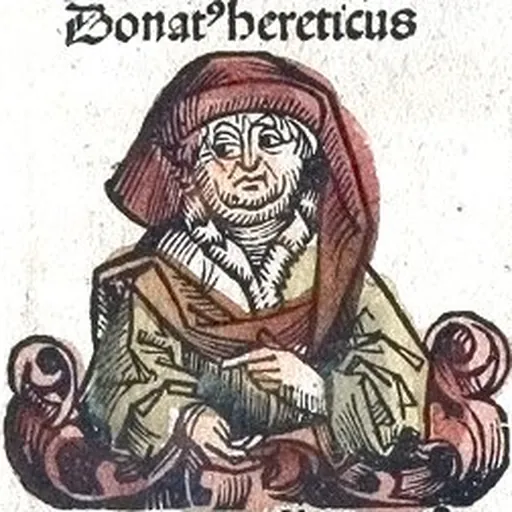
About Donatus Magnus
Lived 250 – 355 (aged 104–105). Donatus Magnus was a Roman presbyter.
Donatus Magnus, also known as Donatus of Carthage, was a prophetic and charismatic leader who emerged in the early fourth century as the founder of the Donatist movement, a Christian sect that arose in North Africa as a result of the Diocletianic Persecution.
Life Donatus was born in Theveste around the year 270 into an ancient Christian family reputedly evangelized by the Apostle Simeon the Zealot during his mission to Carthage and Africa. He later appears in Church records as Donatus of Casae Nigrae in October 313, when the Roman bishop accused him of re-baptizing clergy who had lapsed and of fomenting a schism within the Church. Casae Nigrae was a settlement situated on the far southern edge of the Numidian plains, south of Theveste.
The Schism During the wave of Christian persecutions under the Roman Emperor Diocletian, Roman authorities demanded that Christians surrender their sacred scriptures, intending to revise them to depict Jesus in a manner more sympathetic to Roman authority. To escape torture, exile, or execution, many Christians of Roman origin complied, handing over their scriptures, liturgical texts, and other ecclesiastical possessions to the imperial officials. These individuals came to be known as traditores.
The schism between the two Christian factions revolved primarily around the status of traditor clergy. The Libyco-Punic party argued that those who had surrendered sacred texts under persecution had forfeited their spiritual authority and could not be reinstated without undergoing re-baptism and re-ordination. They maintained that sacraments administered by traditores were invalid and viewed scriptures written in Latin and Greek as potentially corrupted, favoring texts preserved in their own native tongue unblemished by the hand of Roman scribes. In contrast, the Greco-Roman faction held that traditores could be restored to office without the need for re-baptism or re-ordination and accept their canon.
During the Diocletianic Persecution in Carthage, many Christians barricaded themselves inside the church, choosing martyrdom over surrender as they courageously defended sacred property from pagan confiscation. The Romans enlisted a traditor named Mensurius to persuade the Christians of Carthage to submit to imperial authority. Acting on Mensurius’s orders, his servant Caecilian approached the besieged believers with false assurances: that the persecution had ended, that their act of defiance would be pardoned, and that Church property would remain untouched if they peacefully departed. Trusting his promises, the Christians emerged from the church, only to be ambushed by Roman soldiers lying in wait. Many were captured and crucified before the gates of Carthage. As a reward for his betrayal, the Romans appointed Mensurius as Bishop of Carthage.
Following the death of Mensurius of Carthage in 311, Caecilian was appointed his successor by the Roman authorities. He was consecrated as Bishop of Carthage and Primate of Africa by Felix of Aptungi, himself a known traditor. In response, Secundus of Tigisis, the legitimate Primate of Numidia, convened a council of seventy bishops at Cirta, which declared Caecilian’s ordination invalid on the grounds that it had been performed by a traditor. Caecilian, who already occupied the basilica, refused to attend the council in person but sent word that, should his consecration be deemed invalid, he was willing to be re-consecrated. In Carthage, it was widely known that Caecilian had been the preferred candidate of the Roman occupiers and that both he and Felix of Aptungi had previously surrendered the Sacred Scriptures.
The council responded by consecrating Majorinus as Bishop of Carthage. This marked the beginning of a deep ecclesiastical divide, as many cities across North Africa soon found themselves with two rival bishops, one aligned with the Roman-backed Caecilian, and the other loyal to Majorinus. After the early death of Majorinus, Donatus was elected to succeed him. as well as three leading bishops from Gaul: Reticius of Autun, Maternus of Cologne, and Marinus of Arles. The proceedings were poorly managed, as Miltiades ruled in favor of Caecilian by default, disregarding testimonies and written evidence that implicated him. This blatant partiality enraged many Christians who supported Donatus' position, who walked out in protest. The council concluded abruptly, with the Bishop of Rome affirming Caecilian’s position as Bishop of Carthage and condemning Donatus’s doctrine of re-baptism for bishops and priests.
Among these, the Agonistici, also known as Circumcellions by outsiders, were zealous Donatists of Punic descent, who were fiercely committed to liberating the Punic people from Roman domination and establishing a Donatist state. They conducted raids against Roman settlers in the interior regions of Carthaginian territory. Their militant attitude and growing successes against Roman authority propelled them to a leadership role within the Donatist movement, prompting outsiders to equate the entire Donatist Church with their violent actions and respond with severe reprisals.
Don’t just read it —
keep it.
Full-length biographies made to live with: read them, listen on the way to work, watch them tonight.
- E-book
- Audio
- Video
Instant download · yours to keep · every purchase keeps this site free
Important facts
People in Donatus Magnus's life
Named in this biography and alive at the same time

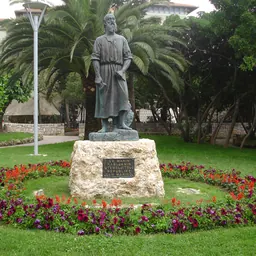

Related people
Same field, nearest in time




Contemporaries
People whose lives overlapped Donatus Magnus's


Frequently asked questions
Who was Donatus Magnus?
founder of Donatism
When was Donatus Magnus born?
Donatus Magnus was born in 250.
When did Donatus Magnus die?
Donatus Magnus died in 355.
What was Donatus Magnus's occupation?
Donatus Magnus was a presbyter.
What nationality was Donatus Magnus?
Donatus Magnus was Roman.
Sources & further reading
Cite this page
APA: Biography.guide. (2026). Donatus Magnus. https://biography.guide/donatus-magnus/
MLA: "Donatus Magnus." Biography.guide, https://biography.guide/donatus-magnus/.
Chicago: "Donatus Magnus." Biography.guide. https://biography.guide/donatus-magnus/.
Data last updated: 2026-09-23 · Spot an error? Report a correction.
Portrait: Wikimedia Commons · author & licence
Page generated 2026-09-27 05:06 UTC