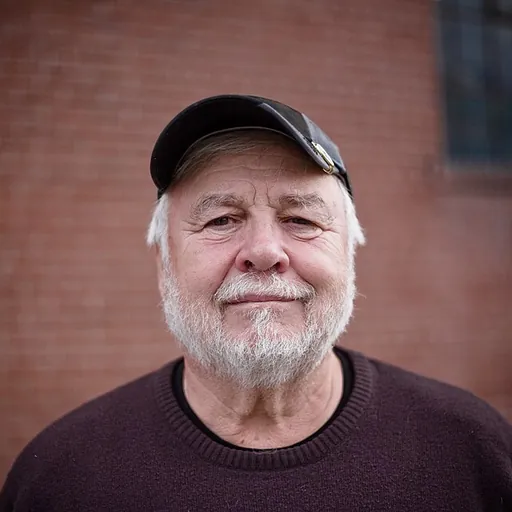
About Donald Shebib
Lived 1938 – 2023 (aged 85). Donald Shebib was a Canadian film director, screenwriter, cinematographer, film producer and director.
Donald Everett Shebib (27 January 1938 – 5 November 2023) was a Canadian film and television director. Shebib was a central figure in the development of English Canadian cinema who made several short documentaries for the National Film Board of Canada and CBC Television in the 1960s before turning to feature films, beginning with the influential Goin' Down the Road and what many call his masterpiece, Between Friends (1973). He soon became frustrated by the bureaucratic process of film funding in Canada and chronic problems with distribution as well as a string of box office disappointments. After Heartaches (1981), he made fewer films for theatrical release and worked more in television.
Shebib was Noah "40" Shebib's father.
Early life Shebib was born in Toronto, Ontario, the son of Mary Alice Long, a Newfoundlander of Irish descent, and Moses "Morris" Shebib, born in Sydney, Nova Scotia, in 1910, himself the son of Lebanese immigrants. In a 2011 interview with Andrea Nemetz in the Halifax Chronicle Herald, Shebib said: "I was aware of migratory experiences – like the Okies in California in the dust bowl. I had a cousin who came to stay with us in Toronto in the late 1950s and he tried to make a go of it and couldn't and went back to the Maritimes."
Education Shebib played semi-pro football as a young man, and studied sociology and history at the University of Toronto. While very interested in sociological patterns from history, he did not enjoy reading enough to pursue this interest further academically, but was still looking for something to do that would appeal to his "jock and artist impulses". notably as a cinematographer and assistant editor on Dementia 13 (1962), his classmate Francis Ford Coppola's first film, and The Terror (1963). He also made his earliest short films.
Career Over the next five years, Shebib found his way into the Canadian film industry and quickly established himself, reflecting on his decision to return in 1970:There's more of a chance here... and it's much easier to get started. There isn't really all that much filmmaking to be done in the States. Educational TV has opened up some opportunities for the documentary, but other than that there is nothing at all. Period. Flat. Nothing exists. Nothing at all. Surfin''' (1964), Satan's Choice (1965), an inside view of the motorcycle club, and Good Times, Bad Times (1969), before turning to feature filmmaking. The low-budget film crew travelled around Toronto in a station wagon, supported by funding from the newly formed Canadian Film Development Corporation. The movie was screened in New York and hailed by Pauline Kael and Roger Ebert. Kael wrote that the movie showed up the ostensibly forced sincerity and perceived honesty of the films of John Cassavetes. It has consistently remained near the top of the list of top 10 films made in Canada in three separate surveys of academics, critics, and film programmers, and was designated a "masterwork" by the Audio-Visual Preservation Trust of Canada. In 1998, a DVD copy was struck from the master negative by the Toronto International Film Festival in conjunction with Telefilm Canada.
Later features and sequel Following the success of Goin' Down the Road, Shebib expressed a preference for making dramatic rather than documentary films going forward, Worse still, the ceremony itself was cancelled and all the promotional planning along with it:In unison, the long promise of the Canadian industry and Don Shebib seemed to be coming to fruition this year: Shebib had made the film which was the confirmation of all his earlier work; there were six strong feature entries in the Canadian Film Awards; the Awards were to be carried on network television; the films were booked to open across the country with full publicity—all firsts. But instead both had their heads bitten off. Today, Don Shebib says he will never again enter a film in the Canadian Film Awards, that he needs a job and would take one in the U.S. in a minute. This is not sour grapes from someone who's inadequate. This is English Canada's best feature filmmaker reacting to the treatment of the best feature film he's ever made. The awards scheduled for the following year were cancelled and did not return until 1975. Shebib did enter his next film, Second Wind (1976) and won the award for Best Editing. Neither it nor Fish Hawk (1979) were commercial successes. He found success once more with Heartaches (1981), described by Wyndham Wise as a variation of Goin' Down the Road with a pair of working-class women. In 2008, he was quoted as saying that Canada was a great place to make a first film, but "a hard place to keep things going."
Nightalk Shebib's son Noah "40" Shebib is the executive producer of his father's last film, Nightalk, which stars Ashley Bryant and Al Mukadam. The film premiered on September 16, 2022, at the Toronto International Film Festival.
Television Shebib earned critical acclaim and a Canadian Film Award for Good Times, Bad Times, made for the CBC in 1969. Another television film, The Fighting Men (1977), was later given a theatrical release.
The director's later television work included By Reason of Insanity (1982), Slim Obsession (1984) both made for the CBC series For the Record and sold to overseas markets, and the television movies The Climb (1986), The Little Kidnappers (1990) and The Pathfinder (1996).
Shebib watched Turner Classic Movies "religiously", and after John Ford, his favourite directors were Frank Capra, William Wellman, Howard Hawks, Marcel Carné, David Lean ("especially his early stuff") and F.W. Murnau ("Sunrise is one of my favorite films"):These films made from 1930 to 1934, the Pre-Code films, are among the best Hollywood films ever made. People always think 1939 was the sort of glory year of American film. Actually I'd say it was 1933. The films made before the code were infinitely superior. Shebib believed in the John Ford style of cinematic storytelling.
Recurring themes and socio-political views The director's own youth as an "outsider" is particularly reflected in the early short films: "every one of Shebib's two dozen films has studied the shades of yet another caste of society's disbarred... who never quite make it to their place in the sun."
In the mid-1970s, Peter Harcourt remarked on the frequent moments of silence denoting introspection in Shebib's films, both in the early documentaries and in the feature films, a "feeling of emptiness, of restlessness, often of irrelevance". Shebib places great value on "male comradeship" and "the need of real challenges to give individuals a sense of their dignity". Sandra Gathercole found it impossible to overstate his significance as "one of the few English Canadian filmmakers whose work illustrates what is meant by indigenous, rather than derivative, Canadian films – films with a character, integrity and identity that are the backbone of any hope we have for an autonomous Canadian industry." and as of the Toronto International Film Festival's most recent poll of greatest Canadian films, is ranked 6th. It had done more than any other work to advance the Canadian film industry at the time of its release. Within a few years, Shebib's body of work had made him a "unique and recognizable film presence" in Canada and beyond, "verging on international stature."
Sam Weisberg opines that, with the exception of Between Friends (1973), none of Shebib's feature films made after Goin' Down the Road have quite the same resonance.
In 2017, Shebib was presented with a Directors Guild of Canada Lifetime Achievement Award.
Legacy Don Shebib Collection In 1999, the TIFF Reference Library in Toronto received "records created by Shebib and his collaborators," consisting of "script drafts and occasional production records" ranging in production date from "circa 1969 to 1994."
Personal life Pastimes Shebib surfed while he lived in Los Angeles,
In 2011, Shebib said of his hobbies and sporting life that he was "a very serious, obsessive person. If it isn't golf it's football or it's stamp collecting. And I was a serious airplane model maker." Tedde Moore is known for her role as Miss Shields in A Christmas Story and she was pregnant with their son Noah during filming. They no longer lived together, though Moore called him her "life partner."
Their two children Noah and Suzanna are both involved in the performing arts: Suzanna began her career an actress, while Noah, better known as OVO Sound's "40", is an actor and music producer (the siblings have an older half-sister, Zoe).
Friendships and connections Shebib met his lifelong friend Carroll Ballard, with whom he often collaborated, while attending classes at UCLA. He was close friends with and dated dancer and columnist Zella Wolofsky who provided guidance on the beginning and ending of Nightalk. She and his son Noah shared Don's primary caregiving during his final weeks alive.
Death Donald Shebib died on 5 November 2023, at the age of 85.
Selected accolades
Canadian Film Awards Best Feature Length Documentary, Good Times, Bad Times (1969) 1961 The Train (13 min., 16mm) 1968 San Francisco Summer 1967 (59 min., 16mm); Unknown Soldier (7 min., 16mm); Stanfield (20 min., 16mm); Graduation Day (7 min., 16mm) 1972 CBC, Telescope: Born Hustler (25 min., 16mm) 1988 theatrical release: Men of Steel, 91 min., 35mm) 1985–1986 The Edison Twins (CBC): 4 episodes 1987 Danger Bay (CBC): "All the King's Horses", "S.S. Friendship" Diamonds Night Heat: "Bad Timing" "Vantage Point", "The Mercenary" Sea Hunt: 5 episodes T. and T. 1987–1988: Katts and Dog 1988–1990: The Campbells: "Ancient Wounds", "The Miller's Son", "The Reluctant Candidate", "Fortunes of War", "The Sky Is the Limit" My Secret Identity: "The Lost Weekend", "Look Before You Leap", "When the Sun Goes Down", "White Lies", "Seems Like Only Yesterday" 1990–1992 E.N.G.: "All Things Betray Thee", "Lest You Be Judged", "Harvest" 1991 Street Justice (CBC): "Shadows" 1990–1993: Counterstrike: "Verathion", "Masks", "Clearcut" 1994–1995 Lonesome Dove: The Series: "Law and Order", "Blood Money", "Rebellion" 1997–1999 Wind at My Back: "Triple Trouble", "New Directions", "Grace of Hollywood" 1998 Police Academy: The Series: "Mr. I.Q.", "The Truth Ain't What It Used to Be", "Luke...Warm" 1998 The New Addams Family: "Cousin Itt Visits the Addams Family", "Thing Is Missing" 2000 Code Name: Eternity: "Dark of Night" 2001–2002 Caitlin's Way: "Duh Truth, Uh-Huh" 2000–2002 The Zack Files: "Captain Sonic", "Things to Do at Horace Hyde White When You're Dead", "Zack Greenburg's Day Off" 2003 Radio Free Roscoe Further reading Monographs Handling, Piers. The Films of Don Shebib. Canadian Film Institute, 1978 (Canadian film series ; 2). Pevere, Geoff. Donald Shebib's 'Goin' Down the Road'. University of Toronto Press, 2012 (Canadian cinema ; 8). Essay Harcourt, Peter. "Men of vision: Donald Shebib." Cinema Canada 32 (November 1976): 35–40.
Don’t just read it —
keep it.
Full-length biographies made to live with: read them, listen on the way to work, watch them tonight.
- E-book
- Audio
- Video
Instant download · yours to keep · every purchase keeps this site free
Important facts
Family & relationships
People in Donald Shebib's life
Named in this biography and alive at the same time




Related people
Same field, nearest in time



Contemporaries
People whose lives overlapped Donald Shebib's



Frequently asked questions
Who was Donald Shebib?
Canadian film director (1938–2023)
When was Donald Shebib born?
Donald Shebib was born on 17 January 1938 in Toronto.
When did Donald Shebib die?
Donald Shebib died on 5 November 2023 in Toronto.
What was Donald Shebib's occupation?
Donald Shebib was a film director, screenwriter, cinematographer, film producer and director.
What nationality was Donald Shebib?
Donald Shebib was Canadian.
Sources & further reading
Cite this page
APA: Biography.guide. (2026). Donald Shebib. https://biography.guide/donald-shebib/
MLA: "Donald Shebib." Biography.guide, https://biography.guide/donald-shebib/.
Chicago: "Donald Shebib." Biography.guide. https://biography.guide/donald-shebib/.
Data last updated: 2026-09-23 · Spot an error? Report a correction.
Portrait: Wikimedia Commons · author & licence
Page generated 2026-09-27 05:06 UTC