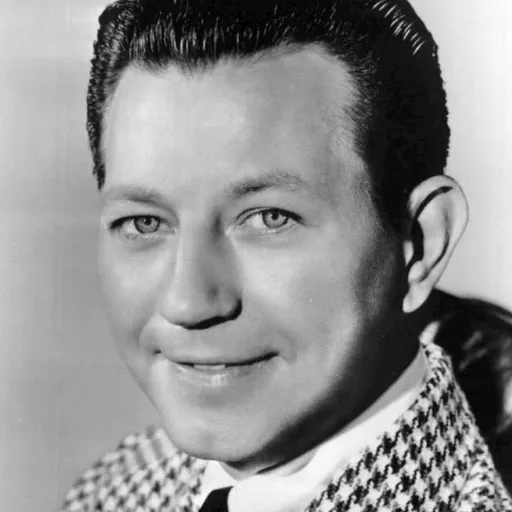
About Donald O'Connor
Lived 1925 – 2003 (aged 78). Donald O'Connor was an American film actor, singer, stage actor, television actor, showman and television presenter.
Donald David Dixon Ronald O'Connor (August 28, 1925 – September 27, 2003) was an American dancer, singer and actor. He came to fame in a series of films in which he co-starred, in succession, with Gloria Jean, Peggy Ryan, and Francis the Talking Mule.
O'Connor was born into a vaudeville family, where he learned to dance, sing, play comedy, and perform slapstick. The most distinctive characteristic of his dancing style was its athleticism, for which he had few rivals. Yet it was his boyish charm that audiences found most engaging, and which remained an appealing aspect of his personality throughout his career. In his Universal musicals of the early 1940s, O'Connor was a wisecracking, fast-talking teenager, much like Mickey Rooney of Metro-Goldwyn-Mayer (MGM). But by 1952 and Singin' in the Rain, MGM had cultivated a much more sympathetic sidekick persona for him, and that remained O'Connor's signature image.
His best-known work was his "Make 'Em Laugh" dance routine in Singin' in the Rain (1952), for which O'Connor was awarded a Golden Globe. He also won a Primetime Emmy Award from four nominations and received two stars on the Hollywood Walk of Fame.
Early years O'Connor was born on August 28, 1925 in Chicago to Vaudevillians Edward "Chuck" O'Connor and Effie Irene (née Crane), the 200th child born at St. Elizabeth Hospital there. Both the O'Connors struggled to remember where and when exactly Donald was born, due to the family's extensive travel. Effie was a bareback rider and Chuck was a circus strongman and acrobat. His father's family was from Ireland.
When O'Connor was only two years old, he and his seven-year-old sister, Arlene, were hit by a car while crossing the street outside a theater in Hartford, Connecticut; Donald survived, but his sister died. A few weeks later, his father died of a heart attack while dancing on stage in Brockton, Massachusetts.
O'Connor's mother was extremely possessive of her youngest son due to these traumas, not allowing him to cross the street on his own until he turned 13. Effie also stopped O'Connor from learning hazardous dance routines, and made sure she always knew where he was when he was not performing.
Career O'Connor Family O'Connor joined a dance act with his mother and elder brother Jack. They were billed as the O'Connor Family, the Royal Family of Vaudeville. They toured the country doing singing, dancing, comedy, and acting. "Our entire family composed an act," he says. "We really didn't have a choice; if you were in the family you appeared in the act. I loved vaudeville. The live audiences created a certain spontaneity." but performed in the Danville High School dramatic club with Dick Van Dyke and Bobby Short.
He later said, "I learned two dance routines. I looked like the world's greatest dancer. I did triple wings and everything. But I had never had any formal training. So, when I went into movies and started working with all those great dancers, I had a terrible time. I couldn't pick up routines because I didn't have any formal training. At the age of 15 — from 15 on, I really had to learn to dance. And that's quite old for someone to start dancing real heavy, professionally."
He was in Sons of the Legion (1938), then had the second lead in a B-picture, Tom Sawyer, Detective (1938), playing Huckleberry Finn opposite Billy Cook's Tom Sawyer. O'Connor third billed in both Boy Trouble (1939) and Unmarried (1939), playing John Hartley as a young boy in the latter.
O'Connor was billed fourth in Million Dollar Legs (1939) with Betty Grable. He played Gary Cooper as a young boy in Beau Geste (1939), directed by Wellman.
Night Work (1939) was a sequel to Boy Trouble and O'Connor was in Death of a Champion (1939). The film was popular and Universal began to develop O'Connor and Ryan as their version of Mickey Rooney and Judy Garland.
He, Ryan, and the Andrews Sisters were in Private Buckaroo (1942) and Give Out, Sisters (1942); then he was co-starred opposite Jean in four films: Get Hep to Love (1942), When Johnny Comes Marching Home (1943), It Comes Up Love (1943), and School for Jive, which showed O'Connor to such good advantage that he became the focal point of the film, retitled Mister Big (1943). Universal added $50,000 to the budget and elevated the "B" movie to "A" status. and kept him busy in musical comedies: Are You with It? (1948) with Olga San Juan, Feudin', Fussin' and A-Fightin' (1949) with Marjorie Main and Percy Kilbride, and Yes Sir, That's My Baby (1949) with Gloria DeHaven.
"I wasn't really a dancer, a good dancer, until I got older," he said later. "I could do those wings and stuff and I looked very good, but my heavens, it was very, very hard for me to pick up on — pick up steps. It was just oh — so laborious for me. I didn't have a short cut like the other dancers do."
O'Connor followed the first Francis with comedies: Curtain Call at Cactus Creek (1950), The Milkman (1950), and Double Crossbones (1951).
He did Francis Goes to the Races (1951), another big hit. In February 1951 he signed a new contract with Universal for one film a year for four years, enabling him to work outside the studio.
Singin' in the Rain In January 1952, O'Connor signed a three-picture deal with Paramount. He also received an offer to play Cosmo the piano player in Singin' in the Rain (1952) at Metro-Goldwyn-Mayer
That film featured his widely known rendition of "Make 'Em Laugh," which he choreographed with help from the assistant dance directors and his brother. The number featured dozens of jumps, pratfalls, and two backflips launched by running halfway up a wall.
"The scene was building to such a crescendo, I thought I'd actually have to kill myself," said O'Connor.
He acted alongside Gene Kelly, and earned the 1953 Golden Globe Award for Best Performance by an Actor in a Comedy or Musical.
O'Connor went back to Universal for Francis Goes to West Point (1952) then returned to MGM for I Love Melvin (1953) a musical with Debbie Reynolds.
He began appearing regularly on television. One review in 1952 called him "1952's new star. Movie bred, he has the versatility of a Jimmy Durante and the effervescence of youth. He can dance, he can sing, he can act, and he can spout humor, but not yet with the finesse of a veteran."
He supported Ethel Merman in Call Me Madam (1953) at 20th Century Fox, later saying the film contained his best dancing. He co-starred in another Fox musical, There's No Business Like Show Business (1954), which featured Irving Berlin's music and also starred with Ethel Merman, Marilyn Monroe (O'Connor's on screen love interest), Dan Dailey, Mitzi Gaynor, and Johnnie Ray.
After Francis Covers the Big Town (1953), Universal put O'Connor in a musical in color, Walking My Baby Back Home (1953) with Janet Leigh.
O'Connor's industry and public recognition reached a peak in 1954, when he was asked to emcee that year's Academy Awards ceremony.
He received excellent notices for Francis Joins the WACS (1954) and was scheduled to play Bing Crosby's partner in White Christmas (1954). O'Connor was forced to withdraw because he contracted an illness transmitted by the mule and was replaced in the film by Danny Kaye.
O'Connor, resentful of how the Francis series had interfered with his musical career, reluctantly agreed to star in Francis in the Navy (1955). Arthur Lubin, who directed the series, later recalled that O'Connor "got very difficult" to work with: "He'd sit in his dressing room and stare into space, and I think he had problems at home."
Universal did not renew O'Connor's contract after 13 years with the company. At a farewell luncheon, the studio executives presented him with a gift: a camera and 14 rolls of film. O'Connor was stunned at the insignificance of the gift after all the millions of dollars he had made for the studio, and in later life recalled, "What can I say about these people?"
O'Connor and Bing Crosby united on Anything Goes (1956) at Paramount. That studio also released The Buster Keaton Story (1957), in which O'Connor had the title role.
The Brussels Symphony Orchestra recorded some of his work, and in 1956 he conducted the Los Angeles Philharmonic in a performance of his first symphony, "Reflections d'Un Comique."
Television O'Connor was a regular host of NBC's Colgate Comedy Hour,
1960s O'Connor teamed with Glenn Ford in Cry for Happy (1961) at Columbia and he played the title role in The Wonders of Aladdin (1961) for MGM.
He subsequently focused on theatre work and his nightclub act, performing in Las Vegas. He returned to Universal for the first time in ten years to make the Sandra Dee comedy That Funny Feeling (1965).
He did episodes of Bob Hope Presents the Chrysler Theatre, Vacation Playhouse, ABC Stage 67 and The Jackie Gleason Show. He also appeared in several productions of Little Me.
In 1968, O'Connor hosted a syndicated talk show also called The Donald O'Connor Show. The program was canceled because the dancer was becoming "too political," and O'Connor was reprimanded by the studio.
He was among the first to receive a star on the Hollywood Walk of Fame in 1960.
1970s He began to use nitroglycerin pills before performances so that he would have the stamina to complete them. He then suffered a heart attack in 1971, leading him to quit taking the medication.
He was in a TV production of Li'l Abner (1971) and continued to perform on stage, notably in Las Vegas.
He guest-starred on episodes of The Girl with Something Extra, Ellery Queen, The Bionic Woman, Police Story, and Hunter.
O'Connor claimed to have overcome his depression after being hospitalized for three months after collapsing in 1978.
He was Cap'n Andy in a short-lived Broadway revival of Show Boat (1983) and continued to tour in various shows and acts.
"I've been on the road forever," he said in 1985, adding "I'd consider another movie or a TV series, but I won't play an old man. Art Carney is about my age and he's making a career out of being old. I'm still singing and dancing. I'm not ready to be old."
O'Connor guest starred on The Littlest Hobo, Fantasy Island, Simon & Simon, Hotel, Alice in Wonderland, The Love Boat, and Highway to Heaven, and was in the films Pandemonium (1982), A Mouse, a Mystery and Me (1988), and A Time to Remember (1988).
He bought a theatre, the Donald O'Connor Theatre, and would perform in it with his children. In a 1989 interview he said "There's an element out there that wants to be entertained-and they can't find this kind of thing I do. And yeah, I think I wear well. I sing, I dance, I do comedy. I'm not threatening. When you grow up in a circus family, the more things you learn, the more you get paid. So I can do straight comedy without the song and dance; I can do all kinds of combinations. Whatever's in at the time, I can fit into."
He developed heart trouble and underwent successful quadruple-bypass surgery in 1990.
1990s O'Connor continued to make film and television appearances into the 1990s, including the Robin Williams film Toys (1992) as the president of a toy-making company. He continued to perform live.
He had guest roles in Murder, She Wrote, Tales from the Crypt, The Building, The Nanny and Frasier, and was in the films Bandit: Bandit's Silver Angel (1994), and Father Frost (1996).
In 1992, he said, "I never wanted to be a superstar. I'm working on being a quasar, because stars wear out. Quasars go on forever... I look for the parts where I die and they talk about me for the rest of the movie."
O'Connor's last feature film was the Jack Lemmon-Walter Matthau comedy Out to Sea, in which he played a dance host on a cruise ship. O'Connor was still making public appearances well into 2003. He said he went on the road "about 32 weeks a year. I do my concert work and I do night clubs and that kind of stuff. So I don't dance much any more, but I do enough to show people I can still move my legs." Together they had one child, a daughter Donna. The couple divorced in 1954.
He was married to Gloria Noble from October 11, 1956 until his death. They had three children: Alicia, Fred, and Kevin. They were married for 47 years and lived in Thousand Oaks, California. Gloria died on June 11, 2013, of natural causes.
O'Connor had undergone quadruple heart bypass surgery in 1990, and he nearly died from pleural pneumonia in January 1999. He died from complications of heart failure on September 27, 2003, at age 78 at the Motion Picture & Television Country House and Hospital, in Woodland Hills, California.
Filmography Film
Television
Stage Little Me (1964; 1965; 1968; 1980) Promises, Promises (1972) Where's Charley? (1976) Weekend with Feathers (1976) Sugar (1979) Wally's Cafe (1980) Bring Back Birdie (1981) Say Hello to Harvey (1981) Show Boat (1982; 1983) I Ought to Be in Pictures (1982) How to Succeed in Business Without Really Trying (1985) Two for the Show (1989) Charley's Aunt (1989) The Sunshine Boys (1990) The Fabulous Palm Springs Follies (1998)
Don’t just read it —
keep it.
Full-length biographies made to live with: read them, listen on the way to work, watch them tonight.
- E-book
- Audio
- Video
Instant download · yours to keep · every purchase keeps this site free
Important facts
People in Donald O'Connor's life
Named in this biography and alive at the same time


Related people
Same field, nearest in time



Contemporaries
People whose lives overlapped Donald O'Connor's



Frequently asked questions
Who was Donald O'Connor?
American dancer, singer, and actor (1925-2003)
When was Donald O'Connor born?
Donald O'Connor was born on 28 August 1925 in Chicago.
When did Donald O'Connor die?
Donald O'Connor died on 27 September 2003 in Calabasas.
What was Donald O'Connor's occupation?
Donald O'Connor was a film actor, singer, stage actor, television actor, showman and television presenter.
What nationality was Donald O'Connor?
Donald O'Connor was American.
Sources & further reading
Cite this page
APA: Biography.guide. (2026). Donald O'Connor. https://biography.guide/donald-o-connor/
MLA: "Donald O'Connor." Biography.guide, https://biography.guide/donald-o-connor/.
Chicago: "Donald O'Connor." Biography.guide. https://biography.guide/donald-o-connor/.
Data last updated: 2026-09-24 · Spot an error? Report a correction.
Portrait: Wikimedia Commons · author & licence
Page generated 2026-09-27 05:09 UTC