About Dombipa
Dombipa was a mahasiddha and poet.
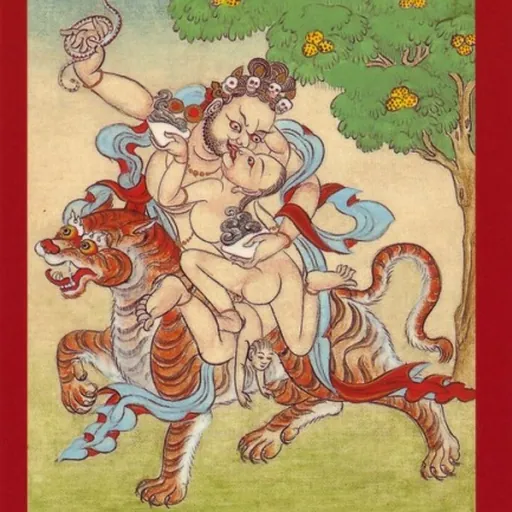
Dombi Heruka (8th-9th century CE, Sanskrit: , ), also known as Dombipa (Sanskrit: , ) and by his epithet Tiger-Rider, is one of the eighty-four mahasiddhas ('great adept') venerated in Vajrayana Buddhism. In paintings and sculptures, he is depicted seated on a tiger, with a snake in his hand, sometimes in union with his consort.
Dombi Heruka is described as king of Magadha or Tripura; or at least a Brahmin son of a local chieftain. His legends and name emphasize his relationship with an outcaste spiritual consort, which was taboo. He is associated with Tantric rituals related to the deity Hevajra. A few works including Shri-sahaja-siddhi are attributed to Dombi Heruka.
Various lama lineages like the Gelugpa Longdol Lama, Trungpa tulkus and Tai Situpa lamas claim to be incarnations of Dombi Heruka.
Names and dating Dombi Heruka is an amalgamation of two terms - dombi and heruka. Dombi refers to an "untouchable" nomadic artist caste, to which the mahasiddha's spiritual consort belonged. Heruka refers to the deity Samvara or the mahasiddha's chosen deity Hevajra. It also refers to siddhas, who embody the god's attributes. His legend says that Dombi Heruka becomes Hevajra, which may also explain his name.
His other name, Dombipa, means "he who relates with the lower caste" As per Trungpa legend, Dombi Heruka once threw his skull cap in the air from India and decreed that he would reincarnate when the cup fell. It fell at Surmang in Tibet, where the Surmang monastery – the seat of the Trungpa tulkas –- was founded. The mahasiddhas are depicted iconographically in three types: a layman, a monk and a siddha (heruka). Dombi Heruka's iconography mirrors that of a heruka, who are depicted wearing bone ornaments and in unique "contrived and contorted postures".
In paintings, Dombi Heruka is depicted riding a tiger, embracing his consort. Both of them may be depicted naked. Sometimes, Dombi Heruka may wear a loincloth. Both of them wear a crown adorned with skulls, bone or gold ornaments and jewelled earrings. In his raised right hand, he holds poisonous snake as a whip. The hood of the snake is visible. His left arm may hold the consort; he may hold a skull cup filled with elixir. Alternately, his hand may show a fierce mudra (gesture). The consort holds a filled skull cup in her left hand. A corpse may be depicted on her thigh. The couple astride the tiger may be depicted in the forest or leaving the forest and triumphantly entering the capital. In the latter scene, Dombi Heruka's subjects may be seen bowing before him and making offering of food. In sculpture and paintings, the mahasiddha may be depicted alone on the tiger, without a consort.
Don’t just read it —
keep it.
Full-length biographies made to live with: read them, listen on the way to work, watch them tonight.
- E-book
- Audio
- Video
Instant download · yours to keep · every purchase keeps this site free
Important facts
Related people
Same field, nearest in time
Frequently asked questions
Who was Dombipa?
author of Charyapada
What was Dombipa's occupation?
Dombipa was a mahasiddha and poet.
Sources & further reading
Cite this page
APA: Biography.guide. (2026). Dombipa. https://biography.guide/dombipa/
MLA: "Dombipa." Biography.guide, https://biography.guide/dombipa/.
Chicago: "Dombipa." Biography.guide. https://biography.guide/dombipa/.
Data last updated: 2026-09-23 · Spot an error? Report a correction.
Portrait: Wikimedia Commons · author & licence
Page generated 2026-09-27 05:06 UTC