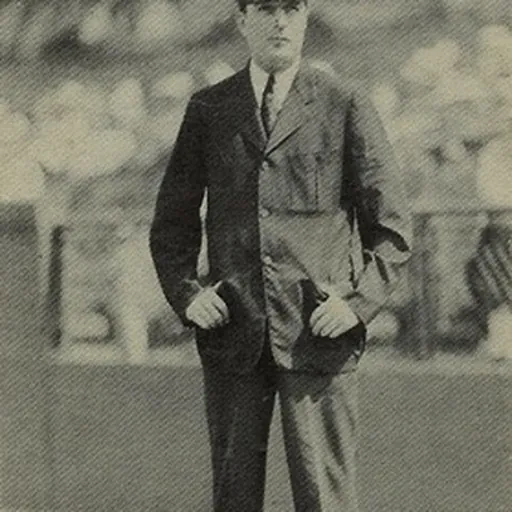
Dolly Stark
American baseball umpire
About Dolly Stark
Lived 1897 – 1968 (aged 70). Dolly Stark was an American baseball umpire.
Albert D. "Dolly" Stark (November 4, 1897 – August 24, 1968) was an American umpire in Major League Baseball who worked in the National League from 1928 to 1935 and from 1937 to 1940. Stark was the first Jewish umpire in modern baseball.
Early life Stark was born to a working-class Jewish family in Manhattan's Lower East Side. He attended tryouts for the New York Yankees and Washington Senators, but failed both, in part due to his weight of only . Stark would continue to umpire. He was umpiring in the Eastern League in 1927 when his performance was noticed and he was promoted to the National League to succeed Hank O'Day. A player favorite, he was voted the most competent umpire by National League players in a 1934 poll sponsored by the Sporting News. In August 1935, league President Ford Frick presented Stark with a new automobile at "Dolly Stark Day" before a New York Giants game at the Polo Grounds. This was the first and only time a "Day" has been held in honor of a Major League Baseball umpire. Stark ultimately spent the year as a radio broadcaster for the Philadelphia Phillies and Philadelphia Athletics.
Outside umpiring In addition to his umpiring career, Stark coached basketball at Dartmouth College from 1923 until 1936, and was also a college umpire and basketball referee. He was coaching Dartmouth at the time that he was appointed a National League umpire. In 1936, he teamed with Bill Dyer to form the Philadelphia Phillies' first radio announcing crew on WCAU.
Stark returned to umpiring in 1937, but ultimately retired in 1940 due to a knee issue. He attempted to find work as a scout, but was largely unsuccessful. (However, Stark was instrumental in getting Saul Rogovin a tryout with the New York Giants in 1944). Stark did find success as a women's clothing designer, starting a line called the "Dolly Stark Dress."
Personal life Stark's personal life included much tragedy; he was forced to spend large sums of money to support his blind mother, and his sister, who was constantly in poor health and ultimately committed suicide. His marriage to Betsy Lee in 1952 ended in divorce after 4 years, and Stark was in poor financial shape in his later life, forcing him to apply for unemployment compensation in 1968.
Stark died of a heart attack in New York City on August 24, 1968.
Don’t just read it —
keep it.
Full-length biographies made to live with: read them, listen on the way to work, watch them tonight.
- E-book
- Audio
- Video
Instant download · yours to keep · every purchase keeps this site free
Important facts
People in Dolly Stark's life
Named in this biography and alive at the same time



Related people
Same field, nearest in time

Contemporaries
People whose lives overlapped Dolly Stark's



Frequently asked questions
Who was Dolly Stark?
American baseball umpire (1897–1968)
When was Dolly Stark born?
Dolly Stark was born on 4 November 1897 in Manhattan.
When did Dolly Stark die?
Dolly Stark died on 24 August 1968 in New York City.
What was Dolly Stark's occupation?
Dolly Stark was a baseball umpire.
What nationality was Dolly Stark?
Dolly Stark was American.
Sources & further reading
· DBpedia: Dolly Stark (umpire)
Cite this page
APA: Biography.guide. (2026). Dolly Stark. https://biography.guide/dolly-stark-baseball-umpire/
MLA: "Dolly Stark." Biography.guide, https://biography.guide/dolly-stark-baseball-umpire/.
Chicago: "Dolly Stark." Biography.guide. https://biography.guide/dolly-stark-baseball-umpire/.
Data last updated: 2026-09-22 · Spot an error? Report a correction.
Portrait: Wikimedia Commons · author & licence
Page generated 2026-09-27 05:02 UTC