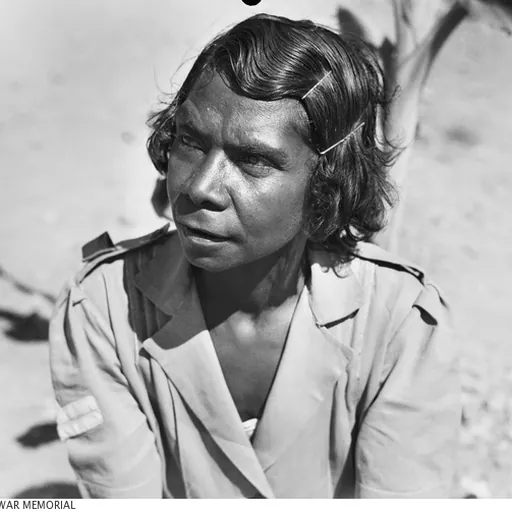
Dolly Gurinyi Batcho
Australian Aboriginal woman
About Dolly Gurinyi Batcho
Lived 1905 – 1973 (aged 67–68).
Dolly Gurinyi Batcho at the 69th Australian Women's Army Service (AWAS) Barracks.
Dolly Gurinya Batcho (c.1905 - 1973) was a Larrakia woman (part of the Danggalaba clan) from Darwin, Northern Territory and she was one of an estimated 6,000 Aboriginal and Torres Strait Islander people who worked in support of the war effort in World War II as a part of the Aboriginal Women's Hygiene Squad, 69th Australian Women's Army Service Barracks at Adelaide River.
After the war Batcho became a passionate advocate for the rights of Aboriginal people and for Land Rights; she was a signatory on the 1972 Larrakia Petition. Adelaide River, NT [Northern Territory]. 4 September 1944. The 69th Australian Women's Army Service Barracks; Dolly pictured in the front row 2nd to the left.
Service in World War II Little is known of Batcho's early life, except that she left the Darwin area, which are her ancestors' lands, to serve the war effort in Adelaide River, which had become the headquarters for Australian and United States Troops, after the initial Bombing of Darwin. This was despite the fact that much of her family, along with 2,000 other women and children, were evacuated to Adelaide, South Australia. In choosing to do so Batcho took a great risk as Adelaide River was a dangerous place to be as it was regularly bombed during the Japanese bombing raids on Darwin. Despite this, reports of the time were often condescending towards Batcho, particularly regarding the way she wore her uniform with the strips on the front and "coy" colour patches on her should strap. This is seen in newspaper coverage in late 1944 when numerous newspapers around Australia reported the following of the Aboriginal women working for the Hygiene Squad:
In 1945 journalist Ernestine Hill wrote about Batcho, who she also named only as "Corporal Dolly" in an article for The Chronicle (Adelaide) in which she spoke about the changing role of women in society during the war. Hill stated that many of the women serving would not put up with things like their mothers did and advised women to "take heart, girls, a new day is dawning". In the same article she also wrote that "high finance is quite beyond feminine intellect".
While at Adelaide River, Batcho experienced homesickness and so, in a hope of making her feel better, they collected a bucket of sand from Mindil Beach, while on a trip there for supplies, to help console her. Batcho was not able to make this visit herself as, because she was an Aboriginal woman, she was not allowed to enter Darwin herself. She wept openly when presented with it and thought it a truly generous gesture. this was a landmark document which was signed by more than 1,000 people. It sought to ask Elizabeth II for both Land Rights and political representation.
Legacy Batcho is one of more than 4,400 names list on the Australian War Memorial's Second World War Indigenous Service List. She was also featured in the digital exhibition, Facing Two Fronts: The Fight for Respect, by the National Archives of Australia.
She was respected in her community, described by her family members as a ‘wiry’ and ‘cheeky’ woman.
Don’t just read it —
keep it.
Full-length biographies made to live with: read them, listen on the way to work, watch them tonight.
- E-book
- Audio
- Video
Instant download · yours to keep · every purchase keeps this site free
Important facts
People in Dolly Gurinyi Batcho's life
Named in this biography and alive at the same time

Contemporaries
People whose lives overlapped Dolly Gurinyi Batcho's




Frequently asked questions
Who was Dolly Gurinyi Batcho?
Australian Aboriginal woman
When was Dolly Gurinyi Batcho born?
Dolly Gurinyi Batcho was born in 1905.
When did Dolly Gurinyi Batcho die?
Dolly Gurinyi Batcho died in 1973.
Sources & further reading
· Wikipedia: Dolly Gurinyi Batcho
· DBpedia: Dolly Gurinyi Batcho
Cite this page
APA: Biography.guide. (2026). Dolly Gurinyi Batcho. https://biography.guide/dolly-gurinyi-batcho/
MLA: "Dolly Gurinyi Batcho." Biography.guide, https://biography.guide/dolly-gurinyi-batcho/.
Chicago: "Dolly Gurinyi Batcho." Biography.guide. https://biography.guide/dolly-gurinyi-batcho/.
Data last updated: 2026-09-22 · Spot an error? Report a correction.
Portrait: Wikimedia Commons · author & licence
Page generated 2026-09-27 05:03 UTC