Djehutynakht
Ancient Egyptian nomarch
About Djehutynakht
Djehutynakht, tentatively identified with Djehutynakht IV or Djehutynakht V, was an ancient Egyptian "nomarch of the Wenet nome" (the 15th nome of Upper Egypt) during the very end of the 11th Dynasty or the early 12th Dynasty (21st-20th century BCE). He is well known for his painted outer coffin (commonly called the “Bersha coffin”) now exhibited in the Museum of Fine Arts, Boston along with his other grave goods.
Biography Once believed to have lived during the reign of king Senusret III of the 12th Dynasty, from the analysis of his furniture it has been deducted that he actually lived in an earlier period, although a degree of uncertainty still remains: it is very difficult to trace Djehutynakht's family and life events, and the only certain relationship is that with his wife, also named Djehutynakht. The name was very common in this period and six nomarchs bearing it are known, two of whom – the fourth and the fifth respectively – were married to a wife with the same name.
Djehutynakht IV, son of Ahanakht I If this nomarch was the same as Djehutynakht IV, then he lived at the very end of the 11th Dynasty and was the son of the nomarch Ahanakht I, successor of his brother Ahanakht II, and predecessor of the nomarch Neheri I.
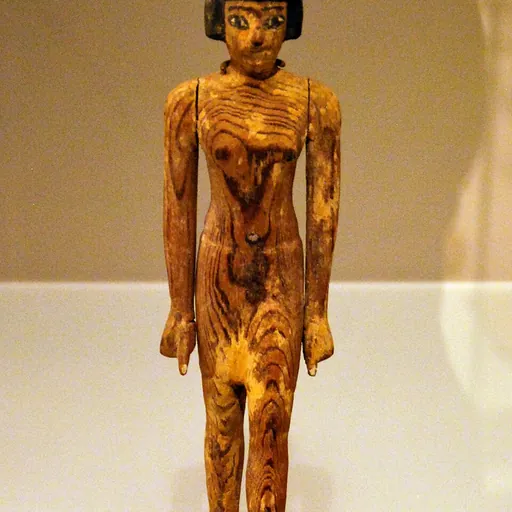
Djehutynakht V, son of Neheri I If he was the same of Djehutynakht V, then he lived during the late reign of pharaoh Amenemhat I of the 12th Dynasty and was Neheri I's son and successor by his wife Djehutyhotep, and the uncle of his successor Neheri II. In either case, no children are known for Djehutynakht and his wife. In addition to the coffins, the tomb contained the nomarch's mummified head as well as lady Djehutynakht's canopic chest and a great quantity of funerary furniture such as pottery, canopic jars, several model boats, many models of men and women in different daily life activities, and the famous group composed of a priest and many offering girls, known as the “Bersha procession”. In its entirety, these objects form the largest Middle Kingdom funerary assemblage ever found. Similar sequences have been observed in ancient DNA from Phoenicia and Europe but without an exact match, the nearest match is a living person from Lebanon. The observed U5 lineage could potentially reflect interactions between Egypt and the Near East that date as far back as the Predynastic and Early Dynastic periods. Haplogroup U5 is found in modern Egyptians at moderate frequencies but is higher in the Berbers of the Siwa Oasis in North West Egypt (16.7% in Siwa according to a 2009 study by C. Coudray). The related haplogroup U6 is much more common in most Berber populations.
Gallery
Don’t just read it —
keep it.
Full-length biographies made to live with: read them, listen on the way to work, watch them tonight.
- E-book
- Audio
- Video
Instant download · yours to keep · every purchase keeps this site free
Important facts
Frequently asked questions
Who was Djehutynakht?
ancient Egyptian nomarch
Sources & further reading
Cite this page
APA: Biography.guide. (2026). Djehutynakht. https://biography.guide/djehutynakht/
MLA: "Djehutynakht." Biography.guide, https://biography.guide/djehutynakht/.
Chicago: "Djehutynakht." Biography.guide. https://biography.guide/djehutynakht/.
Data last updated: 2026-09-22 · Spot an error? Report a correction.
Portrait: Wikimedia Commons · author & licence
Page generated 2026-09-27 05:03 UTC