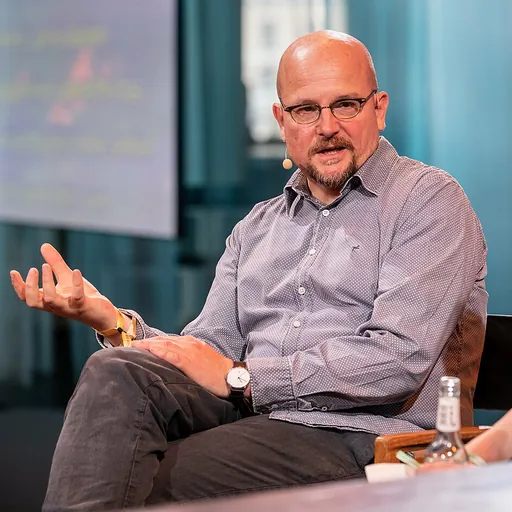
About Dirk Brockmann
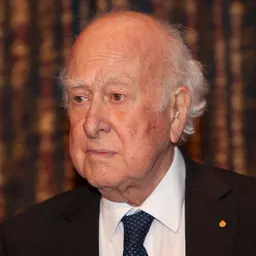
Born 1969. Dirk Brockmann is a German physicist and scientist.
Dirk Brockmann (born September 2, 1969) is a German physicist and Professor in Biology of Complex Systems and the founding director of the Center Synergy of Systems at Technische Universität Dresden. Brockmann is known for his work in complex systems, complex networks, computational epidemiology, human mobility and anomalous diffusion.
Education and career Brockmann was born in Braunschweig and studied physics and mathematics at Duke University and the University of Göttingen where he received his degree in theoretical physics in 1995 and his PhD in 2003 under the supervision of Theo Geisel. After postdoctoral positions at the Max Planck Institute for Dynamics and Self-Organization, Göttingen he became associate professor in the Department of Engineering Sciences and Applied Mathematics at Northwestern University in 2008.
In 2013 he returned to Germany, where he became professor at the Institute for Biology at Humboldt University of Berlin with a project group at the Robert Koch Institute. During the COVID-19 pandemic Brockmann initiated and led multiple big data projects to mitigate the pandemic as the mobility monitor, contact monitor and the Corona Data Donation Project.
Since October 2023, he is Professor in Biology of Complex Systems at Technische Universität Dresden and the founding director of the Center Synergy of Systems (SynoSys), which promotes complexity research with a trans-/anti-disciplinary approach.
Brockmann worked on a variety of topics ranging from computational neuroscience, anomalous diffusion, Levy flights, human mobility, computational epidemiology, and complex networks.
Research Brockmann pioneered the scientific use of mass data collected in online games in a 2006 study in which he and his colleagues analyzed the geographic circulation of millions of dollar-bills registered at the online bill tracking website Where's George? This study lead to the discovery of universal scaling laws in human mobility, the forecast of spreading routes of the 2009 flu pandemic in the United States and effective geographic borders in the United States. Brockmann also pioneered the development of computational models and forecast systems for the global spread of epidemics based on global air-transportation. In a 2013 study Brockmann and his colleague Dirk Helbing showed that complex global contagion phenomena can be mapped onto simple propagating wave patterns using the theoretical concept of effective distance. This method was employed for import risk estimates during the Ebola virus epidemic in West Africa in 2014.
Brockmann's research has been featured in an episode of the American crime drama television series Numbers.
Since 2017 he has been publishing "Complexity Explorables", which are interactive D3 animations of complex systems.
Don’t just read it —
keep it.
Full-length biographies made to live with: read them, listen on the way to work, watch them tonight.
- E-book
- Audio
- Video
Instant download · yours to keep · every purchase keeps this site free
Important facts
People in Dirk Brockmann's life
Named in this biography and alive at the same time

Related people
Same field, nearest in time



Contemporaries
People whose lives overlapped Dirk Brockmann's




Frequently asked questions
Who is Dirk Brockmann?
German scientist, Humboldt University of Berlin
When was Dirk Brockmann born?
Dirk Brockmann was born on 2 September 1969 in Brunswick.
What is Dirk Brockmann's occupation?
Dirk Brockmann is a physicist and scientist.
What nationality is Dirk Brockmann?
Dirk Brockmann is German.
Sources & further reading
Cite this page
APA: Biography.guide. (2026). Dirk Brockmann. https://biography.guide/dirk-brockmann/
MLA: "Dirk Brockmann." Biography.guide, https://biography.guide/dirk-brockmann/.
Chicago: "Dirk Brockmann." Biography.guide. https://biography.guide/dirk-brockmann/.
Data last updated: 2026-09-22 · Spot an error? Report a correction.
Portrait: Wikimedia Commons · author & licence
Page generated 2026-09-27 05:04 UTC