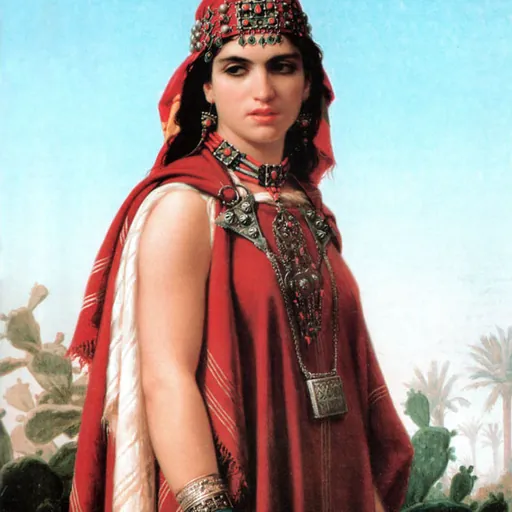
About Dihya
Lived 668 – 703 (aged 34–35). Dihya was a monarch.
Military victory in Meskiana
In the 680s, after Kusaila was killed and the Kingdom of Altava declined, most of the Berbers joined Dihya and the Kingdom of the Aurès.
After a successful siege of Carthage, the Arab Muslim general Hassan ibn al-Nu'man searched for his next enemy to confront. The people of Kairouan told him that the most powerful ruler in North Africa was al-Kahina. They described her as "a woman in the Aurès Mountains, feared by the Romans and followed by the Berbers", and he accordingly marched into the Aurès Mountains.
In 698, after hearing of Hassan’s arrival, al-Kahina demolished the city of Baghaya, believing that Hassan intended to use it as a fortified base. When Hassan heard of this, he advanced into the Aurès, and Kahina moved to meet him. the armies met in the Meskiana Valley in the present-day province of Oum el-Bouaghi in Algeria, at the Battle of Meskiana. Al-Kahina defeated Hassan decisively, and after pursuing him as far as Gabes, he fled Ifriqiya and remained in Cyrenaica for five years.
Reign After the battle, she spared all the Muslim captives and sent them to Hassan in Cyrenaica, except for Khalid ibn Yazid al-Qaysi. She took him back with her to her home in the Aurès and said to him, "I have never seen a man more handsome or braver than you. I want to nurse you so that you will be a brother to my sons." She had two sons, one said to be of Greek origin and the other Berber. According to al-Raqiq al-Kairouani, one was named "Qwaider" and the other "Yamin". Khalid answered, “How can that be when you have lost the ability to nurse?” She replied, “We Berbers have a custom of nursing that allows us to inherit from one another.” She then took barley flour and mixed it with oil, making what is known in the Maghreb as bsisa, and placed it on her breasts. She called her two sons and said to them, “Eat it with him from my breasts.” After they finished, she told them, “You are now brothers.” In this way, she adopted Khalid ibn Yazid.
Realizing that the enemy was too powerful and bound to return, and believing that Muslims came for gold and silver and the riches of the cities, Kahina was said to have embarked on a scorched earth campaign, which had little impact on the mountain and desert tribes, but lost her the crucial support of the sedentary oasis-dwellers. Instead of discouraging the Muslim armies, her desperate decision hastened defeat, as the Roman and Berber population went to Barqa telling Hassan and asking for his help.
Defeat and demise Hasan ibn al-Nu'man eventually returned, aided by communications with the captured officer Khalid ibn Yazid al-Qaysi, who had been adopted by al-Kahina. When she heard of his arrival, Kahina gathered many Berber tribes to resist the new invasion. She fortified herself in the Amphitheatre of El Jem. That night, however, she saw a vision in which she was killed and her head was placed before the "Great King of the Arabs". Other sources claim that the battle took place in Tabarka, where al-Kahina was killed. According to Ibn Khldun, she was killed at the age of 127, which is hard to believe.
Legacy Although Al-Kahina's writings (including poems and speeches) were all destroyed after her death, she was adopted as a symbol by North African women in resistance to foreign occupation and against male hegemony. During the period of French colonisation of Algeria, Kahina was a model for the militant women who fought as part of the resistance. In the Kabyle insurrection of 1851 and 1857, women such as Algerian national hero Lalla Fatma N'Soumer and Lalla Khadija Bent Belkacem, who were known as chief warriors, took Al-Kahina as a model.
In the early 20th century, the French, anxious to Frenchify Algeria by Romanising its past, drew parallels between themselves and the Romans. The Algerian nationalists, seeking to tie Algeria to the East instead, draw the same parallels, but for them both Rome and France were colonial powers, responsible for the decline of Phoenician civilisation in the past, and Arabic civilization in the present. Both ideologies used Kahina's mythology as a founding myth. On one side, she was the one who fought the Arabs and Islam to keep Algeria Christian. On the other, she was the one who fought all invaders (Byzantines or Arabs) to create an independent state.
Don’t just read it —
keep it.
Full-length biographies made to live with: read them, listen on the way to work, watch them tonight.
- E-book
- Audio
- Video
Instant download · yours to keep · every purchase keeps this site free
Important facts
more
DamyaFamily & relationships
People in Dihya's life
Named in this biography and alive at the same time

Related people
Same field, nearest in time

Contemporaries
People whose lives overlapped Dihya's



Frequently asked questions
Who was Dihya?
Amazigh queen of Aurès
When was Dihya born?
Dihya was born in 668 in Aurès Mountains.
When did Dihya die?
Dihya died in 703 in Tabarka.
What was Dihya's occupation?
Dihya was a monarch.
Sources & further reading
Cite this page
APA: Biography.guide. (2026). Dihya. https://biography.guide/dihya/
MLA: "Dihya." Biography.guide, https://biography.guide/dihya/.
Chicago: "Dihya." Biography.guide. https://biography.guide/dihya/.
Data last updated: 2026-09-24 · Spot an error? Report a correction.
Portrait: Wikimedia Commons · author & licence
Page generated 2026-09-27 05:08 UTC