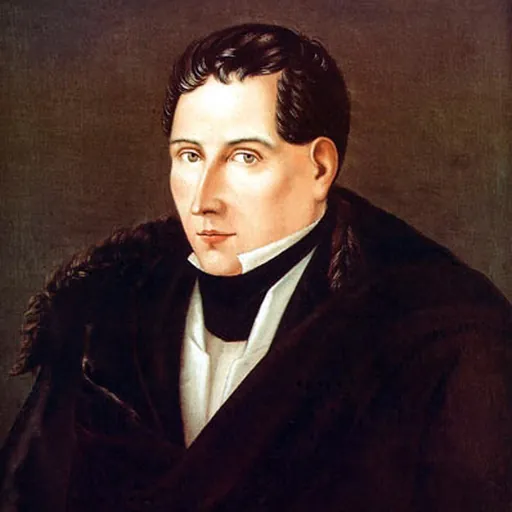
Diego Portales Palazuelo
Chilean businessman, conservative politician and admiral
About Diego Portales Palazuelo
Lived 1793 – 1837 (aged 43). Diego Portales Palazuelo was a Chilean entrepreneur, politician and diplomat.
Diego José Pedro Víctor Portales y Palazuelos (; June 16, 1793 – June 6, 1837) was a Chilean statesman, military figure and entrepreneur. As a minister of president José Joaquín Prieto's government, he played a pivotal role in shaping the state and politics in the 19th century, delivering with the Constitution of 1833 the framework of the Chilean state for almost a century. Portales' influential political policies included unitarianism, presidentialism and conservatism which led to the consolidation of Chile as a constitutional, authoritarian and aristocratic republic with the franchise restricted to upper class men from the gentry.
On August 15, 1819, he married his cousin, Josefa Portales y Larraín. He had two daughters with her, both of whom died within days of their birth. His wife also died soon after in 1821. He never remarried, but took Constanza Nordenflicht as his mistress, with whom he had three children.
In July 1821, he resigned from his job at the Mint and went into business. He opened a trading house, Portales, Cea and Co., based in Valparaíso with a branch in Lima, Peru. He bid and obtained management of the government monopoly on tobacco, tea, and liquor (known in Spanish as estanco). In exchange for the monopoly, he offered to service in full Chile's foreign debt. Nonetheless, in the anarchy that was regnant in Chile at the time, there was no means of enforcing a monopoly as the government could not regulate sales of tobacco, tea, and liquor, and the company eventually went bankrupt. His contract with the government was voided and the Chilean government was found to owe Portales 87,000 pesos. Out of this unsuccessful business venture, the only remnant was the name eventually applied to his political followers, who in time came to be known as the estanqueros (monopolists).
Political career
Soon after, he aligned with the conservatives in the political fights that were wracking Chile at the time. As aforementioned, in 1824, Portales' business firm acquired control over the government's monopoly of tobacco, tea, and liquor; however, the country's troubled conditions soon thwarted his profitable business. For these reasons, Portales finally entered into the political sphere, and very soon he would become the intellectual leader of the conservative side. He helped to reorganize the conservative party, and, in 1827, founded El Hambriento (or The Starveling), a journal attacking liberal idealists known as the pipiolos ("white beaks") from Portales' party's (a.k.a. the pelucones or "big wigs") perspective. Portales was an effective satirist, contributing several popular articles to The Starveling. Portales' articles placed him in the limelight and paved the way for his political career.
After the triumph of the conservatives in the Revolution of 1829, President José Tomás Ovalle y Bezanilla named him Minister of the Interior and Foreign Affairs on April 6, 1830, remaining until May 1831. He was named again to that position by President Fernando Errázuriz Aldunate on July 9, 1831, and remained until August 31, 1831, and named once again by President José Joaquín Prieto from November 9, 1835, to January 1837. Something similar happened with his nomination as minister of war and navy from April 6, 1830, until May 1831; then from July 9, 1831, until December 1832 and from September 21, 1835, to September 1836.
There was an assassination attempt on Portales in November 1836; the assassin was shot and killed. supported an oligarchic control for landowners, miners, and merchants; and made Catholicism the state religion.
Political philosophy
In 1822, before his rise to power Portales wrote to a friend:Politics doesn't interest me, but as a good citizen I feel free to express my opinions and to censure the government. Democracy, which is so loudly proclaimed by the deluded is an absurdity in our countries, flooded as they are with vices and with their citizens lacking all sense of civic virtue, the prerequisite to establishing a real Republic. But monarchy is not the American ideal either; if we get out of one terrible government just to jump headlong into another, what will we have gained? The Republican system is the one which we must adopt, but do you know how I interpret it for our countries? A strong central government whose representatives will be men of true virtue and patriotism, and who thus can direct the citizens along the path of order and progress.
The figure and legacy of Portales has been praised by some historians like and Alberto Edwards. Other historians, including Benjamín Vicuña Mackenna, Sergio Villalobos and Gabriel Salazar, have a negative view of Portales.
Remains
Portales' remains, missing since his assassination, were found in March 2005 in Santiago's Metropolitan Cathedral during renovation projects, and were identified after forensic examination. On June 20, 2006, the remains were taken to the civic crypt of the Cathedral for a civic-religious re-burial ceremony attended by then-President Michelle Bachelet, along with several civil and military authorities.
Don’t just read it —
keep it.
Full-length biographies made to live with: read them, listen on the way to work, watch them tonight.
- E-book
- Audio
- Video
Instant download · yours to keep · every purchase keeps this site free
Important facts
People in Diego Portales Palazuelo's life
Named in this biography and alive at the same time


Related people
Same field, nearest in time


Contemporaries
People whose lives overlapped Diego Portales Palazuelo's





Frequently asked questions
Who was Diego Portales Palazuelo?
Chilean businessman, conservative politician and admiral (1793-1837)
When was Diego Portales Palazuelo born?
Diego Portales Palazuelo was born on 16 June 1793 in Santiago.
When did Diego Portales Palazuelo die?
Diego Portales Palazuelo died on 6 June 1837 in Valparaíso.
What was Diego Portales Palazuelo's occupation?
Diego Portales Palazuelo was an entrepreneur, politician and diplomat.
What nationality was Diego Portales Palazuelo?
Diego Portales Palazuelo was Chilean.
Sources & further reading
· Wikipedia: Diego Portales Palazuelo
Cite this page
APA: Biography.guide. (2026). Diego Portales Palazuelo. https://biography.guide/diego-portales-palazuelo/
MLA: "Diego Portales Palazuelo." Biography.guide, https://biography.guide/diego-portales-palazuelo/.
Chicago: "Diego Portales Palazuelo." Biography.guide. https://biography.guide/diego-portales-palazuelo/.
Data last updated: 2026-09-20 · Spot an error? Report a correction.
Page generated 2026-09-27 05:10 UTC