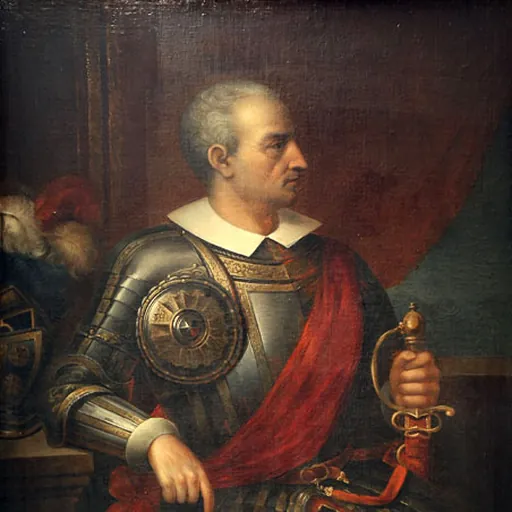
About Diego de Almagro
Lived 1475 – 1538 (aged 62–63). Diego de Almagro was a Spanish explorer and conquistador.
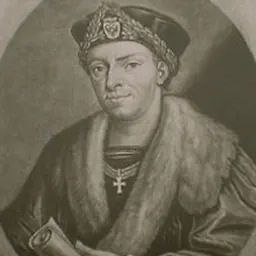
Diego de Almagro (; – July 8, 1538), also known as El Adelantado and El Viejo, was a Spanish conquistador known for his exploits and killings in western South America. He participated with Francisco Pizarro in the Spanish conquest of Peru. While subduing the Inca Empire he laid the foundation for Quito and Trujillo as Spanish cities in present-day Ecuador and Peru, respectively. From Peru, Almagro led the first Spanish military expedition to central Chile. Back in Peru, a longstanding conflict with Pizarro over the control of the former Inca capital of Cuzco erupted into a civil war between the two bands of conquistadores. In the battle of Las Salinas in 1538, Almagro was defeated by the Pizarro brothers and months later he was executed.
Early years
De Almagro's origins were humble. He was born in 1475 in the village of Almagro or in Malagón,
Conquest of Peru
By 1524 an association of conquest regarding South America was formalized among De Almagro, Pizarro and Luque. By the beginning of August 1524, they had received the requisite permission to discover and conquer lands further south. In the first expedition, De Almagro lost his eye to an arrow shot at the Battle of Punta Quemada. He subsequently remained in Panama to recruit men and gather supplies for the expeditions led by Pizarro. During Pizarro's continued exploration of Incan territory, he and his men succeeded in defeating the Inca army under Emperor Atahualpa during the Battle of Cajamarca in 1532. De Almagro joined Pizarro soon afterward, bringing more men and arms.
After Peru fell to the Spanish, both Pizarro and De Almagro initially worked together in the founding of new cities to consolidate their dominions. As such, Pizarro dispatched De Almagro to pursue Quizquiz, fleeing to the Inca Empire's northern city of Quito. Their fellow conquistador Sebastián de Belalcázar, who had gone forth without Pizarro's approval, had already reached Quito and witnessed the destruction of the city by Inca general Rumiñawi. The Inca warrior had ordered the city to be burned and its gold to be buried at an undisclosed location where the Spanish could never find it. The arrival of Pedro de Alvarado from Guatemala, in search of Inca gold further complicated the situation for Almagro and Belalcázar. Alvarado's presence, however, did not last long as he left South America in exchange for monetary compensation from Pizarro.
Following the Inca Trail and crossing the Andes Almagro left Cuzco on July 3, 1535, with his supporters and stopped at Moina until the 20th of that month. Meanwhile, Francisco Pizarro's brother, Juan Pizarro, had arrested Inca Manco Inca Yupanqui, further complicating De Almagro's plans as it heavily increased the dissatisfaction of the Indians submitted to Spanish rule. Not having formally been appointed governor of any territories in the Capitulation of Toledo in 1528, however, forcing him to declare himself adelantado (governor) of Nueva Toledo, or southern Peru and present-day Chile. Some sources suggest Almagro received such a requirement in 1534 by the Spanish king and was officially declared governor of New Toledo.
Once he left Moina, De Almagro followed the Inca trail followed by 750 Spaniards deciding to join him in quest for the gold lost in the ransom of Atahualpa, which had mainly benefited the Pizarro brothers and their supporters. After crossing the Bolivian mountain range and traveling past Lake Titicaca, Almagro arrived on the shores of the Desaguadero River and finally set up camp in Tupiza. From there, the expedition stopped at Chicoana and then turned to the southeast to cross the Andes mountains.
The expedition turned out to be a difficult and exhausting endeavor. The hardest phase was the crossing of the Andean cordilleras: the cold, hunger and tiredness meant the death of various Spanish and natives, but mainly slaves who were not accustomed to such rigorous climate.
During this time De Almagro fell ill, and Pizarro and his brothers grabbed the opportunity to defeat him and his followers. The Almagristas were defeated at Las Salinas in April 1538, with Orgóñez being killed on the field of battle. De Almagro fled to Cuzco, still in the hands of his loyal supporters, but found only temporary refuge; the forces of the Pizarro brothers entered the city without resistance. Once captured, Almagro was humiliated by Hernando Pizarro and his requests to appeal to the King were ignored.
When Diego de Almagro begged for his life, Hernando responded:
"-he was surprised to see Almagro demean himself in a manner so unbecoming a brave cavalier, that his fate was no worse than had befallen many a soldier before him; and that, since God had given him the grace to be a Christian, he should employ his remaining moments in making up his account with Heaven!"
Almagro was condemned to death and executed by garrote in his dungeon, and then decapitated, on July 8, 1538. His corpse was taken to the public Plaza Mayor of Cuzco, where a herald proclaimed his crimes. Hernán Ponce de León took his body and buried him in the church of Our Lady of Mercy in Cuzco.
El Mozo Diego de Almagro II (1520–1542), known as El Mozo (The Lad), son of Diego de Almagro I, whose mother was an Indian girl of Panama, became the foil of the conspirators who had put Pizarro to the sword. Pizarro was murdered on June 26, 1541; the conspirators promptly proclaimed the lad De Almagro Governor of Peru. From various causes, all of the conspirators either died or were killed except for one, who was executed after the lad Almagro gave an order. The lad De Almagro fought the desperate battle of Chupas on September 16, 1542, escaped to Cuzco, but was arrested, immediately condemned to death, and executed in the great square of the city.
Don’t just read it —
keep it.
Full-length biographies made to live with: read them, listen on the way to work, watch them tonight.
- E-book
- Audio
- Video
Instant download · yours to keep · every purchase keeps this site free
Important facts
Family & relationships
People in Diego de Almagro's life
Named in this biography and alive at the same time



Related people
Same field, nearest in time

Contemporaries
People whose lives overlapped Diego de Almagro's




Frequently asked questions
Who was Diego de Almagro?
Spanish conquistador
When was Diego de Almagro born?
Diego de Almagro was born in 1475 in Almagro.
When did Diego de Almagro die?
Diego de Almagro died on 8 July 1538 in Cusco.
What was Diego de Almagro's occupation?
Diego de Almagro was an explorer and conquistador.
What nationality was Diego de Almagro?
Diego de Almagro was Spanish.
Sources & further reading
Cite this page
APA: Biography.guide. (2026). Diego de Almagro. https://biography.guide/diego-de-almagro/
MLA: "Diego de Almagro." Biography.guide, https://biography.guide/diego-de-almagro/.
Chicago: "Diego de Almagro." Biography.guide. https://biography.guide/diego-de-almagro/.
Data last updated: 2026-09-22 · Spot an error? Report a correction.
Portrait: Wikimedia Commons · author & licence
Page generated 2026-09-27 05:04 UTC