About Didrik Pining
Lived 1422 – 1491 (aged 68–69). Didrik Pining was a German and Norwegian explorer.
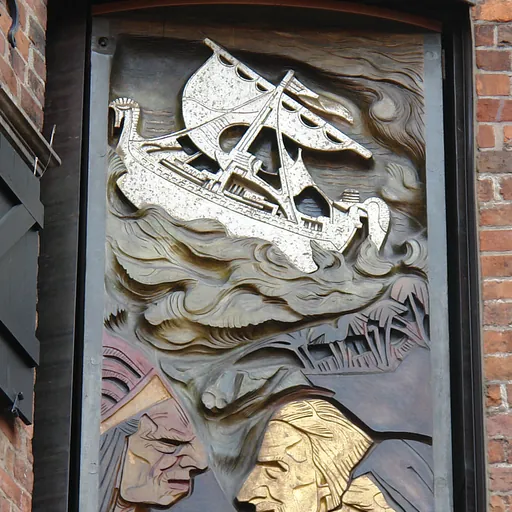
Figures from modern times (20th century) of Pining and his partner Pothorst by Bernhard Hoetger at the Bremen Böttcherstraße Haus des Glockenspiels. The image is based on the notion of them having reached America and also encountered a Native American.
Didrik Pining ( 1430 – 1491) was a German privateer, nobleman, and governor of Iceland and Vardøhus.
In 1925, researcher Sofus Larson proposed that Pining may have landed in North America in the 1470s, almost twenty years before Columbus' voyages of discovery. Some of the claims concerning Pining are controversial because information about him is relatively sparse and partially contradictory. It had been assumed that he was a Dane or Norwegian until the 1930s.
In Hanseatic records until 1468, he is mentioned as a privateer or naval captain in the service of Hamburg, charged with hunting down English merchant ships in the North Atlantic. first under Christian I of Denmark (ruled 1448–1481), and later for his son, John of Denmark (ruled 1481–1513). During the later years of the reign of Christian I, Pining and Pothorst are said to have distinguished themselves "not less as capable seamen than as matchless freebooters."
Alleged trip to America Sofus Larsen's theory The theory of the Pining voyage reaching America was published for the first time by Sofus Larsen of the University of Copenhagen in his book The Discovery of North America Twenty Years Before Columbus in 1925.
Regardless, no sources explicitly support that Pining and Pothorst had any connections with the journey by Corte-Real, nor that they reached North America (excluding Greenland). What is known however, is that Pining and Pothorst were sent out by a royal Danish order to find out which of several possible policies concerning trade in Iceland should be developed, in which settlements and harbours. Pining's orders further included investigating what formerly, in the 11th century, had been called the regiones finitimae (i.e. "the coasts opposite those still-remembered but obsolete settlements in Greenland"). Nothing specific suggests it went further west than this.
Later years In 1478, Didrik Pining became the governor (höfuðsmaðr) of Iceland, serving until 1481, when he is mentioned as having "fared out of Iceland." He also made state visits of homage to Bergen and Copenhagen, became knighted in Norway, and employed his personal coat of arms which featured a grappling hook. Around 1484, he captured, off the coast of England or Brittany and in the Spanish Sea, three Spanish or Portuguese ships which he brought to King John of Denmark in Copenhagen. In 1487, he led a fleet to the island of Gotland in the Baltic Sea, and secured it for Denmark. were to be excluded from the peace. He was then also spoken of as a lord of Iceland. In the same year, Pining was appointed governor of Vardøhus, and may thus have been commander-in-chief of the seas and lands in northern waters.
Didrik Pining likely died (was possibly killed) around Finnmark or the North Cape in 1491. although this has been disputed by some modern historians.
Olaus Magnus' account is illustrated by one of his woodcuts (seen above), resembling the southern Greenland coast where Hvidserk is seen, and the explorers combating Eskimos. Olaus Magnus wrote in 1555 that Pining and Pothorst, due to their piracy, had "by the Nordic kings been excluded from all human contact and declared outlaws, as a result of their extremely violent robberies and numerous cruel acts against all sailors that they could catch, whether close or distant." They then took refuge at a cliff called Hvidserken, which apparently was located between Iceland and Greenland. Magnus added that in "1494", the pirates created a giant compass out of a considerable circular space at the top of the cliff, with rings and lines formed of lead, to make it easier for them to know in which direction they could seek a great plunder. Modern historians have suggested that they may in fact have set up some mark at the coast of Greenland to reclaim it for the Danish king.
In 1625, a report from London talks about Pining and Pothorst (Punnus and Potharse) and states that Pining "gave the Islanders their Lawes," referred to later as Pining's Law, the written Icelandic law.
Don’t just read it —
keep it.
Full-length biographies made to live with: read them, listen on the way to work, watch them tonight.
- E-book
- Audio
- Video
Instant download · yours to keep · every purchase keeps this site free
Important facts
People in Didrik Pining's life
Named in this biography and alive at the same time

Related people
Same field, nearest in time



Contemporaries
People whose lives overlapped Didrik Pining's




Frequently asked questions
Who was Didrik Pining?
German privateer and nobleman (d. 1491)
When was Didrik Pining born?
Didrik Pining was born in 1422 in Hildesheim.
When did Didrik Pining die?
Didrik Pining died in 1491 in Vardø Municipality.
What was Didrik Pining's occupation?
Didrik Pining was an explorer.
What nationality was Didrik Pining?
Didrik Pining was German and Norwegian.
Sources & further reading
Cite this page
APA: Biography.guide. (2026). Didrik Pining. https://biography.guide/didrik-pining/
MLA: "Didrik Pining." Biography.guide, https://biography.guide/didrik-pining/.
Chicago: "Didrik Pining." Biography.guide. https://biography.guide/didrik-pining/.
Data last updated: 2026-09-21 · Spot an error? Report a correction.
Portrait: Wikimedia Commons · author & licence
Page generated 2026-09-27 05:00 UTC