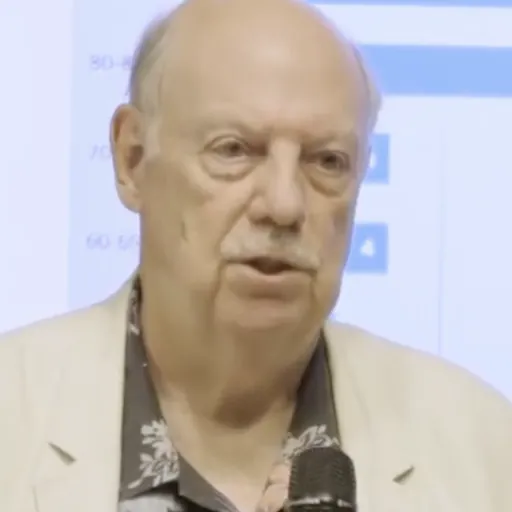
Dick Simpson
American professor (born 1940)
About Dick Simpson
Dick Weldon Simpsonnotetag|"Dick" is his full first name, not a nickname (as opposed to the common usage of "Dick" as shortened version of "Richard"). In 1963, he graduated from the University of Texas. During his studies at Indiana University, he spent some time in Sierra Leone, where he conducted research for his doctoral dissertation. Singer, a 29-year-old political newcomer, won an upset victory over a candidate supported by the political machine of the city's Democratic Party. Singer's victory was by a very narrow 427 votes in the runoff election against an opponent backed by the Democratic Party organization. Singer's election was seen as ushering in an era of prominence for the city's lakefront liberal voting bloc. Simpson also cofounded the Independent Precinct Organization, and served as the organization's executive director. Simpson has (both during and subsequent to his city council tenure) been considered to be a progressive. In the redistricting that took place before the 1971 election, the 44th ward was redrawn to include less of the heavily Jewish and politically independent lakefront, and to include more of the heavily Democratic areas to the west, making it a harder district for Simpson to win as an independent than it had been for Singer to win as an independent. Kargman was the son of a politically-connected Cook County Circuit Court judge. Simpson was supported by lakefront liberal voters. He ran on a platform that advocated for community control of municipal programs such as urban renewal. Community groups of the 44th ward were in the midst of a dispute with the city over urban renewal at the time of the election.
Simpson was reelected alderman in 1975, again defeating an opponent supported by the city's Democratic Party organization, Edward Marsalek. The Committee for an Effective City Council, a group founded to support the election of "independent" candidates to the Chicago City Council, endorsed him and twelve other aldermanic candidates (including fellow incumbents William Cousins, Anna Langford, and John Hoellen) on the same day that Pucinksi withdrew. He was supported by the lakefront liberals.
During his time on the City Council, Simpson was a critic of Richard J. Daley. After he was elected alderman in February 1971, alderman-elect Simpson endorsed Daley's Republican-nominated opponent Richard Friedman in the 1971 Chicago mayoral election (for which the general election was held in April). Despite being nominated by the Republican Party, Friedman was politically a political-reform minded independent Democrat with roots in the Better Government Association, and was similarly endorsed by Jesse Jackson. In once instance, Simpson angered Daley so severely that Daley attempted to have the City Council's sergeant at arms force Simpson back into his seat.
Simpson became the leader of the minority bloc of independents on the Chicago City Council. As such, he came into conflict with Michael Bilandic, first during Bilandic's stint as Daley's floor leader on the City Council, and later when Bilandic took office as mayor after Daley's death in office. Like with Daley, he frequently stood in strong opposition to Bilandic during Bilandic's mayoralty.
Being in the minority opposition to mayors Daley and Bilandic, Simpson's proposed legislation were usually defeated. The resolution, which Simpson had feared would have little chance of passing, was passed on June 26, 1974, in a unanimous 44–0 vote after it was amended by Daley-aligned alderman Paul Wigoda. The investigation was later ended by a Chicago City Council vote of 40–3 in April 1978 to accept the investigative committee's majority report over the minority report written by Simpson, Lathrop, and Oberman as investigative committee members. While few wholesale pieces of legislation authored by Simpson were passed, Simpson saw occasional success in making amendments to legislation. The council debated taking action against the towing company.
In March 1977, Simpson and fellow aldermen Dennis H. Block, Ross Lathrop, Martin Oberman proposed a piece of legislation that would have established community zoning boards in each of the 50 wards of the city. Simpson established a "ward assembly" for the 44th Ward. Decades after Simpson left the council, journalist and news editor Bruce Dold remarked, It wasn't that he and other independents could pull off legislative victories. It was that, fortunately, there was a small band of thoughtful people who thrived on standing up to power. They provided what little check there was on the authority of Richard J. Daley. Dick Simpson, Abner Mikva, Bill Singer, Marty Oberman, they were pretty fearless. He endorsed independent candidate Bruce Young, the director of the Jane Addams Center at Hull House, to succeed him. Simpson continued to teach as a professor at UIC. He was also a Great Cities Scholar and a Humanities Institute Fellow at UIC He was also involved in authoring studies by UIC that ranked cities and states in the United States by their level of corruption. In 2022, Simpson retired as a professor and was named a professor emeritus. Simpson has also been a respected political analyst. He was, for three years, a monthly op-ed columnist for the Chicago Journal, and was subsequently a monthly columnist for the Chicago Sun-Times.
Work for campaigns and government transitions; endorsements of candidates In 1979, Simpson served as an advisor on the mayoral transition team of Jane Byrne. He also worked on both the unsuccessful 1990 Democratic primary election campaign of Ray Smith for Cook County State's Attorney, and the successful general election campaign of Republican nominee Jack O'Malley in the same race. He formally did so on August 21, 2018. He helped then-candidate Lightfoot in writing a proposal for council reform that included putting an end to the practice of aldermanic prerogative and banning outside employment of aldermen. (just over one month a week before Lightfoot would place first the first round of the election). Lightfoot would go on to be elected mayor.
1992 and 1994 congressional campaigns Simpson was twice an unsuccessful candidate for United States congress. Posing the greatest reelection challenge Rostenkowski had faced, Simpson won approximately 43% of the vote against Rostenkowski. Rostenkowski, chairman of United States House Committee on Ways and Means, was considered among the nation's most powerful congressmen.
Simpson again challenged Rostenkowski for the Democratic nomination in 1994. At the time, Rostenkowski was under grand jury investigation, and was also being challenged for the nomination by John Cullerton. Simpson and Cullerton were joined in challenging Rostenkowski by former alderman Michael Wojik and LaRouche movement member John McCarthy. In 1994, Simpson criticized Rostenkowski as corrupt and criticized him for votes such as his vote in support of extending the Hyde Amendment. Simpson placed third behind Rostenkowski and Cullerton. After Langdon Neale retired from the Chicago Board of Election Commissioners, Simpson applied in December 2015 to fill the seat. His candidacy for the position was endorsed by Danny K. Davis, Mike Quigley, Joe Moore, and David Orr.
In 2021, Simpson participated in an effort run by a coalition of civic groups which formed an independent citizens commission that would draw a city council ward redistricting map, producing an alternative proposal to the ward map that would be drawn-up by members of the Chicago City Council itself as part of the council's decennial redistricting. Simpson was a member of the selection commission that chose the citizens to participate in the effort.
Electoral history Aldermanic
Congressional
Don’t just read it —
keep it.
Full-length biographies made to live with: read them, listen on the way to work, watch them tonight.
- E-book
- Audio
- Video
Instant download · yours to keep · every purchase keeps this site free
Important facts
Frequently asked questions
Who was Dick Simpson?
American professor (born 1940)
When was Dick Simpson born?
Dick Simpson was born in Houston.
Sources & further reading
· DBpedia: Dick Simpson (politician)
Cite this page
APA: Biography.guide. (2026). Dick Simpson. https://biography.guide/dick-simpson-q6ea1b8ee/
MLA: "Dick Simpson." Biography.guide, https://biography.guide/dick-simpson-q6ea1b8ee/.
Chicago: "Dick Simpson." Biography.guide. https://biography.guide/dick-simpson-q6ea1b8ee/.
Data last updated: 2026-09-20 · Spot an error? Report a correction.
Portrait: Wikimedia Commons · author & licence
Page generated 2026-09-27 04:58 UTC