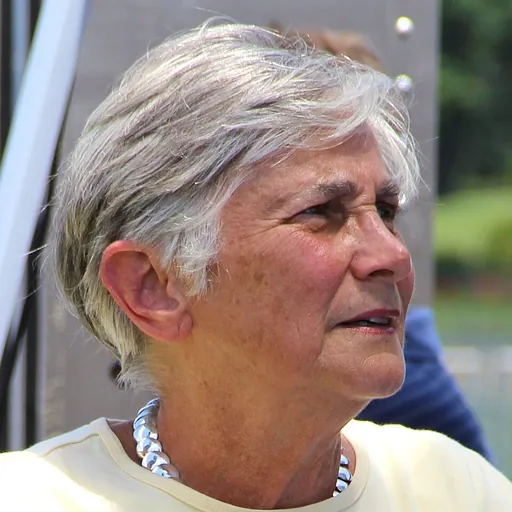
About Diane Ravitch
Born 1938. Diane Ravitch is an American journalist, historian, blogger, political activist, pedagogue and university teacher.
Diane Silvers Ravitch (born July 1, 1938) is an American historian of education, an educational policy analyst, and a research professor at New York University's Steinhardt School of Culture, Education, and Human Development. Previously, she was a U.S. Assistant Secretary of Education. In 2010, she became "an activist on behalf of public schools." Her blog at DianeRavitch.net has received more than 36 million page views since she began blogging in 2012. Ravitch writes for the New York Review of Books.
Early life and education Ravitch was born into a Jewish family in 1938 in Houston, Texas, where she went to public schools from kindergarten through high school graduation from San Jacinto High School. She is one of eight children. She is a graduate of Wellesley College and earned a PhD from Columbia University.
From 1995 to 2020, Ravitch was Research Professor of Education at New York University's Steinhardt School of Culture, Human Development, and Education. She taught at Teachers College, Columbia University, from 1976 to 1991.
Ravitch participated in a "blog debate" called "Bridging Differences" with Steinhardt School colleague Deborah Meier on the website of Education Week from February 26, 2007, until September 2012.
In April 2012, Ravitch launched an education policy blog, posting up to ten times daily.
Educational views Ravitch's first book The Great School Wars (1974) is a history of New York City public schools. It described alternating eras of centralization and decentralization. It also tied periodic controversies over public education to periodic waves of immigration. Publishers Weekly wrote: "Ravitch contends that these sanitized materials sacrifice literary quality and historical accuracy in order to escape controversy."
Ravitch's writings on racial and cultural diversity were summarized by sociologist Vincent N. Parrillo:
Reading instruction Ravitch said that she supported the teaching of phonics when appropriate.
In the early 2000s, she was critical of the then New York mayor Michael Bloomberg who, after taking control over New York public schools, replaced phonics with balanced literacy helped by Joel Klein, the then chancellor of the New York City Department of Education. Klein credited balanced literacy with raising the city's fourth-grade reading scores. Ravitch rebutted that claim by noting that the rise in reading scores occurred in 2002—before Klein became chancellor and implemented balanced literacy.
In 2014, she blogged about a battle "between literacy guru Lucy Calkins of Teachers College and Common Core architect David Coleman about teaching reading". Calkins supported Balanced Literacy, Coleman supported close reading. Some commentators took it as Ravitch endorsing Calkins, while others detected cognitive dissonance in her reporting:
Ravitch clarified her position as neutral, saying that she had stopped taking sides between Balanced Literacy and Core Knowledge, "Each has strong points and weak points. Everything depends on how they are taught."
In 2020, Ravitch reported about Calkins' attempts to "rebalance balanced literacy to incorporate more early phonics", but did not take sides. "Different strategies for different children. The teacher should know them all and use whatever is suited to the child", commented Ravitch.
Ravitch repeatedly said that she could not bring herself to believe in "the science of reading." According to her, "there is no 'science of mathematics,' no 'science of science,' no 'science of history'."
In 2026, Ravitch opposed the proposed Science of Reading Act, which intended to amend the Elementary and Secondary Education Act of 1965 (20 U.S.C. 6641(b)) by prohibiting usage of a three-cueing model and by requiring application of "science of reading", in particular "instruction in phonemic awareness, phonics, vocabulary, fluency, comprehension, and writing as essential components to skilled reading".
As I have said repeatedly, I do not believe that any legislature should mandate teaching methods. They get swept along by fads, they are not experts, they have no business telling teachers how to teach. Legislating “how to teach” makes as little sense as legislating how to perform open heart surgery.
Ravitch said that the charter school and testing reform movement was started by billionaires and "right wing think tanks like The Heritage Foundation" for the purpose of destroying public education and teachers' unions. She reviewed the documentary Waiting for Superman, directed by Davis Guggenheim, as "propagandistic" (pro-charter schools and anti-public schools), studded with "myths" and at least one "flatly wrong" claim. Of Education Secretary Arne Duncan's Race to the Top program, Ravitch said in a 2011 interview it "is an extension of No Child Left Behind ...[,] all bad ideas." She concluded "We are destroying our education system, blowing it up by these stupid policies. And handing the schools in low-income neighborhoods over to private entrepreneurs does not, in itself, improve them. There's plenty of evidence by now that the kids in those schools do no better, and it's simply a way of avoiding their - the public responsibility to provide good education."
Repudiating the policies she had formerly espoused, Ravitch wrote The Death and Life of the Great American School System: How Testing and Choice Undermine Education (2010), which became a surprise best seller. One reviewer noted that "Ravitch exhibits an interesting mix of support for public education and the rights of teachers to bargain collectively with a tough-mindedness that some on the pedagogical left lack."
Her next book Reign of Error: The Hoax of the Privatization Movement and Its Danger to America’s Public Schools was a national bestseller. She describes in detail the policies that are needed to improve the lives of children and families, based on research, and beginning with prenatal care for all pregnant women. Data show that the U.S. lags other nations in providing prenatal care and high-quality preschool, but leads other advanced nations in rates of child poverty and inequality of wealth and income.
National standards and Common Core During the 1980s, Ravitch began calling for voluntary national standards in education. She became associated with Core Knowledge movement, championed by E. D. Hirsch. During her stint as an assistant secretary of education, she was tasked to develop national standards, even though the federal government did not have the authority to make the states adopt them. By 2007, Ravitch no longer accepted the free-market components of education reform. She continued to work with Hirsch calling for more attention to curriculum and instruction. In 2008 she became a co-chair of the board of the newly created Common Core, Inc. Funded by the Gates Foundation, the Common Core issued a press release saying that the curriculum maps were "comprehensive, coherent sequence of thematic curriculum units connecting the skills outlined in the CCSS with suggested student objectives, texts, activities, and much more."
In her book The Death and Life of the Great American School System: How Testing and Choice Undermine Education, published in 2010, Ravitch proclaimed:
Every school should have a well-conceived, coherent curriculum. A curriculum is not a script, but a set of general guidelines. Students should regularly engage in the study and practice of the liberal arts and sciences: history, literature, geography, the sciences, civics, mathematics, the arts, and foreign languages, as well as health and physical education.
She continued:
Nations such as Japan and Finland have developed excellent curricula that spell out what students are supposed to learn in a wide variety of subjects. If we are willing to learn from top-performing nations, we should establish a substantive national curriculum that declares our intention to educate all children in the full range of liberal arts and sciences, as well as physical education. The curriculum would designate the essential knowledge and skills that students need to learn.
Ravitch turned her attention to poverty and racial segregation as the main causes of low student achievement. Ravitch claims that the Common Core "was a rush job, and the final product ignored the needs of children with disabilities, English-language learners and those in the early grades." She says that the country needs "schools where all children have the same chance to learn. That doesn’t require national standards or national tests, which improve neither teaching nor learning, and do nothing to help poor children at racially segregated schools."
Personal life She married Richard Ravitch (who later served as Lieutenant Governor of New York) in 1960; they divorced in 1986. While her husband worked in the family business, she stayed home and raised three sons, the second of whom, Steven, died of leukemia aged two; his brothers went to private schools. She and Butz were married on December 12, 2012.
Don’t just read it —
keep it.
Full-length biographies made to live with: read them, listen on the way to work, watch them tonight.
- E-book
- Audio
- Video
Instant download · yours to keep · every purchase keeps this site free
Important facts
Family & relationships
People in Diane Ravitch's life
Named in this biography and alive at the same time







Related people
Same field, nearest in time




Contemporaries
People whose lives overlapped Diane Ravitch's




Frequently asked questions
Who is Diane Ravitch?
American academic
When was Diane Ravitch born?
Diane Ravitch was born on 1 July 1938 in Houston.
What is Diane Ravitch's occupation?
Diane Ravitch is a journalist, historian, blogger, political activist, pedagogue and university teacher.
What nationality is Diane Ravitch?
Diane Ravitch is American.
Sources & further reading
Cite this page
APA: Biography.guide. (2026). Diane Ravitch. https://biography.guide/diane-ravitch/
MLA: "Diane Ravitch." Biography.guide, https://biography.guide/diane-ravitch/.
Chicago: "Diane Ravitch." Biography.guide. https://biography.guide/diane-ravitch/.
Data last updated: 2026-09-20 · Spot an error? Report a correction.
Page generated 2026-09-27 05:10 UTC