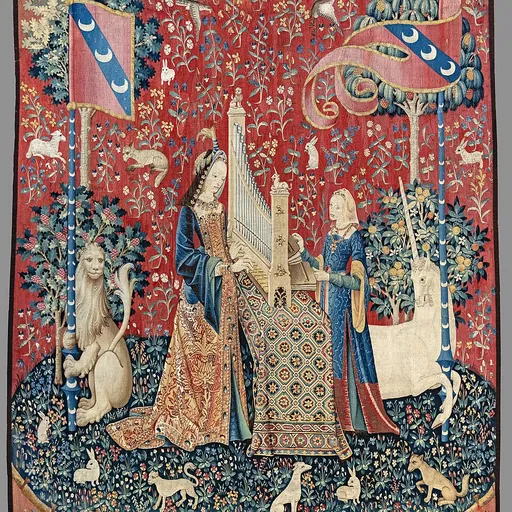
About Dhuoda
Born 803. Dhuoda was a writer, aristocrat and philosopher.
Dhuoda (fl. AD 824–844) was a Frankish writer, as well as Duchess consort of Septimania and Countess consort of Barcelona. She was the author of the Liber Manualis, a handbook written for her eldest son, William of Septimania.
Life
Dhuoda, author of the Liber Manualis, was a significant Carolingian woman and writer. Earlier scholarship suggested that Dhuoda may have come from a powerful Austrasian family connected to Aachen. It has been speculated that her unusual name is an attempt to render the Basque name Toda, and that she may have been daughter of Sancho I, Duke of Gascony. She married Bernard, Duke of Septimania, at the Carolingian capital of Aachen in 824. The specific date of the wedding is contested. Some believe that it fell on the feast of Saints Peter and Paul, which was the 24th of June, while others believe the date to be the 29th of June. Her husband Bernard was the son of William of Gellone, Duke of Toulouse and Charlemagne's cousin, Bernard was a Count of Barcelona and during their marriage he was advisor to Emperor Louis and protector of the Empress Judith as well as being appointed to the office of chamberlain.
Their first son, William of Septimania, was born on 29 November 826, and the second, Bernard Plantapilosa, on 22 March 841. Her husband Bernard’s involvement in the dynastic conflict, including the civil war of the 830s and in the Battle of Fontenoy in 841, led to their elder son, William, being sent to Charles the Bald as a political hostage. While he was away, Dhuoda began to write her handbook for him.
Although Dhuoda was married to the most prominent Frankish magistrate at the time, she is not mentioned in any contemporary works from that period except her own.
Dhuoda noted that she began writing the Liber Manualis in late 841, shortly after a major Frankish civil war battle on 22 June 841 and just after her son William reached the age of fifteen. She completed her manual on 2 February 843, during the period leading up to the Treaty of Verdun. Dhuoda was precise in dating her work. Her references to specific feast days and liturgical celebrations have been understood as linking her personal circumstances to the broader political events of that period.
Dhuoda wrote the Liber Manualis while she was fearing for the lives of herself and her children.
Although the book's title doesn’t contain the name of her son, William, it is made clear in the introduction and conclusion of the book that the intended audience was that of her oldest son. Some historians also believe that in addition to her son Dhuoda intended to have the extended audience of his peers at court including Charles the Bald. In addition to this she also encouraged William to share what he learned from the handbook with his younger brother when he is older. Her work is important in that it offers insight into the education of women, the raising of children, the order of society, the importance of fathers, and how Christianity impacted the lives of the Frankish nobility.
Dhuoda was not the only elite Carolingian woman to combine learning with maternal guidance. Contemporary figures such as Empress Judith, the wife of Louis the Pious, were also recognized for their involvement in their children’s education and as participants in Carolingian literary culture.
Having the Liber Manualis provides one look into what knowledge women's education provided in this period. Dhuoda's handbook showed that she was not only literate but also understood numerical learning. The numerology passages suggest that Carolingian aristocratic women, and men, engaged with mathematical and symbolic ideas beyond basic arithmetic. In addition to being a guide for William, Dhuoda provides examples of her knowledge on Christian texts like the Bible and other topics, like the Latin language.
Quotations
You will find in it [the handbook] a mirror in which you can without hesitation contemplate the health of your soul, so that you may be pleasing not only in this world, but to him who formed you out of dust. (Prologue) Among the human race, to attain perfection requires the application of great and constant effort. We must apply to various evils the remedies that are their antidotes. (Book 4) We know that poverty and want are found not only among the least of men but also frequently, for many reasons, among the great, So it is that a rich man too may be in need. Why? Because his soul is wretchedly needy. And then there is the poor man who gathers riches with great ease. Or the rich man who envies the poor man, or the poor man who wishes to become rich, just as an unlettered man wishing to become learned may desire this completely but never accomplish it. (Book 4) Pray for the past, if you have been neglectful, that you may finally forget this; for present evils, that you may always escape them; for the future, that you may beware those evils and that they not continue to pursue you there. (Book 8) Because the recitation of the Psalms has such and so many powers, my son William, I urge and direct that you recite them constantly, for yourself, for your father, for all the living, for those persons who have stood lovingly by you, for all the faithful who are dead, and for those whose commemoration is written down here or who you command be added. And do not hesitate to recite the Psalms that you choose for the remedy of my soul, so that when my last day and the end of my life come for me, I may be found worthy to be raised up to heaven on the right with those good folk whose actions have been worthy, not on the left with the impious. Return frequently to this little book. Farewell, noble boy, and always be strong in Christ. (Book 11)
Don’t just read it —
keep it.
Full-length biographies made to live with: read them, listen on the way to work, watch them tonight.
- E-book
- Audio
- Video
Instant download · yours to keep · every purchase keeps this site free
Important facts
Related people
Same field, nearest in time


Frequently asked questions
Who was Dhuoda?
Carolingian writer
When was Dhuoda born?
Dhuoda was born in 803 in Spanish march.
When did Dhuoda die?
Dhuoda died in Uzès.
What was Dhuoda's occupation?
Dhuoda was a writer, aristocrat and philosopher.
What nationality was Dhuoda?
Dhuoda's recorded nationality: Carolingian Empire.
Sources & further reading
Cite this page
APA: Biography.guide. (2026). Dhuoda. https://biography.guide/dhuoda/
MLA: "Dhuoda." Biography.guide, https://biography.guide/dhuoda/.
Chicago: "Dhuoda." Biography.guide. https://biography.guide/dhuoda/.
Data last updated: 2026-09-24 · Spot an error? Report a correction.
Portrait: Wikimedia Commons · author & licence
Page generated 2026-09-27 05:09 UTC