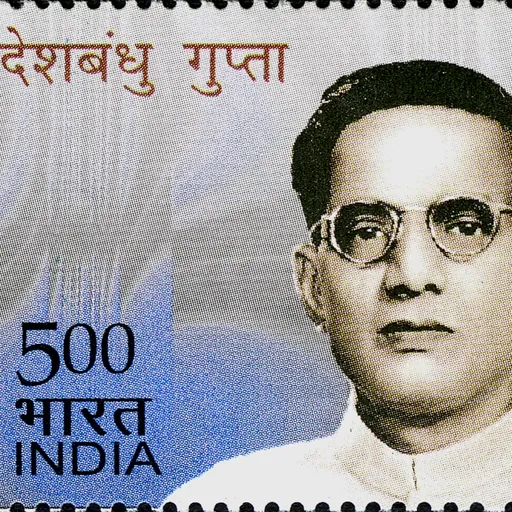
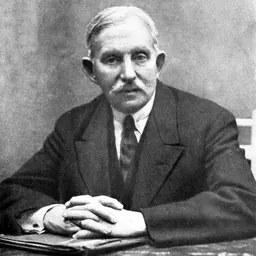
Deshbandhu Gupta
Indian freedom fighter and legislator and journalist
About Deshbandhu Gupta
Lived 1901 – 1951 (aged 50). Deshbandhu Gupta was an Indian journalist and politician, known for Indian Independence Movement.
Deshbandhu Gupta (14 June 1901 – 21 November 1951), also known as Lala Deshbandhu Gupta, was an Indian freedom fighter, politician, and journalist. He served as a member of the Punjab Provincial Assembly, having won the 1937 election representing the Indian National Congress. He was also a member of the Constituent Assembly of India.
He championed the cause of ensuring freedom of the press and actively advocated for the assembly status of the National Capital Territory of Delhi. Additionally, he actively supported the separation of Punjab and Haryana, and he was the first to initiate the independence movement of Haryana.
Swami Shraddhanand and Mahatma Gandhi gave him the title "deshbandhu" (friend of the nation), which became his commonly used name.
Independence movement Deshbandhu Gupta actively participated in the Non-cooperation movement, playing a significant role in mobilizing the people of Delhi to boycott various symbols of British rule. He encouraged active participation among the masses. As a result of his involvement, Gupta endured a year of rigorous imprisonment from 1921 to 1922. He was 19 years old when he was jailed for the first time.
During the Civil disobedience movement, Gupta continued to demonstrate his support. He advocated for the boycott of foreign clothing, promoting the concept of 'Swadeshi' and endorsing locally made products. Gupta served as the editor of the newspaper Daily Tej and was apprehended on 8 October 1923, due to his revolutionary writings. His wife Sona Devi and son Vishwa Bandhu Gupta (later a Member of Parliament, Rajya Sabha ) were also imprisoned for their participation in the Civil Disobedience Movement. Deshbandhu Gupta and his family took on the crucial responsibility of leading and organizing the Civil Disobedience movement in Delhi. He also held several important positions within the Indian National Congress during his political career.
Constituent Assembly He was elected to the Constituent Assembly of India from Delhi as a member of the Indian National Congress. As both a journalist and Constituent Assembly member, he is known to have staunchly supported freedom of the Press in India, as especially evidenced in the debates surrounding the (then) entry 88-A in the Assembly draft, held in September 1949. He voiced his concerns about the imposition of taxes on newspapers and emphasized the need for them to be treated differently from other industries.
Deshbandhu Gupta was involved in the matter of assembly status for Delhi. He advocated for the establishment of a responsible government in Delhi, which put him in opposition to B.R. Ambedkar's stance. Dr. Ambedkar supported granting special status to the National Capital Territory (NCT). Despite facing repeated rejections from the Government of India to grant Delhi equal status to other units of the Indian Union, Gupta tenaciously pursued his cause through his newspapers, parliamentary speeches, and resolutions presented in the Chief Commissioner's Advisory Council. Eventually, Delhi did obtain an assembly, but it became a special Union Territory rather than a full-fledged state.
Contribution to journalism Deshbandhu Gupta was a noted journalist, who served as an editor for Lala Lajpat Rai's newspaper Vande Mataram. Later, in collaboration with Swami Shraddhanand, an Arya Samaj missionary, he established the newspaper Daily Tej, which was published in Urdu as the Rozana Tej. After the death of Swami Shraddhanand on 23 December 1926, Desh Bandhu took over the management of the newspaper until his own passing.
After Deshbandhu Gupta's death in 1951, his son Vishwabandhu Gupta took over the leadership of Daily Tej and expanded its portfolio. It launched Deewana Tej, a popular bilingual satirical magazine that gained prominence in the 1960s. They also introduced The Weekly Sun, India's first political and youth tabloid, which captivated the younger generation throughout the 1970s and 80s. Additionally, it published the Northeast Sun, an English magazine with a substantial readership in the North East region of India and neighboring countries. In 2023, Tej completed a century of its existence.
Personal life At the age of 19, Deshbandhu Gupta married Sona Devi, who was 17 years old. Their matrimonial alliance had been arranged since Gupta was five years old and she was three. Gupta and Sona Devi had four sons named Vishwabandhu Gupta, Prembandhu Gupta, Ramesh Gupta, and Satish Gupta, as well as five daughters named Vimla Gupta, Nirmala Gupta, Urmila Gupta, Sarla Gupta, and Manjula Gupta.
Commemoration In June 2010, the Government of India issued a commemorative postage stamp and a first day cover to honor the birth anniversary of Lala Desh Bandhu Gupta. On 12 August 2010, the Prime Minister of India Manmohan Singh released the postage stamp.
Deshbandhu College, a constituent college of the University of Delhi, was established in 1953 by the Ministry of Rehabilitation and named after Deshbandhu Gupta as a tribute. There is a government college, Deshbandhu Gupta Government PG College, located in Panipat, Haryana, which is named after Deshbandhu Gupta. In 1956, the Municipal Corporation of Delhi installed a statue of Deshbandhu Gupta at Ajmeri Gate, Delhi, which was unveiled by Syed Mahmud, the then Minister of External Affairs.
In August 2008, the Government of Haryana, under the leadership of Bhupinder Singh Hooda, established a state-level award in honor of Lala Deshbandhu Gupta, with a monetary value of 1 lakh. The award is bestowed upon individuals who have made exceptional contributions to the field of writing about the freedom fighters in Haryana. This award is established under the auspices of Haryana Sahitya Akademi.
A statue of Lala Deshbandhu was unveiled by the college administration of Deshbandhu College on 6 August 2022, in the presence of his family members, as a commemorative gesture to honor his contributions. Desh, a student magazine of Deshbandhu College, was started as a commemoration to honor Deshbandhu Gupta. A road in Delhi's Karol Bagh is named after him.
Don’t just read it —
keep it.
Full-length biographies made to live with: read them, listen on the way to work, watch them tonight.
- E-book
- Audio
- Video
Instant download · yours to keep · every purchase keeps this site free
Important facts
People in Deshbandhu Gupta's life
Named in this biography and alive at the same time


Related people
Same field, nearest in time



Contemporaries
People whose lives overlapped Deshbandhu Gupta's



Frequently asked questions
Who was Deshbandhu Gupta?
Indian freedom fighter and legislator and journalist (1901-1951)
When was Deshbandhu Gupta born?
Deshbandhu Gupta was born on 14 June 1901 in Panipat.
When did Deshbandhu Gupta die?
Deshbandhu Gupta died on 21 November 1951 in Kolkata.
What was Deshbandhu Gupta's occupation?
Deshbandhu Gupta was a journalist and politician.
What was Deshbandhu Gupta known for?
Deshbandhu Gupta was known for Indian Independence Movement.
What nationality was Deshbandhu Gupta?
Deshbandhu Gupta was Indian.
Sources & further reading
Cite this page
APA: Biography.guide. (2026). Deshbandhu Gupta. https://biography.guide/deshbandhu-gupta/
MLA: "Deshbandhu Gupta." Biography.guide, https://biography.guide/deshbandhu-gupta/.
Chicago: "Deshbandhu Gupta." Biography.guide. https://biography.guide/deshbandhu-gupta/.
Data last updated: 2026-09-22 · Spot an error? Report a correction.
Portrait: Wikimedia Commons · author & licence
Page generated 2026-09-27 05:00 UTC