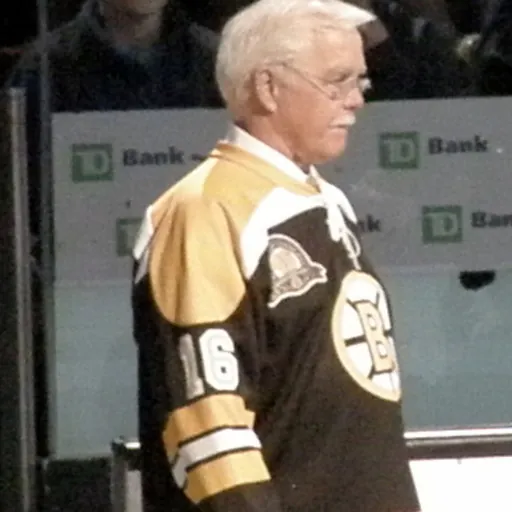
About Derek Sanderson
Born 1946. Derek Sanderson is a Canadian ice hockey player.
Derek Michael Sanderson (born June 16, 1946), nicknamed "Turk", is a Canadian former professional ice hockey centre and two-time Stanley Cup champion who helped transform the culture of the professional athlete in the 1970s era. He set up the epic overtime goal scored by Boston Bruins teammate Bobby Orr that clinched the 1970 Stanley Cup Final, widely considered to be the greatest goal in National Hockey League history. His older sister Karen was born in 1944 while their father was serving in France. In his early youth, Sanderson took to hockey, skating countless hours on a scaled-down version of an NHL rink, which his father built and maintained while his mother served hot chocolate during breaks in the action. The rink spanned two backyards of small cookie-cutter houses on lots provided at modest prices to servicemen such as Harold upon their return home.
Playing career Sanderson played junior hockey in his hometown with the Niagara Falls Flyers of the Ontario Hockey Association. His time with the Flyers saw him being named to the Second All-Star Team in 1965–66, to the First All-Star Team in 1966–67 and winning the Eddie Powers Memorial Trophy as the top scorer in the OHA also in 1966–67. In 1964–65, Sanderson helped the Flyers reach the Memorial Cup Final where they beat the Edmonton Oil Kings in five games. After spending four years in the OHA, Sanderson turned pro by signing with the Boston Bruins of the National Hockey League in 1965–66, and made his professional debut that season by playing two games with the Bruins. During the postseason he recorded 4 assists helping the team win the Adams Cup.
Although Sanderson had been an elite scorer in junior hockey, the Bruins already boasted the most potent offense in hockey when he joined the club. Instead, head coach Harry Sinden had a different vision for him, one as a valuable multi-purpose center who could neutralize the top center men in the league, dominate the face-off dot, help kill penalties at a high rate, unnerve opponents with physical if not chippy play and contribute at the offensive end on a regular basis. Sanderson would become a fixture on the third line, often paired with left wing Wayne Carleton or Don Marcotte and right wing Ed Westfall throughout his Bruins career. In particular, Westfall and Sanderson developed an uncommon chemistry that allowed them to become one of the most accomplished penalty-killing tandems in league history. Sanderson also became one of the first NHL centers to focus on and excel in winning faceoffs.
During his second season with the Bruins in 1968–69 Sanderson appeared in 61 games scoring 26 and 22 against finishing with 48 points one less than the year prior. During a game vs. the Toronto Maples Leafs on March 16, 1969, Sanderson had his best individual game performance where he scored a hatrick and 3 assists for a 6-point game in a Bruins 11–3 victory. During the postseason Sanderson scored 8 goals and 2 assists in 9 games however the Bruins were eliminated by the Montreal Canadiens in the second round.
Due to an injury Sanderson only appeared in 50 games for the Bruins during the 1969-70 season, where he scored 41 points (18 goals, 23 assists). Following the victory Sanderson gave his Stanley Cup ring to his father for filling a promise he made to him when he was 12 years old. It also turned out to be the signature moment for both players in their careers.
In 1970-71, Sanderson scored a NHL career best 29 goals along with 34 assists, helping the Bruins set records for most victories (57) and points (121). The Bruins went on to win the Prince of Wales Trophy as East Division regular season champions, however they were defeated by the Montreal Canadiens in the first round of the playoffs. Following a disappointing end to the previous season the Bruins finished with the leagues best record the following year as Sanderson scored 25 goals and 33 assists in 78 games. During the postseason Sanderson appeared in 11 games scoring 1 goals and 1 assist as the Bruins defeated the New York Rangers to win their second Stanley Cup in 3 years.
Sanderson averaged more than 24 goals over his first five seasons, the best of which was the 1970-71 campaign, when he had career highs of 29 goals, 63 points and a plus-39 rating in 71 games. The Bruins captured consecutive East Division titles in the 1970–71 and 1971–72 seasons, and won the Stanley Cup in 1971–72 against the New York Rangers, its second in three seasons.
Philadelphia Blazers (1972–1973) In the summer of 1972, Sanderson signed what was then the richest contract in professional sports history. The Philadelphia Blazers of the new World Hockey Association signed Sanderson to a five-year, $2.65 million contract that made him the highest-paid pro athlete in the world at the time. He received $600,000 in cash as part of the agreement, an offer that the Bruins declined to match. The remainder of the money was to be spread over 10 years.
On November 1, in a game at Cleveland, Sanderson suffered a back injury when he slipped on a piece of debris on the ice. When he was fit to return weeks later, club management insisted that he remain inactive. It was widely speculated that it had hoped to prod Sanderson to bolt the team and void his lucrative deal but his contract was bought out for $800,000 after the season. Sanderson only appeared in 8 total games for the Blazers scoring 3 goals and 3 assists. In St. Louis, Sanderson was a point per game player setting career highs in assists and points scored in a season with 43 assists and 67 points during the 1975-76 season,
Sanderson was known for his two-way play and penalty killing. Checking, face-offs, and scoring while shorthanded set him apart. Sanderson has since been named to both ESPN's and QG's coolest athletes of all time lists.
The Mod New Face of Hockey Sanderson also received publicity for his numerous female companions and lavish ways, which included a Rolls-Royce car and circular bed. Named by Cosmopolitan as one of the sexiest men in America, he was the subject of gossip columns, and a frequent guest on television talk shows.
By the late 1960s, Sanderson had become known for more than just his hockey prowess. Similar to what New York Jets quarterback Joe Namath was to football, he represented the mod new face of hockey. In June, 1969, Namath called to gauge Sanderson's financial interest in a bar similar to Bachelors III, which the quarterback had owned on New York City's Upper East Side before concerned league commissioner Pete Rozelle ordered him to cut ties or retire from football, only this one in Boston. Not one to turn down the spotlight and its many perks, Sanderson opened Bachelors III along with co-partners Joe Cimino and Jim Colclough, a one-time Boston Patriots wide receiver.
As related by Sanderson in his book years later Crossing The Line: The Outrageous Story of a Hockey Original:
Concerned about the negative publicity generated by some of the club's less-than-reputable patrons, Sanderson eventually relinquished his interests in a venture that had been transformed from a financial "goldmine" to a personal headache.
Personal life, health, and sportscasting career
In April 1979, Sanderson married Rhonda Rapport, a former Playboy Bunny from Chicago. Their son, Scott Leslie Sanderson, died at birth on October 4, 1981, in Niagara Falls. According to a story in the Toronto Star by Ellie Tesher on March 21, 1982, the couple separated soon thereafter. Rhonda Sanderson's detailed questions about their son's death led to an investigation by the College of Physicians and Surgeons of Ontario.
During his career, Sanderson made several bad business investments and lost millions of dollars in the process. His partying lifestyle caught up with him by the time his career ended and he was found sleeping in an inebriated state on a bench in Central Park. Orr then checked Sanderson into rehab in 1979 where he went on to beat his addiction. Wanting to make sure that other hockey players would not follow his path, Sanderson organized The Professionals Group at State Street Global Advisors, where he was Director of The Sports Group that provided professional financial advice to athletes in the 1990s. Sanderson stated that meeting Nancy gave him a reason to "turn his life around."
In 2012, Sanderson became the managing director of The Sports Group, in Boston. His team worked with athletes and high-net-worth individuals, but he is not currently listed on the company's website. His second autobiography, Crossing the Line: The Outrageous Story of a Hockey Original, written with Kevin Shea, was released in October 2012. His first autobiography, I've Got To Be Me, written with Stan Fischler, had been published in 1970. In September 2013, Sanderson received the Hockey Legacy Award from The Sports Museum at TD Garden. Sanderson remains active in Boston area talking part in charity events and autograph signings.
In 2019, Sanderson was honored as an honorary fan banner captain alongside Bobby Orr during game five of the Stanley Cup Final at TD Garden, he was then honored once again during the team's centennial celebrations in 2024.
Television and film Throughout his playing career Sanderson made appearances on the Joe Namath Show, Johnny Carson Tonight, The Merv Griffin Show, 90 minutes live, The Mike Douglas Show and briefly hosted his own Boston based talk show Everybody's Talkin in the early 1970s.
He also had some brief acting roles appearing as in movies such as Winter Comes Early, A Knife for the Ladies and appeared in the opening credits of an episode of the show Banacek.
Awards and achievements Retired as the NHL career leader in shorthanded goals (currently 11th all time) Memorial Cup champion in 1965. Adams Cup champion in 1966 Selected to the OHA-Jr. Second All-Star Team in 1966. Selected to the OHA-Jr. First All-Star Team 1967. Eddie Powers Memorial Trophy (Top scorer in OHA) winner in 1967. Calder Memorial Trophy winner in 1968. Stanley Cup champion in 1970 and 1972. Seventh Player Award winner in 1972. Eddie Shore Award, Presented by the Gallery Gods in 1972. Named One of the Top 100 Best Bruins Players of all Time.
Career statistics Regular season and playoffs Regular seasonPlayoffs Season Team League GP G A Pts PIM GP G A Pts PIM 1962–63 Niagara Falls Flyers OHA 2 0 0 0 10 1 0 0 0 0 1962–63 Niagara Falls Flyers M-Cup — — — — — 1 0 0 0 0 1963–64 Niagara Falls Flyers OHA 42 12 15 27 42 4 0 1 1 0 1964–65 Niagara Falls Flyers OHA 55 19 46 65 128 11 9 8 17 26 1965–66 Boston Bruins NHL 2 0 0 0 0 — — — — — 1965–66 Niagara Falls Flyers OHA 48 33 43 76 238 6 6 0 6 72 1965–66 Oklahoma City Blazers CPHL 2 1 0 1 0 4 0 4 4 5 1965–66 Niagara Falls Flyers M-Cup — — — — — 11 7 6 13 78 1966–67 Niagara Falls Flyers OHA 47 41 60 101 193 13 8 17 25 70 1966–67 Oklahoma City Blazers CPHL — — — — — 2 0 0 0 0 1967–68 Boston Bruins NHL 71 24 25 49 98 4 0 2 2 9 1968–69 Boston Bruins NHL 61 26 22 48 146 9 8 2 10 36 1969–70 Boston Bruins NHL 50 18 23 41 118 14 5 4 9 72 1970–71 Boston Bruins NHL 71 29 34 63 130 7 2 1 3 13 1971–72 Boston Bruins NHL 78 25 33 58 108 11 1 1 2 44 1972–73 Philadelphia Blazers WHA 8 3 3 6 69 — — — — — 1972–73 Boston Bruins NHL 25 5 10 15 38 5 1 2 3 13 1973–74 Boston Bruins NHL 29 8 12 20 48 — — — — — 1973–74 Boston Braves AHL 3 4 3 7 2 — — — — — 1974–75 New York Rangers NHL 75 25 25 50 106 3 0 0 0 0 1975–76 New York Rangers NHL 8 0 0 0 4 — — — — — 1975–76 St. Louis Blues NHL 65 24 43 67 59 3 1 0 1 0 1976–77 Kansas City Blues CHL 8 4 3 7 6 — — — — — 1976–77 Vancouver Canucks NHL 16 7 9 16 30 — — — — — 1977–78 Pittsburgh Penguins NHL 13 3 1 4 0 — — — — — 1977–78 Tulsa Oilers CHL 4 0 0 0 0 — — — — — 1977–78 Kansas City Red Wings CHL 4 1 3 4 0 — — — — — NHL totals 598 202 250 452 911 56 18 12 30 187 WHA totals 8 3 3 6 69 — — — — —
Don’t just read it —
keep it.
Full-length biographies made to live with: read them, listen on the way to work, watch them tonight.
- E-book
- Audio
- Video
Instant download · yours to keep · every purchase keeps this site free
Important facts
People in Derek Sanderson's life
Named in this biography and alive at the same time




Related people
Same field, nearest in time


Contemporaries
People whose lives overlapped Derek Sanderson's


Frequently asked questions
Who is Derek Sanderson?
Canadian ice hockey player
When was Derek Sanderson born?
Derek Sanderson was born on 16 June 1946 in Niagara Falls.
What is Derek Sanderson's occupation?
Derek Sanderson is an ice hockey player.
What nationality is Derek Sanderson?
Derek Sanderson is Canadian.
Sources & further reading
Cite this page
APA: Biography.guide. (2026). Derek Sanderson. https://biography.guide/derek-sanderson-ice-hockey-player/
MLA: "Derek Sanderson." Biography.guide, https://biography.guide/derek-sanderson-ice-hockey-player/.
Chicago: "Derek Sanderson." Biography.guide. https://biography.guide/derek-sanderson-ice-hockey-player/.
Data last updated: 2026-09-21 · Spot an error? Report a correction.
Portrait: Wikimedia Commons · author & licence
Page generated 2026-09-27 04:59 UTC