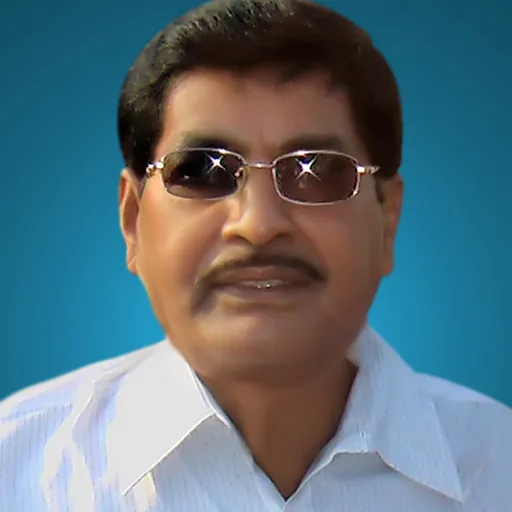
About Deo Kumar Singh
Lived 1950 – 2018 (aged 67). Deo Kumar Singh was a politician, guerrilla warfare and maoist, known for Far-left politics.
Deo Kumar Singh (/dɛv kuˈmɑr sɪŋ/ , 24 November 1950 – 21 March 2018), commonly known by his nom de guerre Arvind Ji, Vikash Ji and Sujeet Ji, was an Indian maoist militant, who was the leader in the Indian Maoist insurgency and the Politburo Member of Communist Party of India (Maoist), a banned Organisation in India. He spent his life as a student leader, a mass organiser and later led and strategised the guerrilla warfare against the Indian state.
Early life Deo Kumar Singh was born in Sukulchak village in the Jehanabad district of Bihar, the eldest child of a middle-class family. His father, Ram Narayan Singh was a government servant and mother Ajnaso Devi was a housewife. Singh had done schooling from Jehanabad and Patna districts in Bihar. He graduated in science from College of Commerce, Arts and Science, Patna. He then married Prabhawati Devi and shortly afterwards moved to Dehri on Sone, where he started a small food business.
Political life
He was known by several aliases including Arvind Ji, Vikash Ji, Sujeet Ji and Nishant. Singh started student politics in the era of Mahamaya Prasad Sinha and Jayaprakash Narayan movement. He soon entered left-wing politics under the influence of Naxalbari uprising led by Charu Majumdar and Kanu Sanyal.
He joined CPI(ML) Party Unity led by Narayan Sanyal and formed a mass organisation Mazdoor Kisan Sangram Samiti to campaign for land reform and to establish minimum wages for agricultural labourers. Later he became General secretary of Mazdoor Kisan Sangram Samiti and a member of the Central Organising Committee (top functionary body) of CPI(ML) Party Unity. After the merger of CPI(ML) Party Unity, Communist Party of India (Marxist–Leninist) People's War and Maoist Communist Centre of India, a new party Communist Party of India (Maoist) was formed on 21 September 2004; he became a member of the Central Committee and Central Military Commission. In 2013 he was elected to the politburo of the Communist Party of India (Maoist).
Role in Maoist movement Singh was one of the most wanted persons by the Indian government and nine states of India including Jharkhand, Bihar, Maharashtra and Chhattisgarh. Jharkhand government alone had announced an award of 10,000,000 for any information leading to his arrest. He was known as the mass organiser and backbone to set up and strategise guerrilla warfare under People's Liberation Guerrilla Army (India) in Indian forests against the imperialist state. He had proposed a new Strategy & Tactics, Critic Document , to central organising committee of CPI (ML) Party Unity which was accepted as a parallel thought of party line and played a key role in formation of Communist Party of India (Maoist) by unification of several left parties distributed across the country fighting for the same goal.
Life in prison Singh was arrested for the first time in 1990 by Bihar Police and kept as a political prisoner in Bankipur Central Jail, Patna. After three years, he was released on bail. On 12 June 2003, he was again arrested in Patna by Special Task Force and was held as a prisoner in Beur Central Jail, Patna, Jehanabad Jail and Bhagalpur Central Jail for more than two years.
Personal life Singh was affable and courteous with his mates and a charismatic person. After massacre of Arwal by police and the state ban on Mazdoor Kisan Sangram Samiti, Singh went underground; he addressed some press conferences and gave only a few interviews, which include those with Alex Perry of Time magazine and Ushinor Majumdar, a journalist from Tehelka.
Death On 21 March 2018, after two months of severe illness, Singh died of respiratory arrest and heart attack at Burha Pahar, Latehar, Jharkhand. Indian government and paramilitary forces of India wanted to see his body as an evidence of death but failed to recover, they detained his family members and did not allow them to attend the last rites. His body was cremated in Latehar forest in Jharkhand under the protection of PLGA surrounded by local people and sympathisers.
Monument
After his death, a bust made of granite on top of a 24-foot high concrete pillar has been created on 0.4 acre land at his native village Sukulchak. The process is currently underway by voluntary contribution involving physical effort and financial support.
Don’t just read it —
keep it.
Full-length biographies made to live with: read them, listen on the way to work, watch them tonight.
- E-book
- Audio
- Video
Instant download · yours to keep · every purchase keeps this site free
Important facts
People in Deo Kumar Singh's life
Named in this biography and alive at the same time




Related people
Same field, nearest in time






Contemporaries
People whose lives overlapped Deo Kumar Singh's
Frequently asked questions
Who was Deo Kumar Singh?
leader of the Indian Maoist movement (1950–2018)
When was Deo Kumar Singh born?
Deo Kumar Singh was born on 24 November 1950 in Jehanabad.
When did Deo Kumar Singh die?
Deo Kumar Singh died on 21 March 2018 in Latehar.
What was Deo Kumar Singh's occupation?
Deo Kumar Singh was a politician, guerrilla warfare and maoist.
What was Deo Kumar Singh known for?
Deo Kumar Singh was known for Far-left politics.
Sources & further reading
Cite this page
APA: Biography.guide. (2026). Deo Kumar Singh. https://biography.guide/deo-kumar-singh/
MLA: "Deo Kumar Singh." Biography.guide, https://biography.guide/deo-kumar-singh/.
Chicago: "Deo Kumar Singh." Biography.guide. https://biography.guide/deo-kumar-singh/.
Data last updated: 2026-09-22 · Spot an error? Report a correction.
Page generated 2026-09-27 05:10 UTC