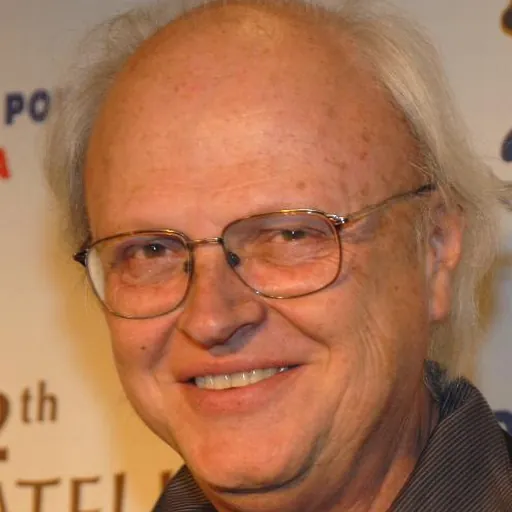
About Dennis Muren
Born 1946. Dennis Muren is an American director and film director.
Dennis Muren, A.S.C (born November 1, 1946) is an American film visual effects artist and supervisor. He has worked on the films of George Lucas, Steven Spielberg, and James Cameron, among others, and has won nine Oscars in total: eight for Best Visual Effects and a Technical Achievement Academy Award. The Visual Effects Society has called him "a perpetual student, teacher, innovator, and mentor."
He has been identified as "a pioneer in bringing a new wave of visual effects films to the public, opening the doors for screenwriters and directors to tell stories never before possible with a new realism through the use of his skills in cinematic arts and advanced technologies."
According to Spielberg, Muren "set the example at Industrial Light & Magic for visual effects excellence with effects that add strong, appropriate emotion to a shot and fit seamlessly into a movie."
Early life Muren was born in 1946 in Glendale, California, the son of Charline Louise (née Clayton) and Elmer Ernest Muren. His interest in photography began at eight years old while shooting model spaceships and dinosaurs. Muren quickly deepened his interest in effects by studying the films of John Fulton, Ray Harryhausen, and Howard Lydecker. He was fascinated by what he observed around him, in appearance and purpose, which led him to study the artwork of John Singer Sargent and Frank Frazetta. He never attended film school but was self-taught, and also learned through friendships with other young Los Angeles effects enthusiasts, including Jim Danforth and David Allen.
In 1965, after graduating from John Muir High School in Pasadena, California, and during a summer vacation at Pasadena City College as a business major, Muren raised $6,500 to make The Equinox, a 71-minute supernatural film incorporating the visual effects techniques he had grown up admiring. He sold it to producer Jack Harris who hired film editor Jack Woods to write and direct additional footage that added a demonic villain and made the film 82 minutes long. When Equinox was released in May 1970, Muren was credited as a producer despite having directed much of the film and created the special effects. Despite its mixed to weak reviews, the movie made enough money for Muren to recoup his investment, and in the years since, it has become a minor cult classic.
Industrial Light & Magic After earning his associate's degree, Muren struggled for years to find steady work as a visual effects cameraman in Hollywood. In 1976, Muren was hired as 2nd cameraman at Industrial Light & Magic (ILM), then an upstart visual effects studio founded by George Lucas, to work on Star Wars. The film was released in 1977 to wide critical and public acclaim and was for years the highest-grossing film of all time. With a weekend off, he immediately went to work on Spielberg’s Close Encounters of the Third Kind, photographing the Mothership for Douglas Trumbull. Former ILM president Jim Morris said Muren "could always find a way to look at a problem from a different angle and come up with a shot or scene that would be wondrous to watch". Over the next seven years, he would win five Oscars.
When Lucas started the Lucasfilm Computer Graphic Group in 1979, Muren hoped to use their technology to make better, original movie images. In a collaboration, he directed the group in the making of the CGI stained glass swordsman for Young Sherlock Holmes, earning an Oscar nomination.
The Graphics Group was sold in 1986, and Lucas started the ILM Computer Graphics Division with Muren helping voice ILM's needs for the digital image to mimic film qualities from lenses to film stocks, with user-friendly tools to mirror what humans see. He has said that his years spent observing and building an understanding of the physical world were invaluable to making virtual realities. The Abyss (1989), Terminator 2: Judgment Day (1991), and Jurassic Park (1993) followed. "It's going to be amazing. People are really going to believe that dinosaurs are walking this earth today," said Steven Spielberg. It was "the shock of the new," earning Muren an Oscar for Best Visual Effects (shared with Stan Winston, Phil Tippett, and Michael Lantieri).
Jurassic Park was the breakthrough that convinced Lucas that technology had advanced enough to make the Star Wars prequels. Director Peter Jackson was similarly inspired by the technical breakthrough in Jurassic Park to begin planning the Lord of the Rings trilogy (2001-2003) and King Kong (2005).
Personal life Muren is married to British documentary filmmaker and landscape architect Zara Muren, who produced and directed Dream of The Sea Ranch and The Landscape Architecture of Roberto Burle Marx. They have two children and live in California.
In June 1999, Muren was honored with a star on the Hollywood Walk of Fame, the first visual effects artist to be so recognized. 1983: In three days, Muren pre-visualized more than 100 shots for the Return of the Jedi speeder bike chase by hand-holding the first tiny video camera and taping a Barbie and Ken doll as well as cardboard tubes on a shag carpet. 1984: Used a Nikon F3 camera as a go-motion movie camera to photograph much of the Indiana Jones and the Temple of Doom mine car chase, saving construction and shooting time. 1985: Directed the Lucasfilm Graphics Group to make the first photo-real CGI character, the "Stained Glass Knight" for Young Sherlock Holmes, and the first theatrical-quality digital film composite. 1990: After The Abyss, Muren took a one-year sabbatical to study CGI software and hardware theory, to which he credits much of the success of the Terminator 2: Judgment Day digital effects. 1991: During his sabbatical, he assembled the first robust film scanning, manipulating, recording system for flawless, photo-real 2D and 3D image manipulation. It was used for Terminator 2: Judgment Day, then Death Becomes Her, and Jurassic Park, among other films. 2001: Used a real-time, on-set rendering and compositing preview viewing with a 6-axis camera movement for A.I. Artificial Intelligence.
Affiliations
American Society Of Cinematography Academy of Motion Picture Arts and Sciences Visual Effects Society
Engagements
Academy of Motion Pictures Arts & Sciences American Film Institute American Society of Cinematographers Smithsonian Institution Supercomputing Conference BFI Berlin Film Festival California Film Institute Dallas Film Festival UCLA Film Department UC Berkeley Film Series Liverpool University Film MARS 2019 Mill Valley Film Festival New Yorker Conference Paris Images Digital Conference San Francisco Art Institute SIGGRAPH ShowBiz Expo Yerba Buena Center for the Arts USA Film Festival USC Film Department VIEW Conference - Torino
Filmography and select awards Academy, BAFTA, Emmy, and VES Awards
Don’t just read it —
keep it.
Full-length biographies made to live with: read them, listen on the way to work, watch them tonight.
- E-book
- Audio
- Video
Instant download · yours to keep · every purchase keeps this site free
Important facts
People in Dennis Muren's life
Named in this biography and alive at the same time





Related people
Same field, nearest in time




Contemporaries
People whose lives overlapped Dennis Muren's


Frequently asked questions
Who is Dennis Muren?
American film special effects artist
When was Dennis Muren born?
Dennis Muren was born on 1 November 1946 in Glendale.
What is Dennis Muren's occupation?
Dennis Muren is a director and film director.
What nationality is Dennis Muren?
Dennis Muren is American.
Sources & further reading
Cite this page
APA: Biography.guide. (2026). Dennis Muren. https://biography.guide/dennis-muren/
MLA: "Dennis Muren." Biography.guide, https://biography.guide/dennis-muren/.
Chicago: "Dennis Muren." Biography.guide. https://biography.guide/dennis-muren/.
Data last updated: 2026-09-22 · Spot an error? Report a correction.
Portrait: Wikimedia Commons · author & licence
Page generated 2026-09-27 05:04 UTC