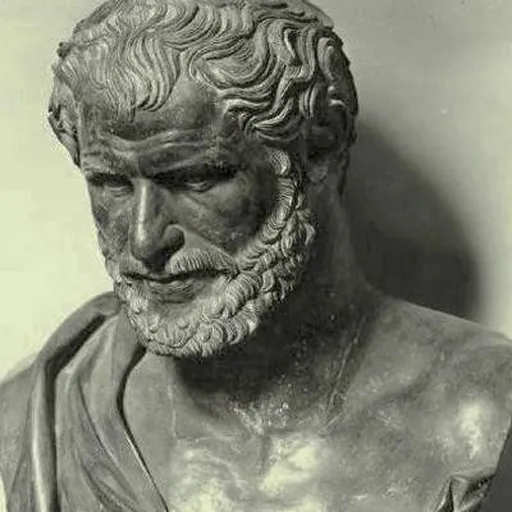
Democritus
Greek philosopher (c. 460–c. 370 BC)
About Democritus
Lived 460 BC – 360 BC (aged 99–100). Democritus was a Greek philosopher, mathematician and art historian.
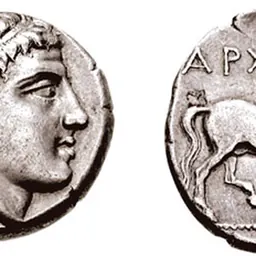
Democritus ( ; , Dēmókritos; – ) was a pre-Socratic Greek philosopher from Abdera, primarily remembered today for his formulation of an atomic theory of the universe. Democritus wrote extensively on a wide variety of topics.
None of Democritus' original work has survived, except through second-hand references. Many of these references come from Aristotle, who viewed him as an important rival in the field of natural philosophy. He was known in antiquity as the ‘laughing philosopher’ because of his emphasis on the value of cheerfulness.
Life
Although many anecdotes about Democritus' life survive, their authenticity cannot be verified and modern scholars doubt their accuracy.
According to Aristotle, Democritus was born in Abdera, on the coast of Thrace. He was a polymath and prolific writer, producing nearly eighty treatises on subjects such as poetry, harmony, military tactics, and Babylonian theology. Some called him a Milesian, and the name of his father too is stated differently. His birth year was fixed by Apollodorus in the first year of the 80th Olympiad, or 460 BC, while Thrasyllus had referred it to as the 3rd year of the 77th Olympiad. Democritus had called himself forty years younger than Anaxagoras. His father, Hegesistratus—or as others called him Damasippus or Athenocritus—was possessed of so large a property, that he was able to receive and treat Xerxes on his march through Abdera.
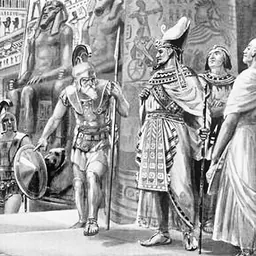
Democritus spent the inheritance left to him by his father on travels to distant countries, which he undertook to satisfy his extraordinary thirst for knowledge. He traveled over a great part of Asia, and, as some state, he even reached India and Aethiopia. We know that he wrote on Babylon and Meroe; he must also have visited Egypt, and Diodorus Siculus even states, that he lived there for a period of five years. He himself declared, that among his contemporaries none had made greater journeys, seen more countries, and made the acquaintance of more men distinguished in every kind of science than himself. Among the last he mentions in particular the Egyptian mathematicians (ἀρπεδονάπται; comp. Sturz, de Dialect. Maced. p. 98), whose knowledge he praises, without, however, regarding himself inferior to them. Theophrastus, too, spoke of him as a man who had seen many countries. It was his desire to acquire an extensive knowledge of nature that led him into distant countries at a time when travelling was the principal means of acquiring an intellectual and scientific culture; and after returning to his native land he occupied himself only with philosophical investigations, especially such as related to natural history. perhaps arose merely from the fact, that he mentioned them in his writings. The account of his hostility towards Anaxagoras, is contradicted by several passages in which he speaks of him in terms of high praise. It is further said, that he was on terms of friendship with Hippocrates, and some writers even speak of a correspondence between Democritus and Hippocrates; but this statement does not seem to be deserving of credit. As he was a contemporary of Plato, it may be that he was acquainted with Socrates, perhaps even with Plato, who, however, does not mention Democritus anywhere. Aristotle describes him and his views as belonging to the pre-Socratic period; but some scholars, such as Groen van Prinsterer, assert that there are symptoms in Plato which show a connection with Democritus, in Plato's language and style an imitation of Democritus. But this tradition is one of the inventions of a later age, which was fond of piquant anecdotes. It is more probable that he may have lost his sight by too severe application to study. This loss, however, did not disturb the cheerful disposition of his mind and his views of human life, which prompted him everywhere to look at the cheerful and comical side of things, which later writers took to mean, that he always laughed at the follies of men. and even the manner in which he died is characteristic of his medical knowledge, which, combined as it was with his knowledge of nature, caused a report, which was believed by some persons, that he was a sorcerer and a magician. His death is placed in the 4th year of the 105th Olympiad, or 357 BC, in which year Hippocrates also is said to have died. Democritus was a student of Leucippus. Early sources such as Aristotle and Theophrastus credit Leucippus with creating atomism and sharing its ideas with Democritus, but later sources credit only Democritus, making it hard to distinguish their individual contributions.
Atomism
It was Democritus who, in his numerous writings, carried out Leucippus's theory of atoms, and especially in his observations on nature. These atomists undertook the task of proving that the quantitative relations of matter were its original characteristics, and that its qualitative relations were something secondary and derivative, and of thus doing away with the distinction between matter and mind or power. In order to avoid the difficulties connected with the supposition of primitive matter with definite qualities, without admitting the coming into existence and annihilation as realities, and without giving up, as the Eleatic philosophers did, the reality of variety and its changes, the atomists derived all definiteness of phaenomena, both physical and mental, from elementary particles, the infinite number of which were homogeneous in quality, but heterogeneous in form. This made it necessary for them to establish the reality of a vacuum or space, and of motion. Motion, they said, is the eternal and necessary consequence of the original variety of atoms in the vacuum or space. All phaenomena arise from the infinite variety of the form, order, and position of the atoms in forming combinations. It is impossible, they add, to derive this supposition from any higher principle, for a beginning of the infinite is inconceivable. The atoms are impenetrable, and therefore offer resistance to one another. This creates a swinging, world-producing, and whirling motion. (This reminds us of the joke in the Clouds of Aristophanes about the god Δῖνος !) Now as similars attract one another, there arise in that motion real things and beings, that is, combinations of distinct atoms, which still continue to be separated from one another by the vacuum. The first cause of all existence is necessity, that is, the necessary predestination and necessary succession of cause and effect. This they called chance, in opposition to the νοῦς of Anaxagoras. But it does the highest honour to the mind of Democritus, that he made the discovery of causes the highest object of scientific investigations. He once said, that he preferred the discovery of a true cause to the possession of the kingdom of Persia. We must not, therefore, take the word chance (τυχή) in its vulgar acceptation. Aristotle understood Democritus rightly in this respect, as he generally valued him highly, and often says of him, that he had thought on all subjects, searched after the first causes of phenomena, and endeavored to find definitions. The only thing for which he censures him, is a disregard for teleological relations, and the want of a comprehensive system of induction. Democritus himself called the common notion of chance a cover of human ignorance (πρόφα-σιν ἰδίης ἀνοίης), and an invention of those who were too idle to think. The position of Parmenides appeared validated by the observation that where there seems to be nothing there is air, and indeed even where there is not matter there is something, for instance light waves. The atomists agreed that motion required a void, but simply rejected the argument of Parmenides on the grounds that motion was an observable fact. Therefore, they asserted, there must be a void.
His exact contributions are difficult to disentangle from those of his mentor Leucippus, as they are often mentioned together in texts. Their speculation on atoms, taken from Leucippus, bears a passing and partial resemblance to the 19th-century understanding of atomic structure that has led some to regard Democritus as more of a scientist than other Greek philosophers; however, their ideas rested on very different bases. Democritus, along with Leucippus and Epicurus, proposed the earliest views on the shapes and connectivity of atoms. They reasoned that the solidness of the material corresponded to the shape of the atoms involved. Using analogies from humans' sense experiences, he gave a picture or an image of an atom that distinguished them from each other by their shape, their size, and the arrangement of their parts. Moreover, connections were explained by material links in which single atoms were supplied with attachments: some with hooks and eyes, others with balls and sockets.
Besides the infinite number of atoms existing in infinite space, Democritus also supposed the existence of an infinite number of worlds, some of which resembled one another, while others differed from one another, and each of these worlds was kept together as one thing by a sort of shell or skin. He derived the four elements from the form of the atoms predominating in each, from their quality, and their relations of magnitude. In deriving individual things from atoms, he mainly considered the qualities of warm and cold. The warm or firelike he took to be a combination of fine, spheric, and very movable atoms, as opposed to the cold and moist. His mode of proceeding, however, was, first carefully to observe and describe the phaenomena themselves, and then to attempt his atomistic explanation, whereby he essentially advanced the knowledge of nature. He derived the soul, the origin of life, consciousness, and thought, from the finest fire-atoms; and in connection with this theory he made very profound physiological investigations. It was for this reason that, according to him, the soul while in the body acquires perceptions and knowledge by corporeal contact, and that it is affected by heat and cold. The sensuous perceptions themselves were to him affections of the organ or of the subject perceiving, dependent on the changes of bodily condition, on the difference of the organs and their quality, on air and light. Hence the differences, e. g., of taste, color, and temperature, are only conventional, the real cause of those differences being in the atoms. A purer and higher knowledge which he opposed to the obscure knowledge obtained through the medium of the senses, must therefore have been to him a kind of sensation, that is, a direct perception of the atoms and of space. For this reason he assumed the three criteria (κριτήρια): a. Phaenomena as criteria for discovering that which is hidden : b. Thought as a criterion of investigation : and c. Assertions as criteria of desires. Now as Democritus acknowledged the uncertainty of perceptions, and as he was unable to establish a higher and purely spiritual source of knowledge as distinct from perceptions, we often find him complaining that all human knowledge is uncertain, that in general either nothing is absolutely true, or at least not clear to us, that our senses grope about in the dark, and that all our views and opinions are subjective, and come to us only like something epidemic, as it were, with the air which we breathe. Archimedes states that Eudoxus of Cnidus, whose rigorous proof using the method of exhaustion that the volume of a cone is one-third the volume of cylinder is preserved in Euclid's Elements, was aided by the fact that Democritus had already asserted it to be true on the argument that this is true for the same reason that the pyramid has one-third the rectangular prism of the same base. Plutarch also reports that Democritus argued that the circular cross-section of a cone would need step-like sides, rather than being shaped like a cylinder, which Thomas Heath suggests may be an early version of infinitesimal calculus.
Anthropology Democritus thought that the first humans lived an anarchic and animal sort of life, foraging individually and living off the most palatable herbs and the fruit which grew wild on the trees, until fear of wild animals drove them together into societies. He believed that these early people had no language, but that they gradually began to articulate their expressions, establishing symbols for every sort of object, and in this manner came to understand each other. He says that the earliest men lived laboriously, having none of the utilities of life; clothing, houses, fire, domestication, and farming were unknown to them. Democritus presents the early period of mankind as one of learning by trial and error, and says that each step slowly led to more discoveries; they took refuge in the caves in winter, stored fruits that could be preserved, and through reason and keenness of mind came to build upon each new idea.
Ethics
In his ethical philosophy Democritus considered the acquisition of peace of mind (εὐθυμία) as the end and ultimate object of our actions. This peace, this tranquillity of the mind, and freedom from fear (φόβος and δεισιδαιμονία) and passion, is the last and fairest fruit of philosophical inquiry. Many of his ethical writings referenced this idea and its establishment, and the fragments relating to this question are full of the most genuine practical wisdom. Abstinence from too many occupations, a steady consideration of one's own powers, which prevents our attempting that which we cannot accomplish, moderation in prosperity and misfortune, were to him the principal means of acquiring the εὐθυμία. The noblest and purest ethical tendency, lastly, is manifest in his views on virtue and on good. Truly pious and beloved by the gods, he says, are only those who hate that which is wrong (ὅσοις ἐχθρὸν τὸ ἀδικεῖν). The purest joy and the truest happiness are only the fruit of the higher mental activity exerted in the endeavour to understand the nature of things, of the peace of mind arising from good actions, and of a clear conscience. He also wrote a treatise on the purpose of life and the nature of happiness. He held that "happiness was not to be found in riches but in the goods of the soul and one should not take pleasure in mortal things". Another saying that is often attributed to him is "The hopes of the educated were better than the riches of the ignorant". He also stated that "the cause of sin is ignorance of what is better", which become a central notion later in the Socratic moral thought. Another idea he propounded which was later echoed in the Socratic moral thought was the maxim that "you are better off being wronged than doing wrong".
Aesthetics Later Greek historians consider Democritus to have established aesthetics as a subject of investigation and study, as he wrote theoretically on poetry and fine art long before authors such as Aristotle. Specifically, Thrasyllus identified six works in the philosopher's oeuvre which had belonged to aesthetics as a discipline, but only fragments of the relevant works are extant; hence of all Democritus writings on these matters, only a small percentage of his thoughts and ideas can be known.
Works Of the extent of his knowledge, which embraced not only natural sciences, mathematics, mechanics (Brandis, in the Rhein. Mus. iii. p. 134, &c.), grammar, music, and philosophy, but various other useful arts, we may form some notion from the list of his numerous works which is given by Diogenes Laertius (9.46-49), and which, as Diogenes expressly states, contains only his genuine works. The grammarian Thrasyllus, a contemporary of the emperor Tiberius, arranged them, like the works of Plato, into tetralogies. Unfortunately, not one of his works has come down to us, and the treatise which we possess under his name is considered spurious. Callimachus wrote glosses upon his works and made a list of them; but they must have been lost at an early time, since even Simplicius, writing in the 6th century AD, does not appear to have read them, and since comparatively few fragments have come down to us, and these fragments refer more to ethics than to physical matters. His works were composed in the Ionic dialect, though not without some admixture of the local peculiarities of Abdera. They are nevertheless much praised by Cicero on account of the poetical beauties and the liveliness of their style, and are in this respect compared even with the works of Plato. Pyrrho is said to have imitated his style, and even Timon praises it, calling it περίφρονα καὶ ἀμφίνοον λέσχην.
The assertion of Democritus having a particular association with laughter existed by the time of Hippolytus of Rome.
He was given the nickname Gelasinos (Γελασῖνος, "Dimple" or "the Laughing One") because he was known for laughing at the empty ambition of human beings.
Don’t just read it —
keep it.
Full-length biographies made to live with: read them, listen on the way to work, watch them tonight.
- E-book
- Audio
- Video
Instant download · yours to keep · every purchase keeps this site free
Important facts
People in Democritus's life
Named in this biography and alive at the same time


Related people
Same field, nearest in time

Contemporaries
People whose lives overlapped Democritus's

Frequently asked questions
Who was Democritus?
Greek philosopher (c. 460–c. 370 BC)
When was Democritus born?
Democritus was born in 460 BC in Ancient Abdera, Miletus.
When did Democritus die?
Democritus died in 360 BC in Greece.
What was Democritus's occupation?
Democritus was a philosopher, mathematician and art historian.
What nationality was Democritus?
Democritus was Greek.
Sources & further reading
Cite this page
APA: Biography.guide. (2026). Democritus. https://biography.guide/democritus/
MLA: "Democritus." Biography.guide, https://biography.guide/democritus/.
Chicago: "Democritus." Biography.guide. https://biography.guide/democritus/.
Data last updated: 2026-09-20 · Spot an error? Report a correction.
Portrait: Wikimedia Commons · author & licence
Page generated 2026-09-27 05:27 UTC