About Declán of Ardmore
Declán of Ardmore was a catholic priest.
Declán of Ardmore (; ; ; died 5th century AD), also called Déclán, was an early Irish saint of the Déisi Muman who was remembered for having converted the Déisi to Christianity in the late 5th century and for having founded the monastery of Ardmore (Ard Mór) in what is now County Waterford.. The principal source for his life and ministry is a Latin Life of the 12th century. Like Ailbe of Emly, Ciarán of Saigir and Abbán of Moyarney, Declán is presented as a Munster saint who preceded Saint Patrick in bringing Christianity to Ireland. He was regarded as a patron saint of the Déisi of East Munster. It is witnessed by two manuscript texts which Charles Plummer has shown to derive from the same original: (1) Dublin, TCD, MS E.3.11 (dubbed T by Plummer), f. 66b-71d; and (2) a somewhat more damaged version in Dublin, Primate Marsh's Library, MS V.3.4 (Plummer's M), f. 101 ff. Those two manuscripts are also collectively known as the Dublin Collection (or the Codex Kilkenniensis though the name is also used to refer to the Primate Marsh's Library manuscript only). In its received form, the Life leans heavily on the Life of Saint Ailbe of Emly in the Codex Salmanticensis, but earlier materials may have been incorporated. Declán is emphatically designated as a bishop of the Déisi, which appears to echo the monastery's political ambitions in the 12th century when the Irish Church was reformed into a diocesan system following the Synod of Rathbreasail and Synod of Kells. Ardmore aspired to the status of episcopal see in the new diocese, but the privilege went instead to Lismore, founded by St Mochuda. The two remaining copies are Dublin, Royal Irish Academy MS 23 M 50, pp. 109–120, in the hand of one John Murphy "na Raheenach" and dated 1740, and a further manuscript once in private possession. The exemplar that underlies either of them is itself an imperfectly transmitted text. and Rawlinson B 502.
Family background and career Mad toich duit, a Hére, "If thou hast a right, O Erin, dot chobair cing báge, to a champion of battle to aid thee, thahut cenn céit míle, thou hast the head of a hundred thousands, Declan Arde máre Declan of Ardmore." (Félire Óengusso, 24 July)
It was through his father that Declán belonged to the royal dynasty of the Déisi Muman. Declán's mother Dethiden or Dethidin, as she is called in the Latin Life (§ 3), is not given any pedigree in the sources.
In the Latin Life, Declán first embarks on a journey to Rome, where he studied and was ordained bishop by the Pope. The relevant Lives are all found in the so-called Dublin Collection (see above), which bears a stamp of editorial intervention.
Their testimony, late though it seems, has often been treated in relation to the historical question of pre-Patrician Christianity in the south of Ireland. It has been argued that before the coming of Patrick, the south coast of Munster would have provided the most likely point of entry for the introduction of Christianity via Britain or via Gaul. The settlements of the Déisi and the Uí Liatháin in southwest Wales, as evidenced by the distribution of ogam stones, provided an important connection between Britain and Ireland. A key aspect of this overseas link, the import of slaves, usually British Christians, by Irish raiders would have directly exposed Munster to the influence of Christianity. Further, Munster, lying opposite to Gaul, would have represented a first destination for Irish trading connections with the Continent. In the context of the wine trade, this is in some way corroborated by the archaeological record for pottery in Munster settlements. The fact that a missionary sent by Rome, Palladius, had been active before St Patrick, in 431, possibly in Leinster, did not sit well with its agenda. In the writings of Armagh scholars, notably Tírechán and Muirchú, Palladius' activities were therefore belittled as a failure, ignored or, as T.F. O'Rahilly famously argues in his hypothesis of the 'Two Patricks', silently conflated with those of Patrick. In Armagh historiography, the conversion of Munster became embodied in the story of the conversion of Óengus mac Nad Froích by St Patrick at Cashel, first told by Tírechán and subsequently elaborated many times over.
The Lives of Ailbe, Declán, Ciarán and Abbán in the Dublin Collection appear to reflect the need of the Munster houses to offer some counterweight against the Patrician dossier promoted by Armagh, even though they do not deny the national importance of Saint Patrick. Historian Richard Sharpe proposed the earlier Life of Ailbe in the Codex Salmanticensis was originally composed in the eighth century to further the cause of the Éoganacht church of Emly. In the same century, the Law of Ailbe (784) was issued, possibly in response to the Law of Patrick.
The most substantial achievement is the hagiographic compilation known as Magnum Legendarium Austriacum (The Great Austrian Legendary), begun sometime in the 1160s or 1170s. The prologue to a recension of St Patrick's Life preserved incomplete at Göttweig (Austria) asserts that disciples of one Mansuetus, an Irish bishop of Toul, had set themselves up as bishops in Ireland to prepare the way for St Patrick. St Declan's Stone on Ardmore beach; supposedly, it carried his bell to Ireland. Declán has enjoyed a steady reputation in Waterford, where many church dedications still name him. The path walked by Declan from Ardmore to Cashel, County Tipperary has been restored as St Declan's Pilgrim Path, and an annual walk of the path, nicknamed the "Irish Camino", is organised from 24 to 28 July, beginning in 2013.
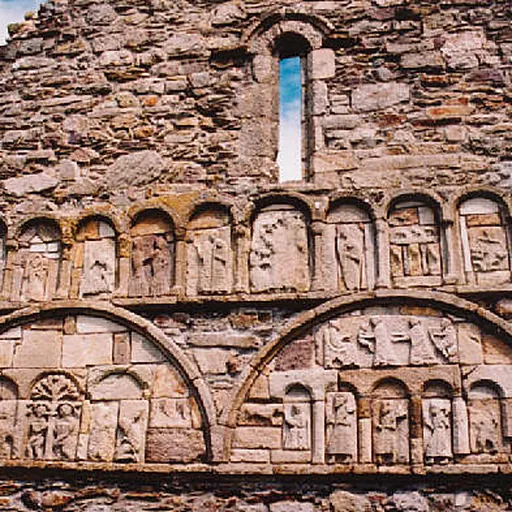
A round tower still stands at the site of the saint's monastery at Ardmore as well as earlier ecclesiastical ruins, such as a stone oratory and a small stone church. The diocese of Ardmore and its episcopal church lasted until the 13th century.
Don’t just read it —
keep it.
Full-length biographies made to live with: read them, listen on the way to work, watch them tonight.
- E-book
- Audio
- Video
Instant download · yours to keep · every purchase keeps this site free
Important facts
Related people
Same field, nearest in time



Frequently asked questions
Who was Declán of Ardmore?
Irish bishop
When was Declán of Ardmore born?
Declán of Ardmore was born in Munster.
What was Declán of Ardmore's occupation?
Declán of Ardmore was a catholic priest.
Sources & further reading
· Wikipedia: Declán of Ardmore
Cite this page
APA: Biography.guide. (2026). Declán of Ardmore. https://biography.guide/declan-of-ardmore/
MLA: "Declán of Ardmore." Biography.guide, https://biography.guide/declan-of-ardmore/.
Chicago: "Declán of Ardmore." Biography.guide. https://biography.guide/declan-of-ardmore/.
Data last updated: 2026-09-23 · Spot an error? Report a correction.
Portrait: Wikimedia Commons · author & licence
Page generated 2026-09-27 05:05 UTC