
About Deborah Castillo
Born 1971. Deborah Castillo is a Venezuelan artist.
Deborah Castillo (born Caracas, Venezuela, 1971) is a Venezuelan artist who currently resides in Mexico. She is known for her controversial works, which challenge the chauvinism of many historical and contemporary political icons. Castillo has explored various artistic media, including video, photography, sculpture, and performance art, disciplines that she intertwines to create complex works that make political statements. Castillo's artist residencies include The Banff Center's Artist in Residence Program in Visual Arts; the Atlantic Center for the Arts #151, New Smyrna Beach, Florida (2014); and the London Print Studio, UK (2007).
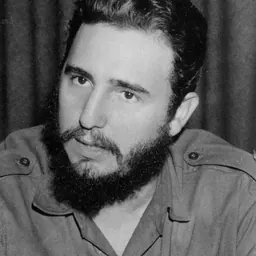
Work The most constant feature in Deborah Castillo's work is her own body, which she uses to make social and political critiques. Many of her performances and installations challenge male authority and political figures by using eroticism to question the dominance of individual male heroic figures in the public imagination and proposing critical making as an effective form of subversion. In Emancipatory Kiss (2013), a performance piece, she repeatedly kisses the face of the gold-colored bust of Venezuelan liberator Símon Bolívar. In Demagogue (2015), also a performance video, she masturbates the nose of a clay military figure. Art critic Irina Troconis has identified the military figure Castillo so often singles out as the subject of her criticism as the caudillo: "Though the head’s identity was never explicitly revealed, there was no mystery regarding what it represented; the frown, the beard, and the military epaulettes gave it the authoritative air of the caudillo, and brought to mind the boundless power historically embedded in that figure and its many visual iterations in the urban and political landscape of Latin America." In particular, Castillo challenges Hugo Chavez's Bolívarian Revolution in Venezuela by attacking Bolívar. In works such as Sisifo (2013), she destroys a bust of Bolívar, and in Slapping Power (2015), she slaps two wet clay busts of military figures. Art historian Sara Garzón has compared Castillo's "iconoclastic" pieces that attack effigies of Bolívar to social protest movements that topple monuments; the artist trivializes the heroic image while performing civil disobedience. Her 2018 exhibition, "Parricidios," at El Museo de Arte Carrillo Gil (MACG) in Mexico City featured Las Dictadoras (2017), a sculptural configuration of five female bodies that parodied the five iconic male leaders Mao ZeDong, Joseph Stalin, Karl Marx, Vladimir Lenin and Fidel Castro. Castillo was forced to leave Venezuela, at one point going into hiding, because its totalitarian regime censored her artwork and its political critiques.
Don’t just read it —
keep it.
Full-length biographies made to live with: read them, listen on the way to work, watch them tonight.
- E-book
- Audio
- Video
Instant download · yours to keep · every purchase keeps this site free
Important facts
People in Deborah Castillo's life
Named in this biography and alive at the same time


Related people
Same field, nearest in time


Contemporaries
People whose lives overlapped Deborah Castillo's



Frequently asked questions
Who is Deborah Castillo?
Venezuelan visual artist
When was Deborah Castillo born?
Deborah Castillo was born in 1971 in Caracas.
What is Deborah Castillo's occupation?
Deborah Castillo is an artist.
What nationality is Deborah Castillo?
Deborah Castillo is Venezuelan.
Sources & further reading
Cite this page
APA: Biography.guide. (2026). Deborah Castillo. https://biography.guide/deborah-castillo/
MLA: "Deborah Castillo." Biography.guide, https://biography.guide/deborah-castillo/.
Chicago: "Deborah Castillo." Biography.guide. https://biography.guide/deborah-castillo/.
Data last updated: 2026-09-20 · Spot an error? Report a correction.
Page generated 2026-09-27 05:26 UTC