
About David Riesman
Lived 1909 – 2002 (aged 92). David Riesman was an American sociologist, lawyer, university teacher, writer and jurist, known for The Lonely Crowd.
David Riesman (September 22, 1909 – May 10, 2002) was an American sociologist, educator, and best-selling commentator on American society.
Career Born to a wealthy German Jewish family, Riesman attended Harvard College, where he graduated in 1931 with a degree in biochemistry. He attended Harvard Law School, where he was a member of the Harvard Law Review. Riesman clerked for Supreme Court Justice Louis Brandeis between 1935 and 1936. He also taught at what is now the University at Buffalo Law School and at the University of Chicago.
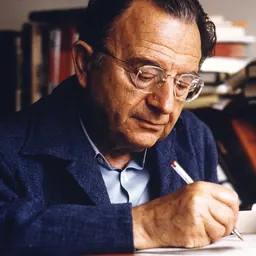
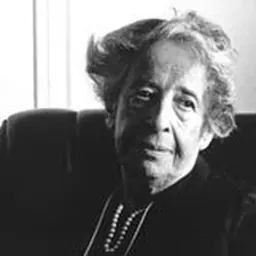
He worked for Sperry Gyroscope company during the war. After a fellowship at Yale to write The Lonely Crowd, he returned to Chicago. In 1958, he became a university professor at Harvard. He was a member of the American Academy of Arts and Sciences (1955) and the American Philosophical Society (1974). Intellectually he was influenced most by Erich Fromm, as well as Carl Friedrich, Hannah Arendt, Leo Löwenthal, Robert K. Merton, Paul Lazarsfeld, Paul Goodman, Martha Wolfenstein, and Nathan Leites. He widely referenced the works of Thorstein Veblen, Max Weber, and Sigmund Freud.
The Lonely Crowd
Daniel Horowitz says The Lonely Crowd: A Study of the Changing American Character, in 1950 quickly became the nation’s most influential and widely read mid-century work of social and cultural criticism. It catapulted its author to the cover of Time magazine in 1954, making Riesman the first social scientist so honored.... Riesman offered a nuanced and complicated portrait of the nation’s middle and upper-middle classes.... Riesman pictured a nation in the midst of a shift from a society based on production to one fundamentally shaped by the market orientation of a consumer culture. He explored how people used consumer goods to communicate with one another.
The book is largely a study of modern conformity, which postulates the existence of the "inner-directed" and "other-directed" personalities. Riesman argued that the character of post-World War II American society impels individuals to "other-directedness," the preeminent example being modern suburbia, where individuals seek their neighbors' approval and fear being outcast from their community. That lifestyle has a coercive effect, which compels people to abandon "inner-direction" of their lives, and it induces them to take on the goals, ideology, likes, and dislikes of their community.
This creates a tightly grouped crowd of people that is yet incapable of fulfilling each other's desires. The book is considered a landmark study of American character. Riesman was a major public intellectual as well as a sociologist and represented an early example of what sociologists now call "public sociology".
American higher education
In addition to his many other publications, Riesman was also a noted commentator on American higher education, publishing, with his seminal work, The Academic Revolution, which was co-written with Christopher Jencks. In it, Riesman sums up his position by stating, "If this book has any single message it is that the academic profession increasingly determines the character of undergraduate education in America."
Riesman highlights the effects of the "logic of the research university," which focuses upon strict disciplinary research. That both sets the goals of the research university and produces its future professors. Riesman noted that the logic isolated any patterns of resistance that might challenge the university's primary purpose as disciplinary research, dashing their chances of success.
Don’t just read it —
keep it.
Full-length biographies made to live with: read them, listen on the way to work, watch them tonight.
- E-book
- Audio
- Video
Instant download · yours to keep · every purchase keeps this site free
Important facts
Family & relationships
People in David Riesman's life
Named in this biography and alive at the same time





Related people
Same field, nearest in time




Contemporaries
People whose lives overlapped David Riesman's


Frequently asked questions
Who was David Riesman?
American sociologist and educator (1909–2002)
When was David Riesman born?
David Riesman was born on 22 September 1909 in Philadelphia.
When did David Riesman die?
David Riesman died on 10 May 2002 in Binghamton.
What was David Riesman's occupation?
David Riesman was a sociologist, lawyer, university teacher, writer and jurist.
What was David Riesman known for?
David Riesman was known for The Lonely Crowd.
What nationality was David Riesman?
David Riesman was American.
Sources & further reading
Cite this page
APA: Biography.guide. (2026). David Riesman. https://biography.guide/david-riesman-sociologist/
MLA: "David Riesman." Biography.guide, https://biography.guide/david-riesman-sociologist/.
Chicago: "David Riesman." Biography.guide. https://biography.guide/david-riesman-sociologist/.
Data last updated: 2026-09-22 · Spot an error? Report a correction.
Page generated 2026-09-27 05:32 UTC