
About David Fraser
Born 2000. David Fraser is a military personnel.
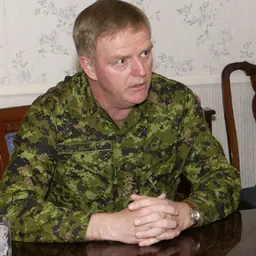
David Allison Fraser is a retired Canadian Forces officer who served as a major-general in Land Force Command. The country’s first general officer to command American troops in combat since the Second World War, Fraser's most noteworthy role was as brigadier-general during Operation Medusa, which took place in Afghanistan from September 1–17, 2006 as part of NATO’s coalition efforts in the region.
Since retiring from the Canadian Armed Forces in 2011 after 32 years of service, Fraser has worked in the private sector, currently serving as president of AEGIS Six Corporation.
Military career Fraser joined the Canadian Armed Forces after graduating from Carleton University in 1980. His responsibilities and positions over the next 19 years were varied, including acting as chief of staff for the Alberta District, working as a Canadian officer responsible for domestic and international planning, and commanding Infantry Battalion in Canada and Bosnia. Fraser then worked as director of the Land Force Command Reserve Restructure in Ottawa from 2001 to 2003 and as co-director of the Bi-National Planning Group in Colorado Springs from 2003 to 2005. He deployed to Afghanistan in January 2006, where, as a brigadier-general, he commanded thousands of NATO troops. One of his main responsibilities there was to lead Operation Medusa in southern Afghanistan that September. Fraser subsequently acted as commandant of the Canadian Forces College in Toronto from 2007 to 2009 and led the Joint Headquarters Renewal Project in 2009 and 2010. He directed the Land Force Doctrine and Training System, and the 1st Canadian Division until 2011, retiring from military service that year.
Operation Medusa Operation Medusa, which took place from September 1 to 17, 2006 during the second Battle of Panjwaii, was a seminal moment in Canada’s involvement in the Invasion of Afghanistan. Intended to secure the authority of the democratic government of Afghanistan in the south of the country, the Canada-led offensive was the largest battle fought by Canadian troops since the country’s involvement in the Korean War.
Fraser was sent to the southern Afghan province of Kandahar, where, as Commander of Regional Command South, he controlled thousands of NATO troops in the southern Afghan provinces of Kandahar, Helmand, Zabul, Uruzgan, Daikundi and Nimroz. The battle spanned a stretch of the Arghandab River valley west of the city of Kandahar. The Taliban amassed on the north side as NATO forces pushed forward from the southern bank. Then general and Chief of Defence Staff Rick Hillier commented afterward on the toll of the first two days of the operation, underscoring the loss of life. Charles Company of the Royal Canadian Regiment was hit particularly hard. On September 4, an American Fairchild Republic A-10 Thunderbolt II ground attack aircraft mistakenly strafed the company as it was preparing to attack a Taliban position, resulting in one death and thirty injuries. Despite this and other unforeseen difficulties such as running out of ammunition, In his book Operation Medusa: The Furious Battle That Saved Afghanistan from the Taliban, Fraser assessed the effect of the operation, calling it a costly yet necessary fight that enabled Afghanistan to continue as a western installed democracy. The efforts of the Canadians and their allies were instrumental in enabling western back Afghan leaders to develop a new constitution, to ensure free and democratic elections, to make it possible for more girls to go to school, and to initiate reform in defence, justice and finance structures within the country.
Controversy
Despite its success, the operation and its aftermath were not without controversy. In 2007 and 2008, newspaper reports revealed that the Leopard tanks sent to Afghanistan had been taken from Canadian monuments. Fraser had requested tanks for the operation to make advances into Taliban controlled settlements while minimizing collateral damage. He commented that the coalition’s attempts to remove the Taliban while attacking al-Qaeda complicated the international community’s ability to complete its mission. According to Fraser, this change in strategy left a vacuum of leadership in its wake.
In 2017, Harjit Sajjan, the Minister of National Defence, who had served as the primary liaison between Canadian commanders and local Afghan leaders during the conflict, claimed that he had been the architect of the operation. His apology included reference to David Fraser, hailing Fraser’s leadership as elemental to Operation Medusa’s success. In 2016, he delivered the keynote address at the FABTECH Canada conference, focusing his remarks on the nature of effective teamwork and leadership. The book offers the senior commander’s view of the political, strategic and tactical complexities of the bloodiest battle in NATO’s history. It has been described by Murray Brewster as a cautionary tale of political hubris that offered lessons for Canada’s current peacekeeping missions. while Murray Brewster commented that it spoke volumes with its dignified omission of Harjit Sajjan and the ensuing controversy. Taillon also deemed the book a "corrective for those who believe that fighting or reading about the ‘last war’ is of little value."
Medals
Degree of Officer
Don’t just read it —
keep it.
Full-length biographies made to live with: read them, listen on the way to work, watch them tonight.
- E-book
- Audio
- Video
Instant download · yours to keep · every purchase keeps this site free
Important facts
People in David Fraser's life
Named in this biography and alive at the same time


Related people
Same field, nearest in time





Contemporaries
People whose lives overlapped David Fraser's



Frequently asked questions
Who is David Fraser?
Canadian general
When was David Fraser born?
David Fraser was born in 2000.
What is David Fraser's occupation?
David Fraser is a military personnel.
Sources & further reading
· DBpedia: David Fraser (Canadian general)
Cite this page
APA: Biography.guide. (2026). David Fraser. https://biography.guide/david-fraser-military-personnel/
MLA: "David Fraser." Biography.guide, https://biography.guide/david-fraser-military-personnel/.
Chicago: "David Fraser." Biography.guide. https://biography.guide/david-fraser-military-personnel/.
Data last updated: 2026-09-20 · Spot an error? Report a correction.
Page generated 2026-09-27 05:34 UTC