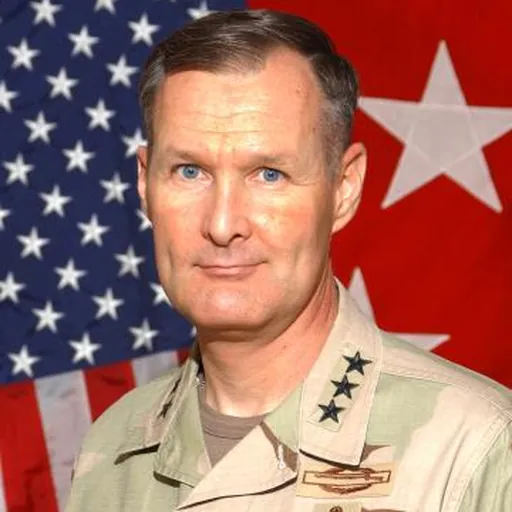
About David Barno
Born 1954. David Barno is an American military personnel, pedagogue, military commander and university teacher.
David William Barno (born July 5, 1954) is a retired lieutenant general of the United States Army. He was commander of Combined Forces Command-Afghanistan from 2003 to 2005.
Early life Barno is a native of Endicott, New York. He is a graduate of Union Endicott High School Class of 1972.
Education Barno's military education includes the United States Military Academy (USMA) at West Point, New York (Class of 1976); Infantry Officer Basic and Advanced courses, Command and General Staff College, and the U.S. Army War College.
In his civilian studies, he earned a Master of Arts degree in National Security and Strategic Studies at Georgetown University. He started his career with the 25th Infantry Division, where he served as a rifle, weapons and scout platoon leader. He commanded companies in the 25th Infantry Division and the 1st Ranger Battalion, leading a Ranger Rifle Company during the invasion of Grenada in 1983.
In 1988, Barno joined the 2nd Ranger Battalion as the S-3 (Operations) officer where he played a key role in the planning and execution of the subsequent invasion of Panama. In December 1989, he parachuted with the 75th Ranger Regiment into Rio Hato, Panama during Operation Just Cause. He subsequently served as the aide de camp to the commanding general of the U.S. Army Training and Doctrine Command.
General Barno commanded the 3rd Battalion, 505th Parachute Infantry Regiment in the 82nd Airborne Division at Fort Bragg, North Carolina, followed by command of the 2nd Ranger Battalion at Ft Lewis, Washington. Following attendance at the Army War College, he commanded the Warrior Brigade, a multi-functional support brigade at Fort Polk, Louisiana, which supported the Joint Readiness Training Center. He then directed the Joint Task Force training program at Joint Forces Command, Norfolk, Virginia. Between three Ranger Battalion tours and command of the 3rd Bn, 505th PIR in the 82nd Airborne Division, he accumulated over 110 parachute jumps during his career, to include a 500-foot night-time parachute assault into Panama in 1989, during which most jump aircraft were struck by enemy fire. He was twice awarded the Combat Infantryman's Badge, and earned the Ranger Tab and Master Parachutist Badge with Combat Jump Star.
Following selection to brigadier general, General Barno served as the assistant division commander (operations) for the 25th Infantry Division as well as deputy director of operations, U.S. Pacific Command. Barno was promoted to major general in 2001 and served as the commanding general, Ft Jackson, SC, the Army's largest training base. During his time at Ft Jackson, he led Chief of Staff Army Task Forces on the Future Force Soldier and Warrior Ethos. Barno was the principal author of the Army's transformational 2003 Warrior Ethos which dictates: "Mission First, Never Accept Defeat, Never Quit, and Never Leave Behind a Fallen Comrade." In January 2003, Barno was deployed to Hungary as the Commanding General of Task Force Warrior tasked to train Free Iraqi Forces in support of Operation Iraqi Freedom.
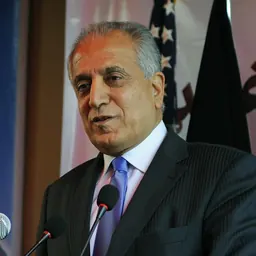
General Barno was promoted to lieutenant general (three stars) in 2003 at age 49, becoming the first member of his West Point class of 1976 to achieve that distinction. In October 2003, he deployed to Afghanistan where he was designated to establish a three-star headquarters in Kabul and ultimately command over 20,000 Coalition Forces for 19 months as the first commander, Military Operations-Afghanistan (later redesignated Combined Forces Command-Afghanistan, United States Central Command, Afghanistan). During his tenure, he forged a close relationship with U.S. Ambassador Zalmay Khalilzad, co-locating his command at the US Embassy compound and creating an integrated civil-military Counter-insurgency campaign plan for Afghanistan focused on the Afghan population. In the absence of an official US military post-Vietnam COIN doctrine, he based his counter-insurgency strategy off his U.S. Military Academy Revolutionary Warfare class notes and COIN works by T. E. Lawrence, the USMC Small Wars Manual, Lewis Sorley's A Better War, and Learning to Eat Soup With a Knife by John Nagl.
After commanding in Afghanistan, General Barno was reassigned to The Pentagon in Washington, DC where he served briefly on the Army Staff as the assistant chief of staff for installation management (ACSIM) until his decision to retire in the spring of 2006.
Post-military career
Following his retirement from active duty, Barno served as the director of the Near East South Asia Center for Strategic Studies (NESA) at the National Defense University in Washington, D.C. from 2006 until April 2010. During this time, he testified over a dozen times before Congress on counter-insurgency in Afghanistan and Pakistan, Al Qaeda and Joint Professional Military Education, as well as lectured and wrote extensively on those topics. Barno also travelled widely throughout the Middle East and South Asia region in his NESA director capacity, and lectured at Harvard, Yale, Tufts, Johns Hopkins SAIS, West Point, and the US Army and Naval War Colleges. From 2007 to 2009, he also served as the Chairman of the Advisory Committee on Operation Iraqi Freedom and Operation Enduring Freedom Veterans and Families for the Secretary of Veterans' Affairs.
Barno joined the Center for a New American Security (CNAS) as a senior advisor and Senior Fellow in May 2010, the Washington Post, and numerous military journals. He has appeared in interviews for a wide range of television and radio outlets, including CNN, BBC World, PBS NewsHour, C-SPan's Washington Journal, Al Jazeera, Fox News, Government Matters and NPR.
He is a member of the Council on Foreign Relations and the International Institute of Strategic Studies.
Military and government issued awards
General Barno's many awards and decorations include the Defense Distinguished Service Medal, the Distinguished Service Medal with oak leaf cluster, the Defense Superior Service Medal (three awards), the Legion of Merit with oak leaf cluster, the Bronze Star Medal, the Meritorious Service Medal (with silver and bronze oak leaf clusters), the NATO Meritorious Service Medal, the Department of State Meritorious Honor Award, the Army Commendation and Achievement Medals and several campaign and unit awards for combat actions. He also has been awarded the Combat Infantryman's Badge Master Parachutist Badge with Combat Star, Pathfinder Badge, the Ranger Tab, and the German parachutist badge.
Dates of rank
Don’t just read it —
keep it.
Full-length biographies made to live with: read them, listen on the way to work, watch them tonight.
- E-book
- Audio
- Video
Instant download · yours to keep · every purchase keeps this site free
Important facts
People in David Barno's life
Named in this biography and alive at the same time



Related people
Same field, nearest in time




Contemporaries
People whose lives overlapped David Barno's



Frequently asked questions
Who is David Barno?
United States Army general
When was David Barno born?
David Barno was born on 5 July 1954 in Endicott.
What is David Barno's occupation?
David Barno is a military personnel, pedagogue, military commander and university teacher.
What nationality is David Barno?
David Barno is American.
Sources & further reading
Cite this page
APA: Biography.guide. (2026). David Barno. https://biography.guide/david-barno/
MLA: "David Barno." Biography.guide, https://biography.guide/david-barno/.
Chicago: "David Barno." Biography.guide. https://biography.guide/david-barno/.
Data last updated: 2026-09-23 · Spot an error? Report a correction.
Portrait: Wikimedia Commons · author & licence
Page generated 2026-09-27 05:07 UTC