
About David Bache
Lived 1925 – 1994 (aged 69). David Bache was a British engineer and car designer, known for Automobile design.
David Ernest Bache (14 June 1925 – 26 November 1994) was a German-born English automobile designer. For much of his career he worked with Rover.
Early life Bache was born in Mannheim, Germany, the son of Aston Villa and England footballer Joe Bache who was coaching in Mannheim following his retirement. Towards the end of World War II David joined the Austin Motor Company as an engineering apprentice. When he had finished his apprenticeship he moved to Austin's design office.
Career Austin In the Austin design office Bache worked under Dick Burzi, recruited from Lancia by Austin in 1929. One of his first jobs was to design the dashboard of the Austin A30.
Rover
In 1954 Bache moved to Rover in Solihull, becoming Rover's first ever stylist; the term 'stylist' was used at the time to differentiate the role from that of design engineer. His first task was to update the Rover 60, 75 and 90 models. He raised the boot height and enlarged the rear window. A year later he modified the frontal treatment, strengthening the detail and the new David Bache styled cars lasted ten more years with a very minor alteration to the grille inset.
He was also responsible for giving the Land Rover Series II a more domesticated appearance than its more agricultural predecessor. The revised shape, completed in just six weeks lived on, little changed, until Land Rover Defender production ceased in early 2017.
Rover 3-litre The shape of cars was changing dramatically during the 1950s as soft rounded curves gave way to straight lines and sharp corners. Improvements in construction enabled engineers to dispense with a separate chassis, allowing passengers to sit lower in the vehicle. The development of curved glass also gave stylists new opportunities. A visit to the 1955 Paris Auto Show would have a profound effect on Bache's style vocabulary. He was very taken with the revolutionary new Citroen DS, as well as the imposing Facel Vega. Other influences were the Italian coach-builder Ghia's designs for Chrysler, and work of Pininfarina, who had been commissioned to produce a coupé and convertible on the Rover P4 chassis prior to Bache's arrival.
Rover P5 3-litreBache created the shape for the P5, then expected to be a smaller, higher volume model of a similar size to the current Ford Zephyr. Bache's first attempts were distinctly modern and anticipated generous use of chrome fittings. It did not please Rover Managing Director Maurice Wilks who, before Bache's arrival had closely overseen all styling. "It's a head turner", Wilks explained, "The Rover Company don't make head-turners. We like to make vehicles which pass unobtrusively and are not noticed." Bache went back to the drawing board and came up with something more like an evolution of the P4. But after a full-size mock-up for the P5 was completed, Wilks changed direction. The success of the Land Rover, originally intended as a stop-gap model to help Rover's exports after the war, meant all available space in the Solihull factory was being taken up with meeting this demand. There simply was no room for a new high-volume model. The decision was taken in 1956 to make the P5 a larger lower-volume car. Bache's started again, and produced an imposing unfussy design. The straight line running from the top of the front wing to the rear and slab sides are reminiscent of the Facel Vega, as was the wrap-around front windscreen. It is a tribute to Bache's vision that while the P4 went through at least three facelifts, the shape of the P5 remained unchanged for fifteen years.
Rover 2000 With his 1963 Rover P6, Bache broke new ground not only with its external styling, but with its imaginative interior styling too, including an "open plan" dashboard and individual rear bucket seats.
After being forced to resign from his post by newly installed BL chief Harold Musgrove in 1982 following disagreements over the yet-to-be-launched Austin Maestro, and his replacement by Roy Axe, he set up his own design company, He was married, with two sons and one daughter.
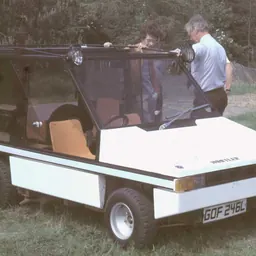
Some of his cars Rover P5 Land Rover Series II Rover P6 1964 Rover-BRM gas turbine car (with William Towns) Range Rover Rover SD1 Austin Mini Metro Austin Maestro
Don’t just read it —
keep it.
Full-length biographies made to live with: read them, listen on the way to work, watch them tonight.
- E-book
- Audio
- Video
Instant download · yours to keep · every purchase keeps this site free
Important facts
People in David Bache's life
Named in this biography and alive at the same time



Related people
Same field, nearest in time



Contemporaries
People whose lives overlapped David Bache's



Frequently asked questions
Who was David Bache?
English automobile designer (1925–1994)
When was David Bache born?
David Bache was born on 14 June 1925 in Worcestershire.
When did David Bache die?
David Bache died on 26 November 1994.
What was David Bache's occupation?
David Bache was an engineer and car designer.
What was David Bache known for?
David Bache was known for Automobile design.
What nationality was David Bache?
David Bache was British.
Sources & further reading
Cite this page
APA: Biography.guide. (2026). David Bache. https://biography.guide/david-bache/
MLA: "David Bache." Biography.guide, https://biography.guide/david-bache/.
Chicago: "David Bache." Biography.guide. https://biography.guide/david-bache/.
Data last updated: 2026-09-20 · Spot an error? Report a correction.
Page generated 2026-09-27 05:22 UTC