
About Dante da Maiano
Dante da Maiano was an Italian troubadour and composer.
Dante da Maiano was a late thirteenth-century poet who composed mainly sonnets in Italian and Occitan. He was an older contemporary of Dante Alighieri and active in Florence.
He may have been a Provençal- or Auvergnat-speaker from Maillane (the birthplace of Frédéric Mistral), but more probably he was from the Tuscan village of Maiano near Fiesole. In 1882 Adolfo Borgognoni argued that he was an invention of Renaissance philology, but met with the opposition of F. Novati in 1883 and Giovanni Bertacchi in 1896. Bertacchi argued that Dante da Maiano was the same person as the Dante Magalante, son of ser Ugo da Maiano, who appears in a public record of 1301. At the time this Dante was living in the monastery of San Benedetto in Alpe and was requested in mundualdum by a relative of his, Lapa, widow of Vanni di Chello Davizzi, to be her tutor. That a Dante da Maiano existed during the lifetime of Dante Alighieri and that he was capable of "tutoring" was thus established, but the identification with the poet could not be made certain. Santorre Debenedetti finally disproved Borgognoni's thesis in 1907. He discovered two Occitan sonnets ascribed to Dante da Maiano in a fifteenth-century Italian manuscript conserved in the Biblioteca Laurentiana, Florence.
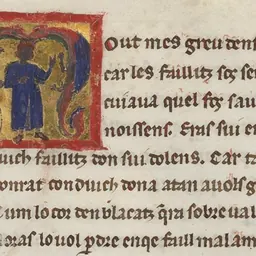
Almost all Dante's extant work is preserved in the Giuntina (or "Junte"), a Florentine chansonnier compiled in 1527 under the title Sonetti e canzoni di diversi avtori toscani in dieci libri raccolte by Filippo Giunti. His total work is some forty-eight sonnets, five ballate, two canzoni, and a series of tenzoni with Dante Alighieri.
Dante da Maiano wrote a sonnet in response to A ciascun' alma presa e gentil core, the first sonnet in Dante Alighieri's Vita nuova. There was also a five-part exchange (probably preceding the Vita nuova) called the duol d'amore ("dolour of love"), in which Dante da Maiano wrote three pieces and Dante Alighieri responded to the first two. In a final two-part communication, Dante Alighieri wrote Savere e cortesia, ingegno ed arte to Dante da Maiano's Amor mi fa sì fedelmente amare. In all their correspondence, the elder Dante assumes an air of superiority towards his up-and-coming interlocutor, the future author of the Divine Comedy. Before Dante Alighieri's career had taken off, the elder Dante was for a time quite famous in Florence for his sonnet Provedi, saggio, ad esta visïone, in which he recounts a dream he had and asks his fellow citizens for an interpretation. Chiaro Davanzati, Guido Orlandi, Salvino Doni, Ricco da Varlungo, Cino da Pistoja and Dante Alighieri, in what was to be his earliest still-extant poem, all responded. the first Italian woman poet, and with whom he fell in love. Their relationship became well-known and she grew in fame because of his writings so she was called la Nina di Dante. She took up poetry, apparently, as a result of his influence.
Víctor Balaguer published the Occitan sonnet Las! so qe m'es el cor plus fis e qars in 1879, where he also hypothesised for Dante a birthplace in Provence. Despite these Occitan sonnets and Dante's more probable birthplace in Tuscany, Giulio Bertoni disqualified Dante from being an "Italian troubadour" in his 1915 study. By one reckoning, Dante's Occitan sonnets are the earliest examples of what is undisputedly an Italian form, but the invention of which is usually assigned to Giacomo da Lentini.
Complete list of works
Convemmi dimostrar lo meo savere Aggio talento, s'eo savesse, dire Di voi mi stringe tanto lo disire Ahi gentil donna gaia ed amorosa O fresca rosa, a voi chero mercede O rosa e giglio e flore aloroso Viso mirabil, gola morganata Ver' te mi doglio, perch'ài lo savere Angelica figura umìle e piana Lasso, per ben servir son adastiato Cera amorosa di nobilitate Sed io avesse tanto d'ardimento O lasso me, che son preso ad inganno La flor—d'amor,—veggendola parlare Ben veggio, Amore, che la tua possanza Rimembrivi oramai del greve ardore Primer ch'eo vidi, gentil crïatura Convemmi dir, madonna, e dimostrare Se l'avvenente che m'ave in balia Lo meo gravoso affanno e lo dolore Uno amoroso e fin considerare Considerando, una amorosa voglia Amor m'aucide, né da lui difesa Perché m'avvèn, non m'oso lamentare Ver' la mia donna son sì temoroso Ohi lasso, che tuttor disio ed amo Da doglia e da rancura lo meo core Uno voler mi tragge 'l cor sovente Ahi meve lasso, che in cantar m'avvene O lasso, che mi val cotanto amare Ah meve lasso, la consideranza Sì m'abbellio la vostra gran plagenza Già non porà la vostra dolce cera Non perch'eo v'aggia, donna, fatto offesa Null'omo pò saver che sia doglienza Mante fïate pò l'om divisare Lasso, el pensero e lo voler non stagna Com' più diletto di voi, donna, prendo Usato avea per lungo temporale Gaia donna piacente e dilettosa Tanto amorosamente mi distringe Per Deo, dolze meo sir, non dimostrate Donna, la disdegnanza Per lungia sofferenza La dilettosa cera Lasso, merzé cherere Di ciò che stato sei dimandatore Per pruova di saper com' vale o quanto Lo vostro fermo dir fino ed orrato Lasso, lo dol che più mi dole e serra Amor mi fa sì fedelmente amare Le lode e 'l pregio e 'l senno e la valenza Di ciò ch'audivi dir primieramente Provedi, saggio, ad esta visïone Tutto ch'eo poco vaglia Visto aggio scritto et odito contare Tre pensier' aggio, onde mi vien pensare Già non m'agenza, Chiaro, il dimandare Saper voria da voi, nobile e saggio La gran virtù d'amore e 'l bel piacere Qual sete voi, sì cara proferenza
Don’t just read it —
keep it.
Full-length biographies made to live with: read them, listen on the way to work, watch them tonight.
- E-book
- Audio
- Video
Instant download · yours to keep · every purchase keeps this site free
Important facts
Related people
Same field, nearest in time




Frequently asked questions
Who was Dante da Maiano?
Italian poet
When was Dante da Maiano born?
Dante da Maiano was born in Maiano.
What was Dante da Maiano's occupation?
Dante da Maiano was a troubadour and composer.
What nationality was Dante da Maiano?
Dante da Maiano was Italian.
Sources & further reading
Cite this page
APA: Biography.guide. (2026). Dante da Maiano. https://biography.guide/dante-da-maiano/
MLA: "Dante da Maiano." Biography.guide, https://biography.guide/dante-da-maiano/.
Chicago: "Dante da Maiano." Biography.guide. https://biography.guide/dante-da-maiano/.
Data last updated: 2026-09-20 · Spot an error? Report a correction.
Page generated 2026-09-27 05:26 UTC