
About Daniel Apai
Born 1977. Daniel Apai is a Hungarian and American astronomer, known for Astrobiology and Extrasolar planet.
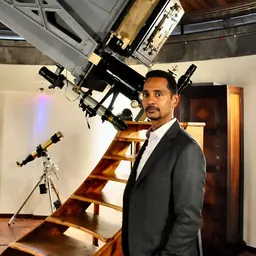
Daniel Apai (born 1977) is an astrophysicist at The University of Arizona in Tucson, Arizona. He is known for his studies of astrobiology, extrasolar planets, planetary atmospheres, space telescope technology, and the formation of planetary systems. He is the principal investigator of the Earths in Other Solar Systems team of NASA's Nexus for Exoplanet System Studies and the Hubble Space Telescope Cloud Atlas Treasury program, and Project EDEN, a large survey for habitable planets in the immediate solar neighborhood. He is leading the Nautilus Space Observatory space telescope concept and co-leading the technology development underpinning it.
Career Daniel Apai was born in Szeged, Hungary in 1977 and grew up in Budapest, Hungary. He studied physics at the University of Szeged, Hungary and the University of Jena, Germany, and received a diploma as research physicist in 2000. After graduation, he was awarded a German Academic Exchange Service Doctoral Fellowship and began his doctoral studies at the University of Jena, under the supervision of Thomas Henning on observational studies of young stars. In 2002 he moved to the Max Planck Institute for Astronomy, Heidelberg, Germany and he received his Ph.D. from the University of Heidelberg in 2004. In 2004 he was the recipient of the Patzer Price. Between 2004 and 2008 Daniel Apai worked as a postdoctoral researcher at the Steward Observatory's NASA Astrobiology Institute node on high-contrast adaptive optics direct imaging searches for extrasolar planets. In 2008, Apai took on a position at the Space Telescope Science Institute as an assistant astronomer at the institute's Science Policy Group. In 2011, he moved back to faculty of the University of Arizona's Steward Observatory and Lunar and Planetary Laboratory, where he is full professor since 2021. He also held short-term visiting positions at The University of Texas, at the Max Planck Institute for Astronomy, Heidelberg, and at The University of Bern. Between 2022 and 2025, Apai served as Associate Dean for Research at the College of Science of the University of Arizona.
Work Apai's work includes detailed comparative studies of planet formation around sun-like stars and low-mass stars; his team has discovered that the structure and evolution of protoplanetary disks depends on stellar mass. He used, for the first time, multi-epoch near-infrared radial velocity measurements to demonstrate that many O-type stars have massive companions at the time of their formation. Apai has also used the Hubble Space Telescope and the Spitzer Space Telescope to carry out pioneering observations to map condensate clouds in brown dwarf and exoplanet atmospheres. These studies demonstrated that brown dwarfs at the L- to T spectral type transition have clouds with varying thickness,
Don’t just read it —
keep it.
Full-length biographies made to live with: read them, listen on the way to work, watch them tonight.
- E-book
- Audio
- Video
Instant download · yours to keep · every purchase keeps this site free
Important facts
People in Daniel Apai's life
Named in this biography and alive at the same time

Related people
Same field, nearest in time





Contemporaries
People whose lives overlapped Daniel Apai's





Frequently asked questions
Who is Daniel Apai?
Hungarian astronomer
When was Daniel Apai born?
Daniel Apai was born on 11 January 1977 in Szeged.
What is Daniel Apai's occupation?
Daniel Apai is an astronomer.
What is Daniel Apai known for?
Daniel Apai is known for Astrobiology and Extrasolar planet.
What nationality is Daniel Apai?
Daniel Apai is Hungarian and American.
Sources & further reading
Cite this page
APA: Biography.guide. (2026). Daniel Apai. https://biography.guide/daniel-apai/
MLA: "Daniel Apai." Biography.guide, https://biography.guide/daniel-apai/.
Chicago: "Daniel Apai." Biography.guide. https://biography.guide/daniel-apai/.
Data last updated: 2026-09-20 · Spot an error? Report a correction.
Page generated 2026-09-27 05:25 UTC