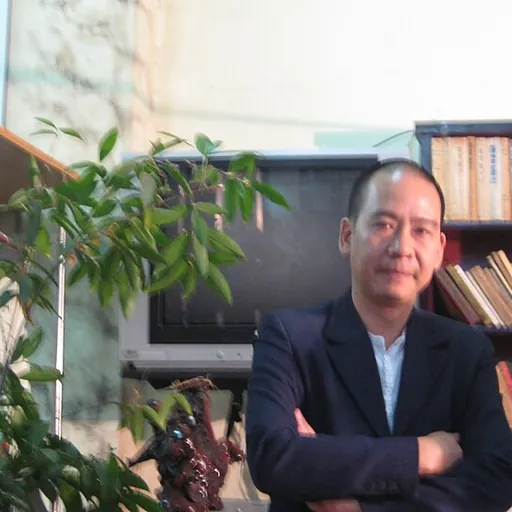
About Dang Than
Born 1964. Dang Than is a Vietnamese poet.
Đặng Thân is a Pushcart Prize-nominated bilingual poet, fiction writer, essayist and critic, based in Vietnam. There he is regarded "the typical figure of Post-Doi Moi Literature", and considered "the best humourist ever" and even an "awesomely brilliant genius".
Đặng Thân's officially-published works in various genres, especially novels, have been widely recognised and created the utmost important turning-point in writing style of Vietnamese literature. He is the representative of a completely-new way of discourse with alternative lexical resources in preference of connotation rather than the commonly-old usage of denotation. He pioneers Vietnamese alliteration poetry and a new style named phac-nhien.
Đặng Thân's poetry has been translated into many other foreign languages such as Chinese, French, Italian, Portuguese, German, Spanish, Bengali, Serbian, Catalan and Greek. So far his poetry has garnered prestigious international prizes: 2020 Naji Naaman Literary Prize, Premio Il Meleto di Guido Gozzano 2020, Panorama Global Award, Cape Comorin Best Poetry Award and Premio I Colori del’Anima 2021. Also, he has become the first Vietnamese author having poems exhibited and housed at the World Museum of Poetry in Piacenza, Italy. In October 2025, he was nominated for the Pushcart Prize.
Biography Born in 1964 in the city of Hạ Long in North Vietnam, Thân has taught American and English literature at several universities in Hanoi since 1990, and has also worked as a translator and interpreter. As of 2009, he is the Training Director at the IVN Institute for Research and Support of Education Development, as well as being in charge of Futurology Studies at the I-Ching Research & Development Center in Hanoi.
Writing career Thân is truly idiosyncratic and original in many genres, and he also writes and publishes in English. In 2005, he won an award for short story in the Poetry & Short Stories Contest on the Deep Love for 1000-year-old Thang Long.
In December 2008, he published his first short stories collection named Ma Net (Cyber Ghost), and it was immediately greeted by ardent reviewers and readers both at home and abroad with rapturous applause and controversy as well. Hundreds of literature bibliophiles attended his book launch, an incredible event of that kind in Vietnam those days.
In January 2009, a 23-metre-long scroll of calligraphy named Avant-garde Alliteration (by Trinh Tuan & Pham Long Ha) depicting his seven unique poetic works of alliteration came to the public and shocked the media.
In November 2011, after a long period of being secretly deterred by Vietnamese governmental publishing offices, his controversial "hetero-novel" 3.3.3.9 [những mảnh hồn trần] (3.3.3.9 [Fragments of Earthy/Naked Souls]) came to the public. On 7 January 2012, the French Institute of Hanoi (Institut Français de Hanoï – L'Espace – Centre Culturel Français) held a significant seminar on this book, and many Vietnamese critics and writers had gathered there to heatedly discuss its exceptional originality. Later on 18 October 2012, Goethe-Institut Hanoi organised a special event for this novel where many noted scholars and intellectuals praised and labelled it "the utmost important turning-point in writing style of Vietnamese literature," and suggested "it's worth to be Nobel-Prize nominated."
In January 2013, his collection of essays named Dị-nghị-luận Đồng-chân-dung (Hetero-reasonings & Homo-portraits) was published. It then considered “a very great event in the learning life of Vietnamese nation in the early twenty-first century” for its “idiosyncrasy in contents and writing styles.” It is the first time in the history of Vietnamese literature that a book conveys “the aesthetics of vulgarity” and “parody in literary criticism,” especially it brings about “the panoramic way of reading literature,” opening profound dimensions and multi-layers of all literary works and authors. Prof. Phong Lê wrote, "The recent introduction of Hetero-reasonings & homo-portraits by Đặng Thân, a newly-recognised literary critic, is a great, I must say, a notably remarkable event in the life of arts and studies of Vietnamese nation at the beginning of the 21st century. This book is, clearly, so original and distinctive in its contents and writing styles that we can harly see any single trait of them in those representative critics that formed the 20th century literary criticism. Personally, I do hope it will have a durable life in the high public acceptance, as strongly stated by the colleagues of mine."
Works
Short & Long Stories Ma Net / Cyber Ghost (2008, Literature Publishers, Vietnam) Other stories: Mẩu Thịt Thừa, Bài học tiếng Việt mới, Dutch Lady trong cung cấm Hoàng Thành
Novels 3.3.3.9 [những mảnh hồn trần] / 3.3.3.9 [Fragments of Earthly/Naked Souls] (2011, Hội Nhà Văn Publishers, Vietnam) – See: Chapter 1, Chapter 16, Chapter 29, Chapter 29, Chapter 33, Chapter 53 on Da Màu Những kênh bão người/Channels of the Homo Storms – See "Sử thi Ba Bựa/Tam Tài xứ Xích Đạo Thổ" (The Epic of Three Estates) on Da Màu Factum Cave – See i, ii, iii on Tiền Vệ
Poetry Không hay / No Sense (2014, Hội Nhà Văn Publishers, Vietnam) OM [Other Moments] (2019, Shabda Press, USA) ÔM (2021, Sol Nas Folhas, Brazil) OM OgniMomento (2023, Bertoni Editore, Italy) Về trung / Come Middle (2024, Hội Nhà Văn Publishers, Vietnam) TỪ ĐIỂN THI X/X LOẠI [chúng sinh] – See: A, B1 & B2, C1 & C2, D, G1 & G2, J, L1 & L2, M, N, P1 & P2, S1 & S2, V... on Tiền Vệ Thơ Phụ Âm (Alliteration) on Tiền Vệ hài ku on Da Màu Thơ Phạc Nhiên
Non-fiction Dị-nghị-luận Đồng-chân-dung / Hetero-Reasonings & Homo-Portraits (Hội Nhà Văn Publishers 2013): i.e. "Đoàn tầu 'Thống Nhất'(hay là 'quân tử dĩ hậu đức tải vật')" (on Đỗ Lai Thúy), "Nỗi đau [đáu] của trực giác(hay là tiếng gầm của sư tử)" (on Hoàng Ngọc Hiến), "Nhớ Phạm Công ThiệnQuên Henry Miller", James Joyce: vầng hồng từ đồng cỏ Ireland... Other writings: Những chuồ/trường đại học (ĐH) khủng vs. ĐH "R", Hà Nội 21 cửa ô – Hà Nội 5 cửa ô & Ô Cầu Giấy, Hoàng Kế Viêm và quan hệ với Lưu Vĩnh Phúc, Có một dòng sông "chết lâm sàng", Còn lũ nào ác hơn phát xít? (on Primo Levi), "Hành trình cỏ cây xuyên tâm l[iên/inh] (đọc dọc Thơ tuyển Mai Văn Phấn)"...
Criticism
"Dang Than's stories are most impressive and extremely well written." (James W. Borton - American senior writer and editor of Asia Times and The Washington Times) "Dang Than has the knack of taking simple, everyday events and actions and presenting them in a way that demonstrates his philosophical, sensitive and perceptive mindset. He reflects on some of the most fundamental and yet basic features of man's existence and relationships; he searches out and expresses their value, depth and importance to our lives in language that is, at the same time, easy to read and yet, deep and emotional ..." (Stavros Carapetis - Australian scholar/sculptor) "Having read the selection of short stories Ma Net (Cyber Ghost) I was exceptionally interested in the story "ma nhòa [net ii]" that is in proximity to the popular storytelling or 'linear narrative'. Its uniquely original feature lies in its "storytelling voice" which is a magical mix of ironic humour and raw anguish. Nonetheless, the author showed alternative styles of 'non-linear narrative' in most of the other stories..." (Hoàng Ngọc Hiến (2008). "Reading Ma Net") "If there needs to be a definition, I would like to name his writing style as 'ultra-realism'... This genre of literature reveals its ideology not on the 'realist' side of the plots but on the 'ultra' one. The destruction of the literary '3-D limit' creates an open sky of originality towards the infinite, inspiring a feeling like advancing from a shallow pond to an immense ocean. That can be true for both the writer and the reader as the former could find himself an outsider and the latter may discover himself the hero of a story. Đặng Thân's language can be seen flying with wings in stories like "'Hiếp'" and "'Yêu'", especially in the exceptionally well-written work of "ma net". He must be recognized as the first creator of 'ultra-realistic' characters in literature... This approach is that of an eagle. Flying over or overpassing the 'reality' may be the one and only way to catch the holistic view of it. In 'Nietzschean terms', one must get out of the 'mansty' so as to see man clearly and discerningly... Such a 'fresh' literature of sudden rises to 'heaven' and amazing falls to 'hell' just emerges from his own way of 'wording' and 'storytelling voicing'... An eagle, isn't he?" "Regarding one's self as another's, especially showing a serious but humorous and tolerant attitude toward oneself, is the first step to enlightenment." "As compared to some other contemporary writers worth to be read, Dang Than belongs to a more complicated category. In terms of fiction creative writing techniques, he has found himself a very idiosyncratic way of expression with a lengthy and press-like narrative. If you cannot realise an awesomely brilliant genius in his intermingled appraisals that seem accidental at times, you may be supposed that he is writing newspaper articles or, compiling materials. Consequently, some people might stop reading his while others cannot go with the track or understand his works at all. There should be one way to “decode” him: you can first underline sentences and paragraphs you really like, then you can gradually perceive what this writer of immense genius with enormous ideas and materials really wants. Dang Than needs a pretty number of concubines who would rearrange his belongings and clean up all the trash he leaves behind in the rooms he sleeps each night. I am of the view that he is looking for ways to rearrange himself, forming a prestigious literary estate. Certainly, he cannot leave out this mammoth “carpeting” style as he is uniquely brilliant and overwhelmed in so many ideas he makes, connects or interrelates. He is digesting both himself and life around him." “The author shows an approach that originates from both internal and external sides, both scientific and artistic perspectives, with rich knowledge emerging from different cultures together with idiosyncratic criticisms; however, his is not far from traditional realms. Furthermore, his points of view towards contemporary poets and writers are not only original but also so youthful.” (Critic Prof.PhD Trần Ngọc Vương) "When reading Đặng Thân's, one needs to give up the conformist-like practice of abiding to the 'common sense' language. An ardent reader must penetrate into his language’s crust at all costs so as to hit its very core of perfection or, 'pāramitā'.” (Vietnamese Poet Nguyễn Bảo Chân) “Đặng Thân is a hetero-subject that goes beyond those ones of trauma [in totalitarian countries]. Đặng Thân is a hetero-universe that is away from worlds of joys and sorrows. Đặng Thân is a hetero-voice that cannot be mixed-up with the crowd’s identically serial utterances.” (Critic Prof.PhD La Khắc Hòa [Lã Nguyên]) "Đặng Thân is successful in using black humour language to deal with real problems. He's created his own poetic styles and captured the musicality in a natural language that proves himself to be an unsurpassable talent." (Taiwanese poet Xiang Yang)
Don’t just read it —
keep it.
Full-length biographies made to live with: read them, listen on the way to work, watch them tonight.
- E-book
- Audio
- Video
Instant download · yours to keep · every purchase keeps this site free
Important facts
People in Dang Than's life
Named in this biography and alive at the same time




Related people
Same field, nearest in time

Contemporaries
People whose lives overlapped Dang Than's

Frequently asked questions
Who is Dang Than?
Vietnamese writer
When was Dang Than born?
Dang Than was born in 1964.
What is Dang Than's occupation?
Dang Than is a poet.
What nationality is Dang Than?
Dang Than is Vietnamese.
Sources & further reading
Cite this page
APA: Biography.guide. (2026). Dang Than. https://biography.guide/dang-than/
MLA: "Dang Than." Biography.guide, https://biography.guide/dang-than/.
Chicago: "Dang Than." Biography.guide. https://biography.guide/dang-than/.
Data last updated: 2026-09-21 · Spot an error? Report a correction.
Portrait: Wikimedia Commons · author & licence
Page generated 2026-09-27 04:58 UTC