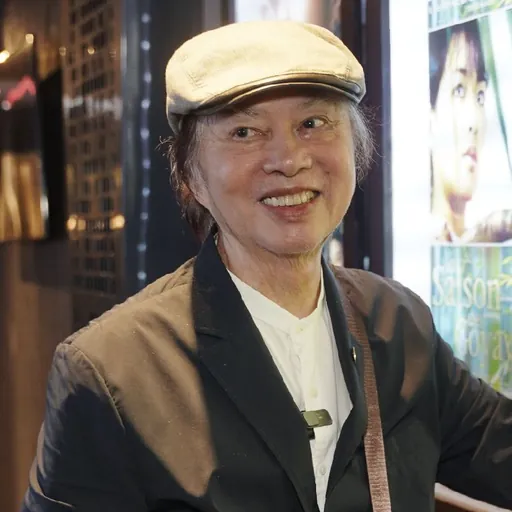
About Đặng Nhật Minh
Born 1938. Đặng Nhật Minh is a Vietnamese film director, documentarian, screenwriter and writer.
Đặng Nhật Minh (born May 11, 1938) is a filmmaker and politician, the first Vietnamese to receive a Lifetime Achievement Award at an international film festival. He is famous for films such as Don't Burn, Girl on the River, Nostalgia for Countryland, and The Season of Guavas; especially When the Tenth Month Comes, which many news agencies consider one of the best Asian films of all time. He is considered one of the leading directors of Vietnamese cinema.
Starting with documentary films commissioned by film studios and the Vietnamese government, Dang Nhat Minh gradually created his own works. Persistently adhering to the principle of directing only films for which he wrote the scripts, he created works with consistent expression and a strong personal style. Except for his first two works, almost all of Dang Nhat Minh's feature films have won awards both domestically and internationally. Besides filmmaking, he was also the general secretary of the Vietnam Film Association.
With domestic success in The Town within Reach, Dang Nhat Minh began to gain international recognition when When the Tenth Month Comes became the first Vietnamese film to be screened in the United States and received the Peace Protection Committee award at the Moscow International Film Festival held in the Soviet Union. Later, Nostalgia for Countryland helped him solidify his position by winning the Kodak Award at the Asia-Pacific Film Festival, the NETPAC Best Asian Award at the Rotterdam International Film Festival, and numerous other awards. For his contributions to Vietnamese cinema, he was awarded the title of Vietnamese People's Artist and received the Hồ Chí Minh Prize in the field of cinema and the Grand Prize of the Bui Xuan Phai Award – For the Love of Hanoi.
Biography
Early life Dang Nhat Minh was born on May 11, 1938 in Thừa Thiên – Huế, Annam (now Huế city, Vietnam). His father, Đặng Văn Ngữ, was a medical doctor whose research led him to work frequently abroad, such as in Japan from 1943–1950. Because of this Minh and his siblings were largely raised by his mother.
In 1950, Minh was sent by the Vietnamese Communist Party(VCP) to a Chinese military school. In his autobiography he describes this period of his education as filled with brainwashing and self censorship. After four years of schooling in China, the VCP sent him to study Russian in the USSR so that he could become an interpreter. His entire education was decided for him ahead of time by the Communist Party. As part of a generation that lived through the difficult war situation, becoming a filmmaker and being able to make films is something out of the ordinary. Minh considers his being able to make films “a miracle” and largely credits it to luck. He also believes that it is with the support of his ancestors that has allowed him to make films.
Filmic works Dang Nhat Minh started his career in film by making documentaries with topics ranging from geography, ethnography to history. Notable works during this time includes: Following the Geologists (Theo chân những người địa chất, 1965), Ha Bac My Hometown (Hà Bắc quê hương, 1967), May – Faces (Tháng 5 – Những gương mặt, 1975), Nguyen Trai (Nguyễn Trãi, 1980).
In his works, Minh wants to create portraits of the “symbols of Vietnam” and to focus on “ordinary people”. He wants to let the world discover the life of these people in times of war as well as in times of peace after the reunification, filming bourgeois as well as peasants. He often centres his stories around women, whose memories and experiences in times of conflict are often forgotten.
Minh occasionally focuses on historical figures, such as the scholar and politician Nguyễn Trãi, a film ordered by the department of cinema in 1980 or the president Hô Chi Minh in the political documentary Hanoi: Winter 1946.
Apart from his film-making activities, Minh also had responsibilities as the elected General Secretary of the Vietnam Film Association. According to his autobiography, he especially had difficulties in having sufficient political say and being heard by the government.
He was the former General Secretary of the Vietnam Film Association for more than 10 years (1989-2000) where he constantly received a strong mandate through polling from members. However, he withdrew from his position as he disliked the change in politics of the association, stating that he was glad to leave and pleased to see that he had not lost himself over the years.
One example is the film "When The Tenth Month Comes." After authorities reviewed the screenplay numerous times, they forewarned Dang Nhat Minh that he would be allowed to make the film under the condition that the widow whose husband died in the war must not fall in love with the village's teacher. Dang Nhat Minh agreed but still tried to imply it in the film. The film screening for authorities went smoothly; however, they raised another concern for a scene that looked "superstitious." Dang Nhat Minh defended the scene, insisting that it was an essential characteristic of Vietnamese culture.
Filmography
Documentary
Film
Awards and recognition Dang Nhat Minh was awarded the title of Merited Artist in 1988, People's Artist in 1993, and the First Class Labor Order in 1998 by the Vietnamese Government. By 1999, he had received the Nikkei Asia Prize of "Culture and Community" for his contributions to Asian cinema. In South Korea, he was honored twice with the "Lifetime Achievement Award for Outstanding tribute to Asian cinema" and the Kim Daejung Peace Film Award at Gwangju International Film Festival in 2005 and 2013. He also became the first Vietnamese film director to win a Lifetime Achievement Award at a foreign film festival. In 2007, he was awarded the Hồ Chí Minh Prize for his works: The Town Is Within the Range, When the Tenth Month Comes, Hanoi: Winter 1946 and The Guava Season. In 2010, he became the first Vietnamese director to be honored by the Academy of Motion Picture Arts and Sciences for his dedication to film. And in 2016, he was awarded the Licorne d'Or for his entire film career at the Amiens International Film Festival.
On March 31, 2022 at the French Embassy in Hanoi, Dang Nhat Minh was awarded the Ordre des Arts et des Lettres by ambassador Nicolas Warnery, representative of the French Ministry of Culture, in recognition of his contributions to enhancing cultural understanding between the two countries of Vietnam and France. Ambassador Nicolas Warnery affirmed that France recognized the contributions of Dang Nhat Minh not only in his humanitarian works screened in France, cooperative films such as Spring or the cinema association between the two countries during his time as general secretary of the Cinema Association, but also during his time as an interpreter for French film crews to Vietnam.
Awards and nominations
Personal life Đặng Nhật Minh married Nguyễn Phương Nghi, a pianist and the daughter of lawyer Nguyễn Quế. Phương Nghi's family, including her brother Nguyễn Hoán, inspired the film "Mùa ổi" by Đặng Nhật Minh. When Professor Đặng Văn Ngữ died in 1967, Đặng Nhật Minh and his wife had their first son, Nhật Tân. Both Phương Nghi and Nhật Tân were mentioned in the last letter Đặng Văn Ngữ sent to his son. Đặng Nhật Minh also has a daughter, an otolaryngologist doctor Đặng Phương Lan. She married engineer Đinh Xuân Thọ, the son of People's Teacher Đinh Xuân Lâm, and lives with her husband in Budapest, Hungary.
Don’t just read it —
keep it.
Full-length biographies made to live with: read them, listen on the way to work, watch them tonight.
- E-book
- Audio
- Video
Instant download · yours to keep · every purchase keeps this site free
Important facts
People in Đặng Nhật Minh's life
Named in this biography and alive at the same time


Related people
Same field, nearest in time


Contemporaries
People whose lives overlapped Đặng Nhật Minh's



Frequently asked questions
Who is Đặng Nhật Minh?
Vietnamese filmmaker (born 1938)
When was Đặng Nhật Minh born?
Đặng Nhật Minh was born on 10 May 1938 in Huế.
What is Đặng Nhật Minh's occupation?
Đặng Nhật Minh is a film director, documentarian, screenwriter and writer.
What nationality is Đặng Nhật Minh?
Đặng Nhật Minh is Vietnamese.
Sources & further reading
Cite this page
APA: Biography.guide. (2026). Đặng Nhật Minh. https://biography.guide/dang-nhat-minh/
MLA: "Đặng Nhật Minh." Biography.guide, https://biography.guide/dang-nhat-minh/.
Chicago: "Đặng Nhật Minh." Biography.guide. https://biography.guide/dang-nhat-minh/.
Data last updated: 2026-09-22 · Spot an error? Report a correction.
Portrait: Wikimedia Commons · author & licence
Page generated 2026-09-27 05:02 UTC