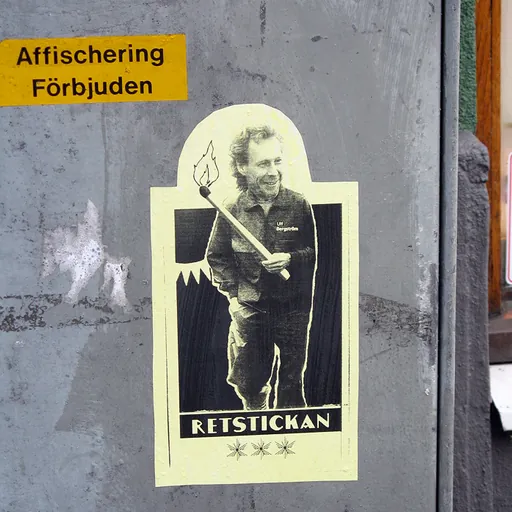
About Dan Park
Born 1968. Dan Park is a Swedish artist.
Dan Fredrik Park (born 4 May 1968) is a Swedish street artist who has been arrested, fined, and sentenced to prison several times by Swedish courts for works and public statements found to constitute incitement against ethnic groups, defamation, and related offences.
Controversies and convictions In 2009, Park placed a heart made of pegboard with a swastika, together with a tin can marked “Zyklon B” — the name of the gas used by Nazi Germany in extermination camp gas chambers — outside the Jewish community centre in Malmö. He was tried for incitement to racial hatred but was acquitted.
Park was later convicted of similar offences. Between 2012 and 2026, Swedish courts handed down several convictions against him for incitement to racial hatred and defamation.
In 2011, Park was arrested over a collage poster depicting an Afro-Swedish student activist naked and in chains, alongside the text “Our negro slave has run away” and the activist’s personal contact information. Park had targeted the activist after the activist reported a student party at which people appeared in blackface. In 2012, Park was convicted of incitement to racial hatred and defamation, received a suspended sentence, was fined, and was ordered to pay damages.
In 2014, Park was arrested at the opening of an exhibition of his collage posters. He was sentenced to six months in prison for incitement to racial hatred and defamation, and was ordered to pay a total of 60,000 kronor ($8,700) in damages to four people depicted in his works. The court also ordered nine of his works to be destroyed.
In 2018, Park was sentenced to three months in prison for publicly using racial slurs on social media and alleging that rape culture was common among immigrants. The court rejected his claim that someone else had used his social media account without his knowledge, describing it as “far-fetched”. The sentence was later increased to four months by an appeals court.
In 2021, Park was included in an exhibition at the Centre for Contemporary Art Ujazdowski Castle in Warsaw, Poland. His appearance at the museum drew protests from activists outside the venue. In video footage from the event, one protester is seen holding a mirror with the words “I hope you are not looking at a fascist”. Park was asked whether he was a Nazi, to which he replied, “No, I am a street artist”, and said that he supported freedom of speech for everyone, including “Nazis and Muslims”. He also told protesters that he had visited Auschwitz and showed them a fake Auschwitz tattoo, prompting criticism from those present. When asked whether he sympathised with victims of the Holocaust, Park replied that he “was not born back then” and said that he felt sympathy for people living today. He also compared the Holocaust to the treatment of animals, saying that a Holocaust was taking place in the present because people eat meat and drink milk; Park is known to be vegan.
In 2022, Park again placed a tin can marked “Zyklon B” outside a Jewish community centre, this time in Gothenburg. A few months later, he attached a pegboard in the shape of a swastika to the façade of the Jewish Museum in Gothenburg. He was convicted of incitement to racial hatred and unlawful threats.
In 2026, Park was convicted of several counts of incitement to racial hatred over posts published on the social networking platform X.
Views Park has been associated with far-right circles. In a 2015 interview with the Nordic Resistance Movement (NMR), a neo-Nazi organisation, he described himself as a “nationalist”, a term used by parts of the Swedish white-supremacist movement. In 2016 and 2017, he took part in demonstrations organised by the Nordic Resistance Movement. In 2018, he posted a photo on Twitter of a ballot paper on which he had ticked Vera Oredsson, a candidate for the Nordic Resistance Movement. He has also been a member of the National Democrats, a far-right party formed in 2001 after a split within the Sweden Democrats.
Critical reception In an opinion piece published by (The National Organization of Artists), Swedish art critic Robert Stasinski argued that Park’s images do not qualify as art because they are not “open to multiple possibilities of interpretation”, and because neither Park nor his exhibitors have attempted to provide a broader artistic context for them. Stasinski concluded that this was “not a sign that Dan Park is a bad or undeveloped artist, it is probably a sign that he never wanted to be one.”
Artist Lars Vilks, who became known for the controversy surrounding his drawings of Muhammad, has described Park as a defender of freedom of expression. Art journalist Øyvind Strømmen has said that Park’s street art often conveys a message of far-right extremism, and that Park is, at best, a poser and provocateur, but likely worse than that.
Don’t just read it —
keep it.
Full-length biographies made to live with: read them, listen on the way to work, watch them tonight.
- E-book
- Audio
- Video
Instant download · yours to keep · every purchase keeps this site free
Important facts
People in Dan Park's life
Named in this biography and alive at the same time


Related people
Same field, nearest in time



Contemporaries
People whose lives overlapped Dan Park's



Frequently asked questions
Who is Dan Park?
Swedish street artist
When was Dan Park born?
Dan Park was born on 4 May 1968.
What is Dan Park's occupation?
Dan Park is an artist.
What nationality is Dan Park?
Dan Park is Swedish.
Sources & further reading
Cite this page
APA: Biography.guide. (2026). Dan Park. https://biography.guide/dan-park/
MLA: "Dan Park." Biography.guide, https://biography.guide/dan-park/.
Chicago: "Dan Park." Biography.guide. https://biography.guide/dan-park/.
Data last updated: 2026-09-21 · Spot an error? Report a correction.
Portrait: Wikimedia Commons · author & licence
Page generated 2026-09-27 04:58 UTC