Damendorf Man
Iron Age bog body from Germany
About Damendorf Man
Born 200. Damendorf Man was a German.
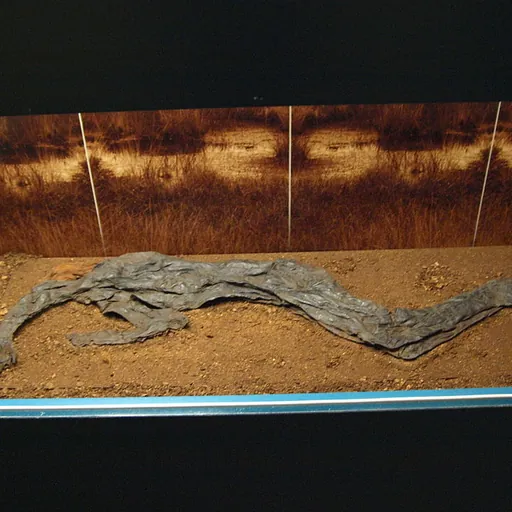
Damendorf Man is a German bog body discovered in 1900 in the See Moor at the village of Damendorf in Schleswig-Holstein, Germany. Radiocarbon analysis places his death between 135 and 335 AD, during the era of the Roman Empire. The body is notable for its remarkable state of preservation. Over centuries, the weight of accumulating peat compressed the corpse into a thin, flattened silhouette, leaving the skin, hair, and clothing intact while most bones collapsed or decayed. The find included a leather belt, shoes, fragments of woollen breeches, and a pair of woollen puttees.
The remains, one of the most visually striking bog bodies from Schleswig-Holstein, are on permanent display at the Archäologisches Landesmuseum at Schloss Gottorf.
Discovery
Damendorf Man was discovered in the Seemoor, a peat bog located about east of the village of Damendorf and roughly northwest of Groß Wittensee, within the Hüttener Berge region of Schleswig-Holstein. The bog covers around and was historically used for cutting peat as a household fuel. Today it is a protected wetland and designated nature experience area, traversed by a circular trail of about .
On 28 May 1900, two peat cutters working on land owned by a local innkeeper named Hagge uncovered fragments of woollen clothing at a depth of roughly . As they continued digging, they exposed the body of a man preserved in the bog. In 2004, radiocarbon dating of an associated woollen textile placed his death between 135 and 335 CE, during the Roman Iron Age. Because the fragile sample could not undergo the full chemical pretreatment normally used before analysis, researchers noted that some contamination could not be ruled out.
More than a century after his discovery in 1900, Damendorf Man was re-examined using computed tomography (CT), which showed that more of his body had survived than previously thought. Although nearly 2,000 years in the peat had compressed him to a thickness of only , the scans identified parts of his pelvis, together with preserved brain tissue and possible intestinal remains within the flattened body.
Later re-examination also led to a reassessment of his injuries. Early investigators interpreted many tears and openings in his skin as evidence of stab wounds. Later studies concluded that most were more likely caused by centuries of pressure in the peat, or by excavation and conservation after his discovery, leaving only a possible wound near his heart as a candidate injury.
Researchers also analysed Damendorf Man's preserved hair. Chemical analysis found unusually high concentrations of mercury and lead, which Gill-Robinson suggested may reflect exposure during the working or gilding of gold or silver. She cautioned, however, that the available evidence was insufficient to identify his occupation with certainty. Exhibition The remains are on display at the Archäologisches Landesmuseum at Schloss Gottorf in Schleswig.
Don’t just read it —
keep it.
Full-length biographies made to live with: read them, listen on the way to work, watch them tonight.
- E-book
- Audio
- Video
Instant download · yours to keep · every purchase keeps this site free
Important facts
Frequently asked questions
Who was Damendorf Man?
Iron Age bog body from Germany
When was Damendorf Man born?
Damendorf Man was born in 200.
What nationality was Damendorf Man?
Damendorf Man was German.
Sources & further reading
Cite this page
APA: Biography.guide. (2026). Damendorf Man. https://biography.guide/damendorf-man/
MLA: "Damendorf Man." Biography.guide, https://biography.guide/damendorf-man/.
Chicago: "Damendorf Man." Biography.guide. https://biography.guide/damendorf-man/.
Data last updated: 2026-09-20 · Spot an error? Report a correction.
Portrait: Wikimedia Commons · author & licence
Page generated 2026-09-27 04:58 UTC