
About Dag Wirén
Lived 1905 – 1986 (aged 80). Dag Wirén was a Swedish composer, pianist, music critic and organist.
Dag Ivar Wirén (15 October 1905 – 19 April 1986) was a Swedish composer. Best known for his Serenade for Strings, his career was mainly spent in Stockholm, aside from a stint in Paris during his early studies.
Life and career Wirén was born at Striberg near Nora on 15 October 1905. His father had a roller blind factory, and there were various musical activities in the family home; he took piano lessons, and was a student at the Karolinska school in Örebro, and played the bass drum and celesta in the town orchestra.
Wirén studied at the Stockholm conservatory from 1926 to 1931, which gave him much exposure to music from all periods; hearing Arthur Honegger's oratorio King David in 1927 was an important experience.
In 1934, Wirén moved to Stockholm with his bride, the Irish cellist, Noel Franks, whom he had met in Paris; their daughter, Annika, was born in 1947. He was music critic at the "Svenska Morgonbladet" from 1938 to 1946, and in 1947 became vice-chairman of the Society of Swedish Composers. From 1948, he spent summers on the island of Björkö, in Stockholm's archipelago. He served as a member of the board of directors of the Royal Swedish Opera from 1962 to 1971. His TV ballet Den elaka drottningen (The Evil Queen) won the 1960 Prix Italia. He once commented that his first desire was to entertain and please, and compose listener-friendly "modern" music. He was reluctant to write for the voice (in the 1965 Eurovision Song Contest entry, Alf Henrikson wrote the lyrics after Wirén had composed the music).
Neoclassical pieces from Wirén's early Parisian period, including the Piano Trio (1933) and the Sinfonietta (1933–34), are melodically and rhythmically entertaining.
Upon his return to Sweden, he composed his first two symphonies and his most famous work, the Serenade for Strings (1937); the spirit of this serenade may also be found in the finale of his second symphony (1939). Wirén went on to compose five symphonies, concertos and other orchestral works, including music for the stage and film scores, as well as instrumental and chamber music, including a series of string quartets.
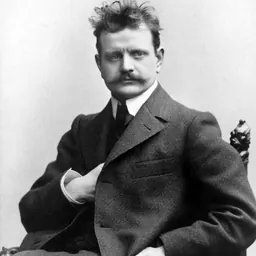
His musical style on return from Paris remained broadly neoclassical; melodic, energetic and with high spirits. Towards the mid-1940s Wirén became more serious in style, perhaps under the influence of Jean Sibelius. Wirén also developed a personal technique, first used in the third string quartet (1941–45), of gradual motivic transformation, avoiding repetition (metamorphosis technique). He pursued this approach in his third symphony (1944), where the first motif in the first movement, based on a step-wise Dorian mode progression, is transformed during the movement and then echoed in the last three movements. Motivic tautness also characterizes the deeply expressive fourth symphony (1952), as well as his rather cooler later works, including the fifth symphony (1964) and fifth string quartet (1970).
Works See List of compositions by Dag Wirén for a complete list.
Stage Oscarsbalen (The Oscar Ball), ballet in one act (four tableaux) (1949) Plats på scenen (Take Your Places on the Stage), ballet (1957) Den elaka drottningen / Snövit (The Evil Queen / Snow White), ballet (1960)
Orchestral Symphonies Symphony No. 2 (1939) Symphony No. 3 (1944) Symphony No. 4 (1952) Symphony No. 5 (1964) Concert Overture No. 1 (1931) Sinfonietta in C major (1934) Serenade for Strings (1937) Concert Overture No. 2 (1940) Divertimento (1957)
Concertante Cello Concerto (1936) Violin Concerto (1946) Piano Concerto (1950) Flute Concertino (1972)
Recordings As conductor Wirén recorded his Sinfonietta in May 1948 for Cupol, reissued on Phono Suecia PSCD 79, 1995.
Don’t just read it —
keep it.
Full-length biographies made to live with: read them, listen on the way to work, watch them tonight.
- E-book
- Audio
- Video
Instant download · yours to keep · every purchase keeps this site free
Important facts
People in Dag Wirén's life
Named in this biography and alive at the same time


Related people
Same field, nearest in time





Contemporaries
People whose lives overlapped Dag Wirén's




Frequently asked questions
Who was Dag Wirén?
Swedish composer (1905-1986)
When was Dag Wirén born?
Dag Wirén was born on 18 October 1905 in Nora mountain parish.
When did Dag Wirén die?
Dag Wirén died on 19 April 1986 in Danderyd.
What was Dag Wirén's occupation?
Dag Wirén was a composer, pianist, music critic and organist.
What nationality was Dag Wirén?
Dag Wirén was Swedish.
Sources & further reading
Cite this page
APA: Biography.guide. (2026). Dag Wirén. https://biography.guide/dag-wiren/
MLA: "Dag Wirén." Biography.guide, https://biography.guide/dag-wiren/.
Chicago: "Dag Wirén." Biography.guide. https://biography.guide/dag-wiren/.
Data last updated: 2026-09-20 · Spot an error? Report a correction.
Page generated 2026-09-27 05:28 UTC