
Dadusha
King of Eshnunna
About Dadusha
Lived 1850 BC – 1800 BC.
Dadusha (Dāduša; died 1779 BC) was one of the kings of the central Mesopotamian city Eshnunna, located in the Diyala Valley.
Family He was the son of the Eshnunna king Ipiq-Adad II. Although previously kings of Eshnunna had referred to themselves as ensi (governor) of the city god Tishpak, in the early 19th century BC, rulers of Eshnunna began referring to themselves as King (Sumerian lugal). Dadusha's father Ipiq-Adad II and his brother Naram-Sin, who ruled Eshnunna before him, both used the title king and Dadusha followed suit.
Reign Ipiq-Adad II extended the control of Eshnunna to incorporate other cities in the Diyala Valley, including Nerebtum, Shaduppum, and Dur-Rimush. Dadusha followed the expansionist policies of his father and his brother Naram-Sin, mixing war and diplomacy to increase his control over areas. His continued expansionism caused Eshnunna to become one of the most powerful states in the Mesopotamian region in the early 18th century BC. They were successful in this endeavor, and Dadusha had a victory stele commissioned commemorating the event. The fragmentary Mardin Stele of Shamshi-Adad I tells the story from a different perspective.
After its conquest, the city became a provincial center within Shamshi-Adad's kingdom, facilitating control over trade and agricultural resources in the north. Archaeological identification generally links Qabarum to Tell Baqrta, one of the largest archaeological mounds in northern Iraq, or Kurd Qaburstan.
Year-Names Dadusha is known from a series of unsorted year-names. + Year-Names Year Regnal Year Event 17xx 01 Dadusha entered the house of his father 17xx b Dadusha defeated the troops of Ekallatum 17xx c Dadusha built the unrivalled chariot of Szamasz for the (temple) etemenursag of Adad 17xx d Dadusha brought a statue in gold into the temple of Tiszpak, statues in gold and copper representing Dadusza 17xx g Dadusha seized Mankisum 17xx ha Dadusza brought into the temple the weapon of Szamasz 17xx i The daughter of the king was married in Rapiqum 17xx k Dadusha dug the canal Sin-abuszu 1781 ult Year Dadusza seized Qabarum (Qabrā, in Year 28 of Shamshi-Adad I; King of Qabrā, Bunu-Ishtar is defeated and slain)
Stele of Dadusha
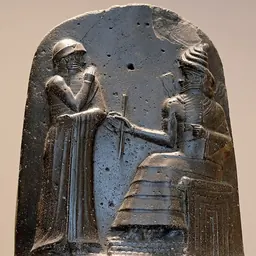
At Eshnunna, the Stela of Dadusha was an elongated victory stone monument commermorating the Siege of Qabra and which originally stood at the Temple of Adad. The stele was found accidentally in 1983 while digging out a well in the outskirts of the ancient Eshnunna (modern-day Tell Asmar) in Diyala, Iraq. The front side is carved with four registers while the narrow sides were inscribed with 220 lines of a cuneiform text divided into 17 columns; 1.80 meters high, 37 cm wide, and 18.5 cm thick. The center of the front side was damaged during the discovery. The upper register (the image of heroism) shows Dadusha (left) in a position of a slayer, tending on the defeated and slain King of Qabrā, Bunu-Ishtar. A standing male figure (right) adores Dadusha; this is thought to be either also Dadusha or the god Adad. The sun-disc with its rays of Shamash, combined with the crescent of Sin, appears at the central upper part. At the bottom of the image, the city walls of Qabrā appear. This stele commemorates his victory over the city-state of Qabrā (possibly Kurd Qaburstan) and its king Bunu-Ishtar, with the help of king Shamshi-Adad I of Ekallatum. The stele's inscription states that Dadusha beheaded Bunu-Ishtar and carried his head back to Eshnunna.
The stele dates back to the Old-Babylonian period, c. 1800-1779 BC. It is on display at the Old-Babylonian Gallery of the Iraq Museum in Baghdad. During the US-led invasion of Iraq in 2003 and subsequent ransacking of the Iraq Museum in April 2003, the stele escaped looting and vandalism.
Laws of Eshnunna
Two tablets found during excavations at the site Shaduppum (modern Tell Harmal) in 1945 and 1947 contain laws similar to the Code of Hammurabi, but predating them. The Laws of Eshnunna were written during or just before the reign of Dadusha, although it is not conclusive whether Dadusha wrote them or not. Some of the laws included in this code are similar to Hammurabi's Code and Moses’ Code in Exodus. For example, they all contain a code pertaining to what happens when an ox gores a man.
Death Dadusha died around 1780 BCE and was succeeded by his son Ibal pi’el II (r. 1779–1767/65 BCE).
Don’t just read it —
keep it.
Full-length biographies made to live with: read them, listen on the way to work, watch them tonight.
- E-book
- Audio
- Video
Instant download · yours to keep · every purchase keeps this site free
Important facts
People in Dadusha's life
Named in this biography and alive at the same time
Contemporaries
People whose lives overlapped Dadusha's


Frequently asked questions
Who was Dadusha?
King of Eshnunna
When was Dadusha born?
Dadusha was born in 1850 BC.
When did Dadusha die?
Dadusha died in 1800 BC.
Sources & further reading
Cite this page
APA: Biography.guide. (2026). Dadusha. https://biography.guide/dadusha/
MLA: "Dadusha." Biography.guide, https://biography.guide/dadusha/.
Chicago: "Dadusha." Biography.guide. https://biography.guide/dadusha/.
Data last updated: 2026-09-20 · Spot an error? Report a correction.
Page generated 2026-09-27 05:33 UTC