
Cyril M. Kornbluth
American science fiction author
About Cyril M. Kornbluth
Lived 1923 – 1958 (aged 34). Cyril M. Kornbluth was an American novelist, writer, science fiction writer, journalist, short story writer and author.
An early Kornbluth novelette, "The Core", was the cover story for the April 1942 issue of Future. It carried the "S. D. Gottesman" byline, a pseudonym Kornbluth used mainly for collaborations with Frederik Pohl or Robert A. W. Lowndes
Another Kornbluth-Merril collaboration, the novelette "Sea-Change", was the cover story for the second issue of Dynamic Science Fiction in 1953. It has apparently never been reprinted.
The last Kornbluth-Pohl sf novel, "Wolfbane", was serialized in Galaxy Science Fiction in 1957, with a cover illustration by Wally Wood. Cyril M. Kornbluth (July 2, 1923 – March 21, 1958) was an American science fiction author and a member of the Futurians. He used a variety of pen-names, including Cecil Corwin, S. D. Gottesman, Edward J. Bellin, Kenneth Falconer, Walter C. Davies, Simon Eisner, Jordan Park, Arthur Cooke, Paul Dennis Lavond, and Scott Mariner.
Early life Kornbluth was born on July 2, 1923 and grew up in the uptown Manhattan neighborhood of Inwood, in New York. He was of Polish-Jewish descent, the son of a World War I veteran and grandson of a tailor, a Jewish immigrant from Galicia. Kornbluth's colleague and collaborator Frederik Pohl confirmed Kornbluth's lack of any actual middle name in at least one interview.
According to his widow, Kornbluth was a "precocious child", learning to read by the age of three and writing his own stories by the time he was seven. He graduated from high school at thirteen, received a CCNY scholarship at fourteen, and was "thrown out for leading a student strike" without graduating. He received a Bronze Star for his service in the Battle of the Bulge, where he served as a member of a heavy machine gun crew. Upon his discharge, he returned to finish his education at the University of Chicago under the G.I. Bill. returning to the East Coast where he collaborated on novels with his old Futurian friends Frederik Pohl and Judith Merril.
Work Kornbluth began writing at 15. His first solo story, "The Rocket of 1955", was published in Richard Wilson's fanzine Escape (Vol. 1, No 2, August 1939); his first collaboration, "Stepsons of Mars," written with Richard Wilson and published under the name "Ivar Towers", appeared in the April 1940 Astonishing. His other short fiction includes "The Little Black Bag", "The Marching Morons", "The Altar at Midnight", "MS. Found in a Chinese Fortune Cookie", "Gomez" and "The Advent on Channel Twelve".
"The Little Black Bag" was first adapted for television live on the television show Tales of Tomorrow on May 30, 1952. It was later adapted for television by the BBC in 1969 for its Out of the Unknown series. In 1970, the same story was adapted by Rod Serling for an episode of his Night Gallery series. This dramatization starred Burgess Meredith as the alcoholic Dr. William Fall, who had long lost his doctor's license and become a homeless alcoholic. He finds a bag containing advanced medical technology from the future, which, after an unsuccessful attempt to pawn it, he uses benevolently.
"The Marching Morons" is a look at a far future in which the world's population consists of five billion idiots and a few million geniuses – the precarious minority of the "elite" working desperately to keep things running behind the scenes. In his introduction to The Best of C. M. Kornbluth, Pohl states that "The Marching Morons" is a direct sequel to "The Little Black Bag": it is easy to miss this, as "Bag" is set in the contemporary present while "Morons" takes place several centuries from now, and there is no character who appears in both stories. The titular black bag in the first story is actually an artifact from the time period of "The Marching Morons": a medical kit filled with self-driven instruments enabling a far-future moron to "play doctor". A future Earth similar to "The Marching Morons" – a civilisation of morons protected by a small minority of hidden geniuses – is used again in the final stages of Kornbluth & Pohl's Search the Sky.
"MS. Found in a Chinese Fortune Cookie" (1957) is supposedly written by Kornbluth using notes by "Cecil Corwin", who has been declared insane and incarcerated, and who smuggles out in fortune cookies the ultimate secret of life. This fate is said to be Kornbluth's response to the unauthorized publication of "Mask of Demeter" (as by "Corwin" and "Martin Pearson" (Donald A. Wollheim)) in Wollheim's anthology Prize Science Fiction in 1953.
Biographer Mark Rich describes the 1958 story "Two Dooms" as one of several stories which are "concern[ed] with the ethics of theoretical science" and which "explore moral quandaries of the atomic age":
"Two Dooms" follows atomic physicist Edward Royland on his accidental journey into an alternative universe where the Nazis and Japanese rule a divided United States. In his own world, Royland debated whether to delay progress at the Los Alamos nuclear research site or to help the atomic bomb achieve its terrifying result. Encountering both a slave village and a concentration camp in the alternative America, he comes to grips with the idea of life under bondage. The Space Merchants contributed significantly to the maturing and to the wider academic respectability of the science fiction genre, not only in America but also in Europe. Kornbluth also wrote several novels under his own name, including The Syndic and Not This August.
Death Kornbluth suffered from "essential malignant hypertension" for many years, causing him to experience tinnitus. He died at age 34 on March 21, 1958 he was delayed because he had to shovel snow from his driveway. After running to meet his train following this delay, Kornbluth suffered a fatal heart attack on the platform of the station. Almost all of Kornbluth's solo SF stories have been collected as His Share of Glory: The Complete Short Science Fiction of C. M. Kornbluth (NESFA Press, 1997).
Personality and habits
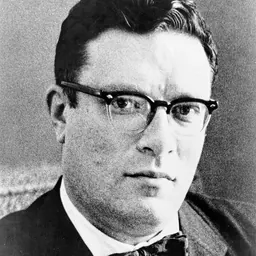
Frederik Pohl, in his autobiography The Way the Future Was, Damon Knight, in his memoir The Futurians, and Isaac Asimov, in his memoirs In Memory Yet Green and I. Asimov: A Memoir, all give descriptions of Kornbluth as a man of odd personal habits and eccentricities.
Kornbluth, for example, decided to educate himself by reading his way through an entire encyclopedia from A to Z; in the course of this effort, he acquired a great deal of esoteric knowledge that found its way into his stories, in alphabetical order by subject. When Kornbluth wrote a story that mentioned the ballista, an Ancient Roman weapon, Pohl knew that Kornbluth had finished the 'A's and had started on the 'B's.
Don’t just read it —
keep it.
Full-length biographies made to live with: read them, listen on the way to work, watch them tonight.
- E-book
- Audio
- Video
Instant download · yours to keep · every purchase keeps this site free
Important facts
more
Jordan Park, Cyril Kornbluth, C. M. KornbluthPeople in Cyril M. Kornbluth's life
Named in this biography and alive at the same time





Related people
Same field, nearest in time




Contemporaries
People whose lives overlapped Cyril M. Kornbluth's


Frequently asked questions
Who was Cyril M. Kornbluth?
American science fiction author (1923-1958)
When was Cyril M. Kornbluth born?
Cyril M. Kornbluth was born on 23 July 1923 in Manhattan.
When did Cyril M. Kornbluth die?
Cyril M. Kornbluth died on 21 March 1958 in Chicago.
What was Cyril M. Kornbluth's occupation?
Cyril M. Kornbluth was a novelist, writer, science fiction writer, journalist, short story writer and author.
What nationality was Cyril M. Kornbluth?
Cyril M. Kornbluth was American.
Sources & further reading
· Wikipedia: Cyril M. Kornbluth
Cite this page
APA: Biography.guide. (2026). Cyril M. Kornbluth. https://biography.guide/cyril-m-kornbluth/
MLA: "Cyril M. Kornbluth." Biography.guide, https://biography.guide/cyril-m-kornbluth/.
Chicago: "Cyril M. Kornbluth." Biography.guide. https://biography.guide/cyril-m-kornbluth/.
Data last updated: 2026-09-20 · Spot an error? Report a correction.
Page generated 2026-09-27 05:26 UTC