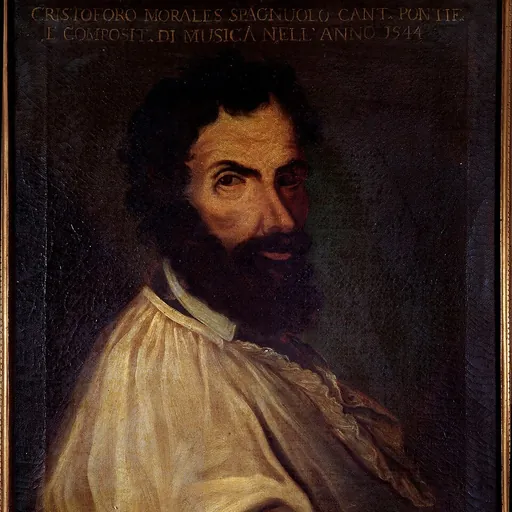
About Cristóbal de Morales
Lived 1500 – 1553. Cristóbal de Morales was a Spanish writer and composer.
Cristóbal de Morales (c. 1500 – between 4 September and 7 October 1553) was a Spanish composer of the Renaissance. He is generally considered to be the most influential Spanish composer before Tomás Luis de Victoria.
Life Cristóbal de Morales was born in Seville and, after an exceptional early education there, which included a rigorous training in the classics as well as musical study with some of the foremost composers, he held posts at Ávila and Plasencia. All that is known about his family is that he had a sister, and that his father died prior to his sister's marriage in 1530. Others who lived in Seville are considered to be potential relatives of Morales. These include Cristóbal de Morales, a singer employed by Duke of Medina Sidonia in 1504; Alonso de Morales, treasurer of the cathedral in 1503; Francisco de Morales (d. 1505), a canon; and Diego de Morales, who was the cathedral notary in 1525.
Earlier Spanish popes of the Borja family held a long tradition of employing Spanish singers in the papal chapel’s choir. This had a significant effect on Morales' success. Starting in 1522, there are three different occurrences where a Cristóbal de Morales was indicated to be an organist. There is little information of the whereabouts of Morales from January 1532 to May 1534. Morales is documented three times in Rome as ‘presbyter toletanus’ in May and December 1534. By 1535 he had moved to Rome, where he was a singer in the papal choir, evidently due to the interest of Pope Paul III who was partial to Spanish singers. He remained in Rome until 1545, in the employ of the Vatican; then, after a period of unsuccessfully seeking other employment in Italy (with the emperor, as well as with Cosimo I de Medici) he returned to Spain, where he held a succession of posts, many of which were marred by financial or political difficulties. The last of these was as maestro di capilla at Málaga Cathedral in his native Andalusia from 1551–53. While he was renowned by this time as one of the greatest composers in Europe, he seems to have been unpopular as an employee, for he began to have difficulty finding and keeping positions.
Morales’s fame was due in part to the numerous testimonials of those around him. The Spanish theorist Juan Bermudo declared him “the light of Spain in music”, while in 1559, a Mexican choir – Spanish polyphony in particular was quick to reach the New World – sang his music at a service commemorating the death of Charles V the previous year. This fame continued into the 18th century when Andrea Adami da Bolsena, biographer of many papal musicians, praised him as the papal chapel’s most important composer between Josquin des Prez and Palestrina.
There is recurrent evidence that he was a difficult character, aware of his exceptional talent, and probably came across as arrogant and incapable of getting along with those of lesser musical abilities. He made severe demands on the singers in his employ and alienated employers. In spite of this, he was regarded as one of the finest composers in Europe around the middle of the 16th century.
On 4 September 1553 he asked to be considered for the position of maestro de capilla at the Cathedral of Toledo, where he had previously worked, but shortly afterwards he died in Marchena; the actual date is not known, but was before October 7.
In addition, he wrote a Missa pro defunctis (a Requiem mass). Its peculiarities of transmission, as well as its apparent incomplete editing, suggest that it may be his last work.
Works 22 masses Missarum Liber primus (Rome, 1544) Missa Aspice Domine 4v Missa Ave Maris Stella 4v Missa De Beata Virgine 4v Missa L'homme armé 5v Missa Mille Regretz 6v Missa Quaeramus cum pastoribus 5v Missa Si bona suscepimus 6v Missa Vulnerasti cor meum 4v Missarum Liber secundus (Rome, 1544) Missa Benedicta est regina caelorum [= Missa Valenciana] 4v Missa De Beata Virgine 5v Missa Gaude Barbara 4v Missa L’homme armée 4v Missa Pro defunctis 5v Missa Quem dicunt homines 5v Missa Tu es vas electionis 4v Others: Missa Caça Missa Cortilla Missa Desilde al cavallero 4v Missa Super Ut re mi fa sol la 4v Missa Tristezas me matan 5v Officium defunctorum 4v (ca. 1526–28) 18 settings of the Magnificat 5 Lamentations of Jeremiah over 100 motets
Recordings
Cristóbal de Morales, Messe Mille Regretz. Victor Alonso, Concert de les Arts. CD Accord 204662. Cristóbal de Morales, Missa de Beata Virgine (a5). Collegium Vocale Gent, Philippe Herreweghe. The V. Sessions, 2009. Cristóbal de Morales, Missa de Beata Virgine. Ensemble Jachet de Mantoue. CD Calliope 9363. Cristóbal de Morales, Missa mille regretz. Paul McCreesh, Gabrieli Consort & Players. CD Archiv 474 228-2. Cristóbal de Morales, Missa Si bona suscepimus. The Tallis Scholars, Peter Phillips. Gimell CDGIM 033. Cristóbal de Morales, Missa Vulnerasti cor meum. – Canticum Canticorum. Orchestra of the Renaissance, Richard Cheetham, Michael Noone. Glossa cabinet GCD C81403. Cristóbal de Morales, Morales en Toledo. Michael Noone, Ensemble Plus Ultra. GCD 922001 Cristóbal de Morales, Office des Ténèbres. Denis Raisin-Dadre, Doulce Mémoire. Naïve E 8878
Office of the Dead/Requiem Cristóbal de Morales, Officium (Parce mihi Domine). Jan Garbarek and the Hilliard Ensemble. ECM 1525 The 'Parce mihi Domine' from his Officium Defunctorum was used as the key track (in three versions) on the best selling Jazz and Classical Album of 1994, Officium, by Jan Garbarek and the Hilliard Ensemble. Cristóbal de Morales, Morales: Requiem. Paul McCreesh, Gabrieli Consort. CD Archiv 457 597-2 Cristóbal de Morales, Officium defunctorum, Missa pro Defunctis. La Capella Reial de Catalunya, Hespèrion XX, Jordi Savall. Naive ES 9926.
Don’t just read it —
keep it.
Full-length biographies made to live with: read them, listen on the way to work, watch them tonight.
- E-book
- Audio
- Video
Instant download · yours to keep · every purchase keeps this site free
Important facts
People in Cristóbal de Morales's life
Named in this biography and alive at the same time

Related people
Same field, nearest in time


Contemporaries
People whose lives overlapped Cristóbal de Morales's





Frequently asked questions
Who was Cristóbal de Morales?
Spanish composer
When was Cristóbal de Morales born?
Cristóbal de Morales was born in 1500 in Seville.
When did Cristóbal de Morales die?
Cristóbal de Morales died in 1553 in Marchena.
What was Cristóbal de Morales's occupation?
Cristóbal de Morales was a writer and composer.
What nationality was Cristóbal de Morales?
Cristóbal de Morales was Spanish.
Sources & further reading
· Wikipedia: Cristóbal de Morales
· DBpedia: Cristóbal de Morales
Cite this page
APA: Biography.guide. (2026). Cristóbal de Morales. https://biography.guide/cristobal-de-morales/
MLA: "Cristóbal de Morales." Biography.guide, https://biography.guide/cristobal-de-morales/.
Chicago: "Cristóbal de Morales." Biography.guide. https://biography.guide/cristobal-de-morales/.
Data last updated: 2026-09-23 · Spot an error? Report a correction.
Portrait: Wikimedia Commons · author & licence
Page generated 2026-09-27 05:07 UTC